
প্যাসিভ ভয়েস: কখন ও কীভাবে সঠিকভাবে ব্যবহার করবেন
প্যাসিভ ভয়েস বাক্যের মনোযোগ সরিয়ে দেয় — কে কাজটি করছে তার বদলে কে বা কী কাজটি গ্রহণ করছে তার দিকে। আনুষ্ঠানিক লেখার জন্য এবং একাডেমিক ও পেশাদার ইংরেজিতে এটি চিনতে পারার জন্য প্রতিটি শিক্ষার্থীরই এই গঠনটি জানা দরকার।
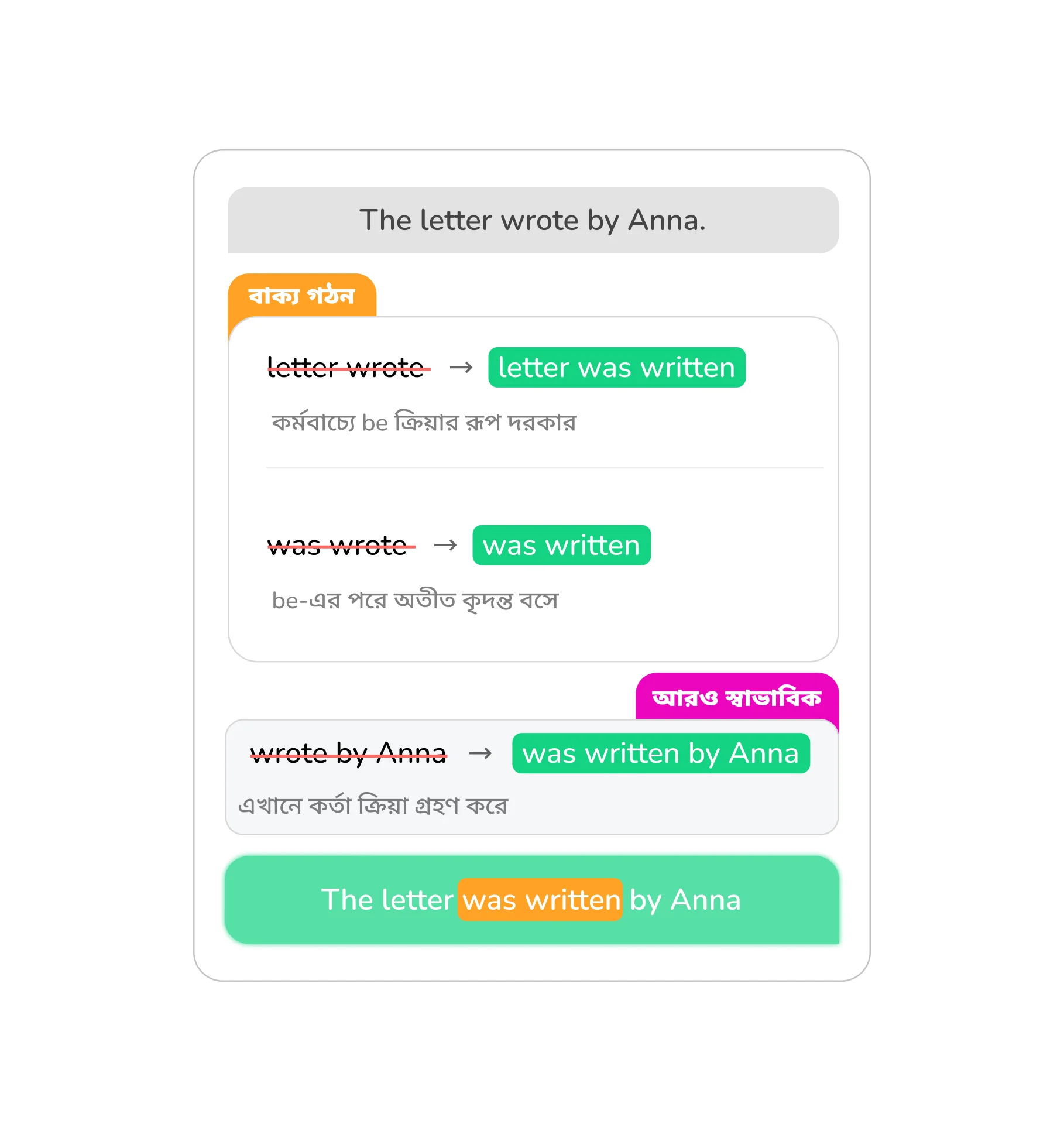
What Is Passive Voice?
In an active sentence, the subject performs the action. In a passive sentence, the subject receives the action, and the person or thing doing the action either appears after by or disappears entirely.
The Critical Distinction: Active vs. Passive Voice
This is the choice that shapes the tone of an entire piece of writing, and it's frequently misused in both directions. Active voice is direct, clear, and generally preferred, since it names who is responsible for the action. Passive voice is useful when the doer of the action is unknown, unimportant, or intentionally left out, which is common in scientific writing, news reporting, and formal reports.
How to Form the Passive Voice
Passive voice is built with a form of be plus the past participle of the main verb. The tense of be matches whatever tense the sentence needs:
| Tense | Active | Passive |
|---|---|---|
| Present simple | She writes the report. | The report is written by her. |
| Past simple | She wrote the report. | The report was written by her. |
| Present continuous | She is writing the report. | The report is being written by her. |
| Present perfect | She has written the report. | The report has been written by her. |
| Future simple | She will write the report. | The report will be written by her. |
| Modal | She can write the report. | The report can be written by her. |
When to Use Passive Voice
The passive voice is particularly effective across specific real-world contexts and writing scenarios:
When you don't know who performed the action.
When the actor is obvious or irrelevant to the reader.
Maintaining objective focus in research papers and lab reports.
Highlighting the final outcome over the person who did it.
Informal Passive with Get
In everyday spoken English, get often replaces be in passive constructions, especially for unexpected, negative, or sudden events. This form is too informal for academic writing but very common in conversation and casual messages.
| Standard Passive (be) | Informal Passive (get) |
|---|---|
| He was fired last week. | He got fired last week. |
| My phone was stolen. | My phone got stolen. |
| She was promoted to manager. | She got promoted to manager. |
| Two people were injured in the accident. | Two people got injured in the accident. |
| We were invited to the party. | We got invited to the party. |
Active or Passive? Quick Check
Practice identifying whether a sentence uses active or passive voice:
| Sentence | Voice | Why |
|---|---|---|
| The chef prepared the meal. | Active | Subject performs the action |
| The meal was prepared by the chef. | Passive | Subject receives the action |
| They will announce the results tomorrow. | Active | Subject performs the action |
| The results will be announced tomorrow. | Passive | Subject receives the action |
| She got promoted last month. | Passive (get) | Informal passive, subject receives the action |
Common Mistakes
Avoid these typical auxiliary verb and participle errors when forming passive structures:
| Incorrect | Correct |
|---|---|
| The report was write by her. | The report was written by her. |
| The cake baked by my mother. | The cake was baked by my mother. |
| Mistakes was made. | Mistakes were made. |
| The report is writing by her. | The report is being written by her. |
How Learna AI Teaches Passive Voice?
Learna AI listens for be plus a past participle and checks that the auxiliary matches the intended tense, correcting mismatches like a missing form of be or a main verb left in its base form. It also flags overused passive voice in casual conversation, since active voice usually sounds more natural in everyday speech, and recognizes get passive as a valid informal alternative while noting when formal writing requires the standard be form instead. Learners practicing formal and scientific English with Learna report a 73% improvement in forming the passive voice correctly across different tenses.
Once passive voice feels natural, it connects closely with reported speech, since both structures often appear together in formal writing and news-style reporting.
আরও দেখুন
Learna-র লার্নিং পাথ দিয়ে আপনার ব্যাকরণ জ্ঞান বাস্তবে কাজে লাগান:
সচরাচর জিজ্ঞাসিত প্রশ্ন
প্যাসিভ ভয়েস কী?

এমন একটি বাক্যগঠন যেখানে সাবজেক্ট কাজটি করে না, বরং কাজটি গ্রহণ করে; এটি গঠিত হয় be-এর একটি রূপ ও past participle দিয়ে।
প্যাসিভ ভয়েসের সূত্র কী?
Subject + be (সঠিক টেন্সে) + past participle + প্রয়োজনে by-agent, যেমন "The report was written by her."
কখন প্যাসিভ ভয়েস ব্যবহার করা উচিত?
যখন কাজটি কে করেছে তা অজানা, গুরুত্বহীন বা ইচ্ছাকৃতভাবে উহ্য রাখা হয়, তখন এটি ব্যবহার করুন; পাশাপাশি আনুষ্ঠানিক ও বৈজ্ঞানিক লেখায়, যেখানে কর্তার চেয়ে ফলাফলে জোর দেওয়া হয়।
অ্যাকটিভ ও প্যাসিভ ভয়েসের পার্থক্য কী?
অ্যাকটিভ ভয়েসে সাবজেক্ট নিজেই কাজটি করে; প্যাসিভ ভয়েসে সাবজেক্ট কাজটি গ্রহণ করে, আর মূল কর্তা হয় by-phrase-এ চলে যায়, নয়তো একেবারেই বাদ পড়ে।
প্রেজেন্ট সিম্পলে প্যাসিভ ভয়েস কীভাবে গঠন করবেন?
is/am/are এর সঙ্গে past participle ব্যবহার করুন: The report is written every week.
পাস্ট সিম্পলে প্যাসিভ ভয়েস কীভাবে গঠন করবেন?
was/were এর সঙ্গে past participle ব্যবহার করুন: The report was written last week.
মডাল ভার্বের সঙ্গে কি প্যাসিভ ভয়েস ব্যবহার করা যায়?
হ্যাঁ: modal + be + past participle, যেমন The report can be written by tomorrow.
প্যাসিভ ভয়েসে একটি সাধারণ ভুল কী?
be-এর সঠিক রূপ ব্যবহার করতে ভুলে যাওয়া, কিংবা past participle-এর বদলে মূল ক্রিয়াকে base form-এ রেখে দেওয়া — যেমন "was written" এর জায়গায় "The report was write" লেখা।
প্যাসিভ ভয়েস কি ব্যাকরণগতভাবে ভুল?
না, এটি ব্যাকরণগতভাবে সঠিক এবং কখনও কখনও জরুরিও; তবে অনেক লেখায় এর অতিরিক্ত ব্যবহার হয়, যেখানে অ্যাকটিভ ভয়েস বেশি স্পষ্ট ও সরাসরি হতো।
প্যাসিভ ভয়েসে কি সবসময় by-phrase দরকার?
না, by-phrase ঐচ্ছিক এবং কাজটি কে করেছে তা অজানা বা গুরুত্বহীন হলে প্রায়ই বাদ দেওয়া হয়, যেমন "My phone was stolen."
অ্যাকটিভ বাক্যকে প্যাসিভে কীভাবে রূপান্তর করবেন?
অ্যাকটিভ বাক্যের অবজেক্টকে সাবজেক্টের জায়গায় নিয়ে আসুন, be-এর সঠিক রূপের সঙ্গে past participle যোগ করুন, আর প্রয়োজনে by-এর পরে মূল সাবজেক্টটি বসান।
বৈজ্ঞানিক লেখায় প্যাসিভ ভয়েস কেন এত প্রচলিত?
এটি মনোযোগ সরিয়ে আনে গবেষকের বদলে প্রক্রিয়া বা ফলাফলের দিকে, যা বৈজ্ঞানিক লেখার কাঙ্ক্ষিত বস্তুনিষ্ঠ সুরের সঙ্গে মানানসই।
Learna AI প্যাসিভ ভয়েসে কীভাবে সাহায্য করে?
Learna AI যাচাই করে যে কাঙ্ক্ষিত টেন্স অনুযায়ী be ক্রিয়া ও past participle সঠিকভাবে ব্যবহার হয়েছে কি না, এবং দৈনন্দিন কথ্য ইংরেজিতে অতিরিক্ত প্যাসিভ ব্যবহার হলে তা ধরিয়ে দেয়।
Learna কি অ্যাকটিভ থেকে প্যাসিভ বাক্য রূপান্তরের অনুশীলনে সাহায্য করতে পারে?
হ্যাঁ। Learna AI অ্যাকটিভ বাক্য দিয়ে অনুশীলন করাতে পারে এবং শিক্ষার্থীর প্যাসিভ রূপান্তরে সঠিক be রূপ, past participle ও ঐচ্ছিক by-phrase আছে কি না তা যাচাই করে।