
受動態: 正しく使うタイミングと方法
受動態は、文の焦点を「誰が動作をするか」から「誰が・何がその動作を受けるか」へと移します。フォーマルな文章を書くときにも、アカデミックやビジネス英語の中で見分けるためにも、すべての学習者に欠かせない構文です。
What Is Passive Voice?
In an active sentence, the subject performs the action. In a passive sentence, the subject receives the action, and the person or thing doing the action either appears after by or disappears entirely.
The Critical Distinction: Active vs. Passive Voice
This is the choice that shapes the tone of an entire piece of writing, and it's frequently misused in both directions. Active voice is direct, clear, and generally preferred, since it names who is responsible for the action. Passive voice is useful when the doer of the action is unknown, unimportant, or intentionally left out, which is common in scientific writing, news reporting, and formal reports.
How to Form the Passive Voice
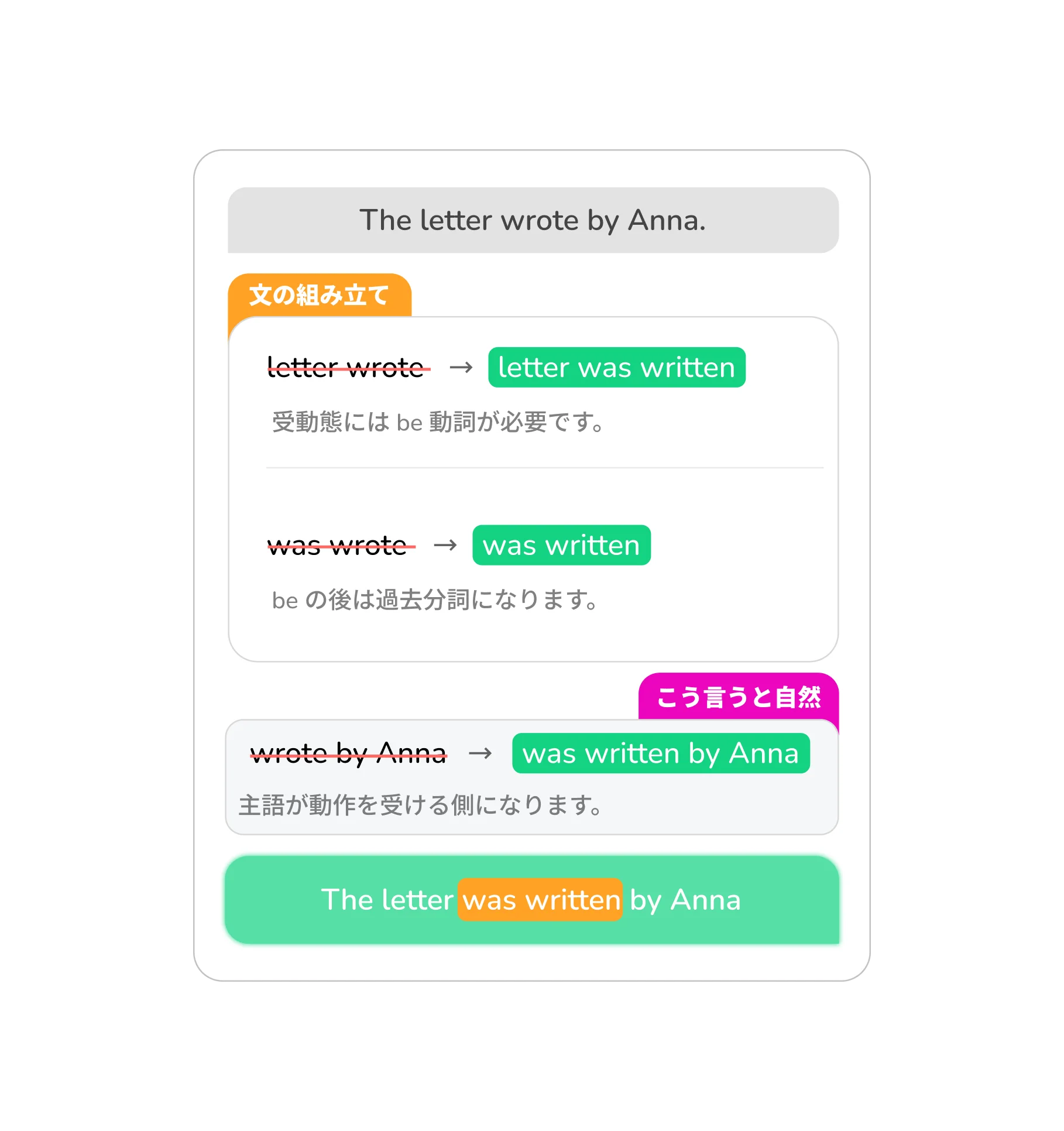
Passive voice is built with a form of be plus the past participle of the main verb. The tense of be matches whatever tense the sentence needs:
| Tense | Active | Passive |
|---|---|---|
| Present simple | She writes the report. | The report is written by her. |
| Past simple | She wrote the report. | The report was written by her. |
| Present continuous | She is writing the report. | The report is being written by her. |
| Present perfect | She has written the report. | The report has been written by her. |
| Future simple | She will write the report. | The report will be written by her. |
| Modal | She can write the report. | The report can be written by her. |
When to Use Passive Voice
The passive voice is particularly effective across specific real-world contexts and writing scenarios:
When you don't know who performed the action.
When the actor is obvious or irrelevant to the reader.
Maintaining objective focus in research papers and lab reports.
Highlighting the final outcome over the person who did it.
Informal Passive with Get
In everyday spoken English, get often replaces be in passive constructions, especially for unexpected, negative, or sudden events. This form is too informal for academic writing but very common in conversation and casual messages.
| Standard Passive (be) | Informal Passive (get) |
|---|---|
| He was fired last week. | He got fired last week. |
| My phone was stolen. | My phone got stolen. |
| She was promoted to manager. | She got promoted to manager. |
| Two people were injured in the accident. | Two people got injured in the accident. |
| We were invited to the party. | We got invited to the party. |
Active or Passive? Quick Check
Practice identifying whether a sentence uses active or passive voice:
| Sentence | Voice | Why |
|---|---|---|
| The chef prepared the meal. | Active | Subject performs the action |
| The meal was prepared by the chef. | Passive | Subject receives the action |
| They will announce the results tomorrow. | Active | Subject performs the action |
| The results will be announced tomorrow. | Passive | Subject receives the action |
| She got promoted last month. | Passive (get) | Informal passive, subject receives the action |
Common Mistakes
Avoid these typical auxiliary verb and participle errors when forming passive structures:
| Incorrect | Correct |
|---|---|
| The report was write by her. | The report was written by her. |
| The cake baked by my mother. | The cake was baked by my mother. |
| Mistakes was made. | Mistakes were made. |
| The report is writing by her. | The report is being written by her. |
How Learna AI Teaches Passive Voice?
Learna AI listens for be plus a past participle and checks that the auxiliary matches the intended tense, correcting mismatches like a missing form of be or a main verb left in its base form. It also flags overused passive voice in casual conversation, since active voice usually sounds more natural in everyday speech, and recognizes get passive as a valid informal alternative while noting when formal writing requires the standard be form instead. Learners practicing formal and scientific English with Learna report a 73% improvement in forming the passive voice correctly across different tenses.
Once passive voice feels natural, it connects closely with reported speech, since both structures often appear together in formal writing and news-style reporting.
もっと見る
Learna の学習パスで、文法の知識を実践に活かしましょう:
よくある質問
受動態とは何ですか?

主語が動作を行うのではなく動作を受ける文構造で、be 動詞+過去分詞で作られます。
受動態の形(公式)は?
主語 + be(適切な時制)+ 過去分詞 + 任意で by 〜。例:「The report was written by her.」
受動態はどんなときに使うべきですか?
行為者が不明なとき、重要でないとき、意図的に省略するとき、または行為者より結果を重視するフォーマルな文章・科学的な文章で使います。
能動態と受動態の違いは何ですか?
能動態では主語が動作を行い、受動態では主語が動作を受けます。元の主語は by 句に移るか、完全に省略されることが多いです。
現在形(単純現在)の受動態はどう作りますか?
is/am/are + 過去分詞を使います:The report is written every week.
過去形(単純過去)の受動態はどう作りますか?
was/were + 過去分詞を使います:The report was written last week.
助動詞と一緒に受動態を使えますか?
はい。助動詞 + be + 過去分詞の形で使えます:The report can be written by tomorrow.
受動態でよくある間違いは?
be 動詞の形を間違えたり、本動詞を過去分詞ではなく原形のままにしてしまうことです。例:「The report was write」ではなく「was written」が正解です。
受動態は文法的に間違いですか?
いいえ。文法的に正しく、必要な場面もあります。ただし、能動態のほうが明快で直接的な文章でも使いすぎてしまう傾向があります。
受動態には必ず by 句が必要ですか?
いいえ。by 句は任意で、行為者が不明または重要でない場合は省略されることがよくあります。例:「My phone was stolen.」
能動態の文を受動態にするには?
能動態の目的語を主語の位置に移し、適切な形の be 動詞+過去分詞を加え、必要に応じて by + 元の主語を続けます。
なぜ科学的な文章では受動態がよく使われるのですか?
動作を行った研究者ではなくプロセスや結果に焦点を移せるため、科学的な文章が目指す客観的なトーンに合っているからです。
Learna AI は受動態の学習にどう役立ちますか?
Learna AI は、意図した時制に合わせて be 動詞と過去分詞が正しく使われているかを確認し、日常会話での受動態の使いすぎも指摘します。
Learna で能動態から受動態への書き換えを練習できますか?
はい。Learna AI が能動態の文を提示し、学習者が書き換えた受動態について be 動詞の形、過去分詞、任意の by 句が正しいかをチェックします。