
수동태: 언제, 어떻게 올바르게 쓸까
수동태는 문장의 초점을 '누가 행동을 하는가'에서 '누가 또는 무엇이 그 행동을 받는가'로 옮깁니다. 격식 있는 글쓰기에서도, 학술·비즈니스 영어에서 이 구조를 알아보기 위해서도 모든 학습자에게 꼭 필요한 문법입니다.
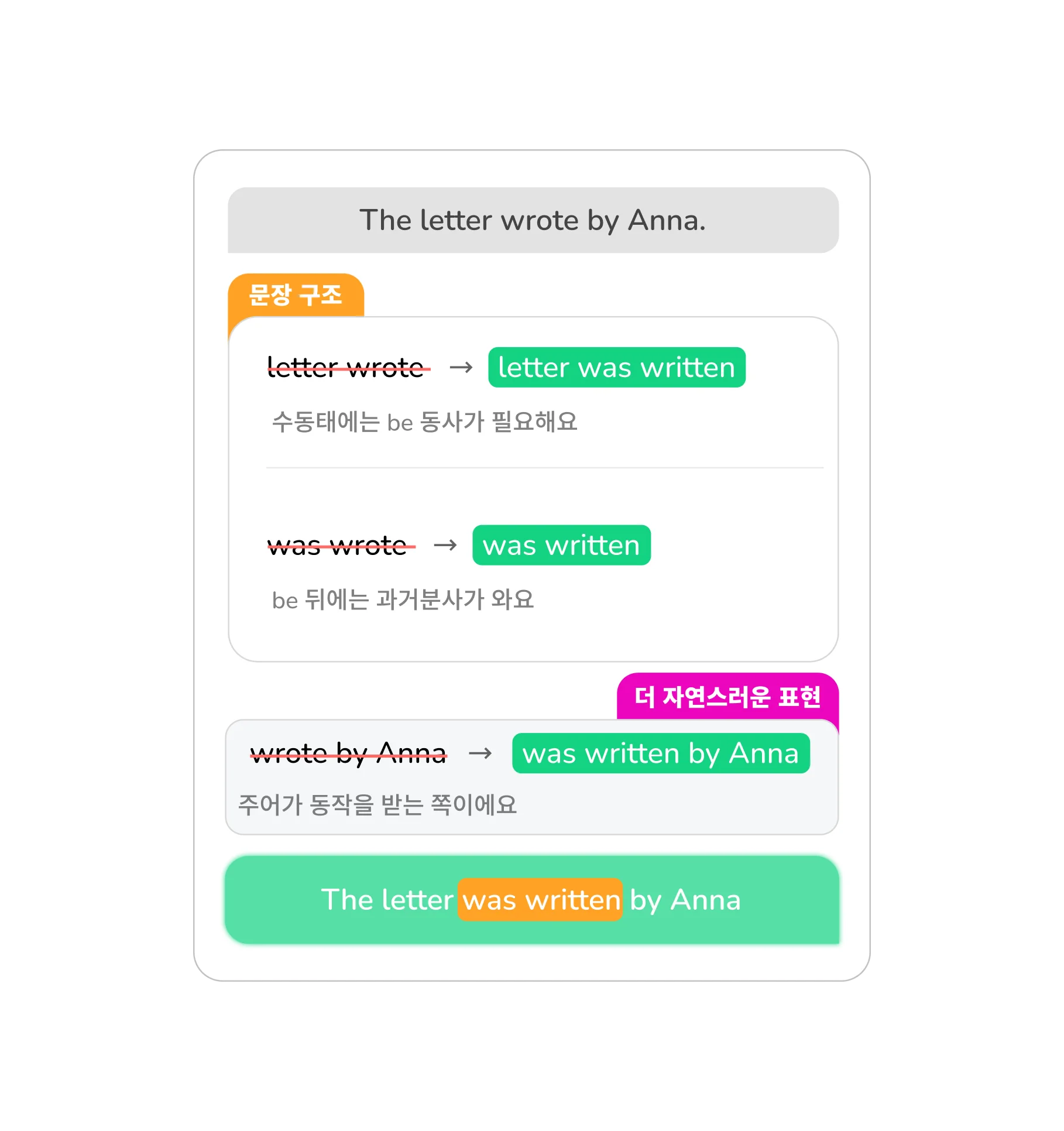
What Is Passive Voice?
In an active sentence, the subject performs the action. In a passive sentence, the subject receives the action, and the person or thing doing the action either appears after by or disappears entirely.
The Critical Distinction: Active vs. Passive Voice
This is the choice that shapes the tone of an entire piece of writing, and it's frequently misused in both directions. Active voice is direct, clear, and generally preferred, since it names who is responsible for the action. Passive voice is useful when the doer of the action is unknown, unimportant, or intentionally left out, which is common in scientific writing, news reporting, and formal reports.
How to Form the Passive Voice
Passive voice is built with a form of be plus the past participle of the main verb. The tense of be matches whatever tense the sentence needs:
| Tense | Active | Passive |
|---|---|---|
| Present simple | She writes the report. | The report is written by her. |
| Past simple | She wrote the report. | The report was written by her. |
| Present continuous | She is writing the report. | The report is being written by her. |
| Present perfect | She has written the report. | The report has been written by her. |
| Future simple | She will write the report. | The report will be written by her. |
| Modal | She can write the report. | The report can be written by her. |
When to Use Passive Voice
The passive voice is particularly effective across specific real-world contexts and writing scenarios:
When you don't know who performed the action.
When the actor is obvious or irrelevant to the reader.
Maintaining objective focus in research papers and lab reports.
Highlighting the final outcome over the person who did it.
Informal Passive with Get
In everyday spoken English, get often replaces be in passive constructions, especially for unexpected, negative, or sudden events. This form is too informal for academic writing but very common in conversation and casual messages.
| Standard Passive (be) | Informal Passive (get) |
|---|---|
| He was fired last week. | He got fired last week. |
| My phone was stolen. | My phone got stolen. |
| She was promoted to manager. | She got promoted to manager. |
| Two people were injured in the accident. | Two people got injured in the accident. |
| We were invited to the party. | We got invited to the party. |
Active or Passive? Quick Check
Practice identifying whether a sentence uses active or passive voice:
| Sentence | Voice | Why |
|---|---|---|
| The chef prepared the meal. | Active | Subject performs the action |
| The meal was prepared by the chef. | Passive | Subject receives the action |
| They will announce the results tomorrow. | Active | Subject performs the action |
| The results will be announced tomorrow. | Passive | Subject receives the action |
| She got promoted last month. | Passive (get) | Informal passive, subject receives the action |
Common Mistakes
Avoid these typical auxiliary verb and participle errors when forming passive structures:
| Incorrect | Correct |
|---|---|
| The report was write by her. | The report was written by her. |
| The cake baked by my mother. | The cake was baked by my mother. |
| Mistakes was made. | Mistakes were made. |
| The report is writing by her. | The report is being written by her. |
How Learna AI Teaches Passive Voice?
Learna AI listens for be plus a past participle and checks that the auxiliary matches the intended tense, correcting mismatches like a missing form of be or a main verb left in its base form. It also flags overused passive voice in casual conversation, since active voice usually sounds more natural in everyday speech, and recognizes get passive as a valid informal alternative while noting when formal writing requires the standard be form instead. Learners practicing formal and scientific English with Learna report a 73% improvement in forming the passive voice correctly across different tenses.
Once passive voice feels natural, it connects closely with reported speech, since both structures often appear together in formal writing and news-style reporting.
더 살펴보기
Learna의 학습 코스로 문법 지식을 실전에서 연습해 보세요:
자주 묻는 질문
수동태란 무엇인가요?

주어가 동작을 하는 것이 아니라 동작을 받는 문장 구조로, be 동사의 알맞은 형태에 과거분사를 더해 만듭니다.
수동태의 공식은 무엇인가요?
주어 + be(알맞은 시제) + 과거분사 + (선택) by + 행위자입니다. 예: "The report was written by her."
수동태는 언제 써야 하나요?
행위자를 알 수 없거나, 중요하지 않거나, 의도적으로 생략할 때, 또는 행위자보다 결과를 강조하는 격식 있는 글과 학술 글에서 사용합니다.
능동태와 수동태의 차이는 무엇인가요?
능동태는 주어가 동작을 하고, 수동태는 주어가 동작을 받습니다. 이때 원래 주어는 by 구로 옮겨지거나 아예 생략되는 경우가 많습니다.
현재 단순 시제의 수동태는 어떻게 만드나요?
is/am/are에 과거분사를 붙입니다: The report is written every week.
과거 단순 시제의 수동태는 어떻게 만드나요?
was/were에 과거분사를 붙입니다: The report was written last week.
조동사와 함께 수동태를 쓸 수 있나요?
네. 조동사 + be + 과거분사 형태로 씁니다. 예: The report can be written by tomorrow.
수동태에서 자주 하는 실수는 무엇인가요?
be 동사의 알맞은 형태를 빠뜨리거나, 본동사를 과거분사가 아닌 원형 그대로 두는 것입니다. 예를 들어 "was written" 대신 "The report was write"라고 쓰는 경우입니다.
수동태는 문법적으로 틀린 표현인가요?
아닙니다. 문법적으로 맞고 때로는 꼭 필요하지만, 능동태가 더 명확하고 직접적인 글에서 지나치게 남용되는 경우가 많습니다.
수동태에는 항상 by 구가 필요한가요?
아닙니다. by 구는 선택 사항이며, 행위자를 모르거나 중요하지 않을 때는 흔히 생략합니다. 예: "My phone was stolen."
능동태 문장을 수동태로 어떻게 바꾸나요?
능동태 문장의 목적어를 주어 자리로 옮기고, 알맞은 형태의 be 동사와 과거분사를 넣은 뒤, 필요하면 by와 원래 주어를 덧붙입니다.
학술·과학 글쓰기에서 수동태가 흔한 이유는 무엇인가요?
연구자보다 과정이나 결과에 초점을 옮겨 주기 때문이며, 이는 과학 글쓰기가 지향하는 객관적인 어조와 잘 맞습니다.
Learna AI는 수동태 학습에 어떤 도움을 주나요?
Learna AI는 의도한 시제에 맞게 be 동사와 과거분사가 올바르게 쓰였는지 확인하고, 일상 구어 영어에서 수동태를 남용하는 경우를 짚어 줍니다.
Learna로 능동태를 수동태로 바꾸는 연습을 할 수 있나요?
네. Learna AI가 능동태 문장을 제시하고, 학습자가 바꾼 수동태 문장에서 be 동사 형태, 과거분사, 선택적인 by 구가 올바른지 확인해 줍니다.