
Test Your English Level Free and Get Your CEFR Result 📊
This free English level test takes about ten minutes, needs no registration, and places your English somewhere between A1 and C1 on the CEFR scale. Answer twenty grammar and vocabulary questions, see your result instantly, and get a clear picture of what to study next.
.webp?alt=media&token=d570c87e-18fc-4875-bccb-ba355ea4ac6f)
Take the Free English Level Test
Twenty multiple choice questions covering English grammar and vocabulary from elementary to advanced. There is no time limit and no account required. Pick the option that sounds most natural, and choose the closest one when you are not sure.
of 20 correct
Your result is an estimate based on grammar and vocabulary. It is not an official English proficiency certificate.
How the English Level Test Works
Every question targets a specific grammar point or usage pattern that separates one CEFR level from the next, which is why twenty questions are enough to place you accurately.
What the Test Measures
The questions cover verb tenses, conditionals, comparatives, prepositions, reported speech, inversion, and everyday idiomatic usage. Speaking, listening, and writing are assessed separately inside Learna, because they cannot be measured through multiple choice.
How Long It Takes
Most learners finish in eight to ten minutes. There is no timer, so you can think about each answer. Working slowly does not change your score, but guessing at random does, so skip rather than guess when a question is beyond you.
How Your Score Maps to CEFR
Your correct answers are mapped onto the Common European Framework of Reference. Zero to four places you at A1, five to eight at A2, nine to twelve at B1, thirteen to sixteen at B2, and seventeen or more at C1.
What English Levels Are There? A1 to C2 Explained
The CEFR describes six English proficiency levels, from A1 for complete beginners to C2 for near native command. Each level is defined by what you can actually do with the language rather than by how many words or rules you have memorised. Understanding the English levels makes your test result useful, because it tells you where the next step is.
At A1 English level you can introduce yourself, order food, ask simple questions, and understand slow, clear speech about familiar things. Sentences stay short and rely on the present simple. You depend heavily on context and repetition to follow a conversation.
- Vocabulary 500 to 900 words
- Typical grammar present simple, articles, plurals, basic prepositions
- To reach A2 roughly 80 to 100 hours of study
At A2 English level you handle routine tasks: shopping, travel, describing your background, and talking about the recent past. You can use the past simple and the future with going to, and you start linking ideas with because, but, and so.
- Vocabulary 1,000 to 2,000 words
- Typical grammar past simple, comparatives, countable and uncountable nouns
- To reach B1 roughly 180 to 200 hours of study
B1 English level is the point where English becomes usable rather than survivable. You can explain opinions, describe experiences and plans, follow a conversation between native speakers on familiar topics, and deal with most situations while travelling. Mistakes still happen but they rarely block understanding.
- Vocabulary 2,500 to 3,500 words
- Typical grammar present perfect, first and second conditionals, reported speech
- To reach B2 roughly 350 to 400 hours of study
At B2 English level you can hold a spontaneous conversation with native speakers without either side straining, follow the argument of a complex text, and write clear detailed pieces on a wide range of subjects. B2 is the level most universities and employers treat as the working threshold for English.
- Vocabulary 4,000 to 6,000 words
- Typical grammar passive voice, third conditional, relative clauses, modal perfects
- To reach C1 roughly 500 to 600 hours of study
C1 English level means you use the language flexibly and effectively for social, academic, and professional purposes. You understand implied meaning, recognise register and tone, and structure long arguments clearly. Idioms, phrasal verbs, and inversion stop being obstacles and become tools.
- Vocabulary 8,000 to 10,000 words
- Typical grammar inversion, cleft sentences, subjunctive, nuanced modality
- To reach C2 roughly 700 to 800 hours of study
C2 English level is near native command. You understand virtually everything you read or hear, summarise arguments from several sources coherently, and express yourself precisely even in complex situations. C2 is not perfection, and native speakers make errors at this level too, but hesitation and searching for words largely disappear.
- Vocabulary 16,000 words or more
- Typical grammar full range, used for stylistic effect rather than correctness
- Maintaining C2 continuous exposure and active use
English Level Comparison: CEFR, IELTS, TOEFL, Cambridge and Duolingo
If you already have an exam score, this table shows roughly where it sits on the CEFR scale, and if you have a CEFR level it shows what score you would be aiming for. Use it to translate your English level test result into the exam language your university or employer uses.
| Exam | A1 | A2 | B1 | B2 | C1 | C2 |
|---|---|---|---|---|---|---|
| CEFR level | Beginner | Elementary | Intermediate | Upper int. | Advanced | Proficiency |
| IELTS | not scored | not scored | 4.0 to 5.0 | 5.5 to 6.5 | 7.0 to 8.0 | 8.5 to 9.0 |
| TOEFL iBT | not scored | not scored | 42 to 71 | 72 to 94 | 95 to 114 | 115 to 120 |
| Cambridge Scale | 80 to 99 | 100 to 119 | 120 to 139 | 140 to 159 | 160 to 179 | 180 to 230 |
| PTE Academic | 10 to 29 | 30 to 42 | 43 to 58 | 59 to 75 | 76 to 84 | 85 to 90 |
| Duolingo English Test | 10 to 55 | 60 to 85 | 90 to 105 | 110 to 125 | 130 to 145 | 150 to 160 |
These mappings are approximate. Exam boards publish their own alignment tables and the boundaries between adjacent bands overlap, so treat a score near the edge of a band as belonging to either level. No unofficial English level test, including this one, can replace a certified exam result.
Test Your English by Skill
A single English proficiency test gives you one number. In practice most learners are uneven, strong in reading and weak in speaking, or fluent in conversation with unreliable grammar. These are the six areas worth checking separately.
English Grammar Test
Grammar is the fastest way to place a learner, because each structure belongs to a level. Tenses, conditionals, and articles carry most of the signal.
Open the grammar hub →English Vocabulary Test
Vocabulary size correlates closely with CEFR level. Roughly 3,000 word families cover B1, while C1 needs three times that number in active use.
Learn key English idioms →English Reading Test
Reading exposes whether you understand structure or only recognise words. Longer sentences with subordinate clauses are where B1 and B2 separate.
Read everyday English →English Listening Test
Listening is usually the weakest skill for learners who studied English at school, because natural speed, linking, and reduced forms are rarely taught.
Train in real situations →English Speaking Test
Speaking cannot be measured by multiple choice. Fluency, pronunciation, and the ability to recover from a mistake mid sentence need a real conversation.
Practise professional speaking →English Writing Test
Writing shows control over register and cohesion. The gap between B2 and C1 writing is rarely vocabulary, it is paragraph logic and linking.
Prepare for exam writing →Sample Questions from the English Level Test
Here are five questions taken from the test, one from each level band, with the correct answer and the reason behind it. If the C1 example feels obvious, the full test will likely place you at the top of the scale.
How to Improve Your English after the Test
A level is only useful if it changes what you do next. These are the priorities that move a learner fastest from each band, based on where the errors typically sit.
Build the Core, Not the Edges
At this stage breadth beats depth. Getting the present, past, and future working reliably matters far more than learning rare vocabulary.
- Master present simple, past simple, and going to
- Learn the 1,000 most frequent words before anything specialised
- Speak in short complete sentences rather than long broken ones
- Practise daily for fifteen minutes rather than weekly for two hours
Fix the Fossilised Errors
Intermediate learners plateau because the same handful of mistakes has become automatic. Naming them is what breaks the plateau.
- Work through conditionals, the present perfect, and reported speech
- Replace basic verbs with precise ones: get becomes obtain, receive, or become
- Read material slightly above your level rather than comfortable material
- Record yourself speaking and listen back for repeated errors
Work on Range and Register
At advanced level accuracy is rarely the problem. What separates C1 from C2 is flexibility: saying the same thing three different ways for three different audiences.
- Practise inversion, cleft sentences, and hedging language
- Switch deliberately between formal and casual register
- Learn collocations rather than isolated words
- Use English in situations with real consequences, not only practice
Practice at Your Level with Learna
83% of Learna users report clearer progress once their lessons match their actual CEFR level rather than a level they guessed. Learna adapts every conversation, correction, and grammar lesson to where you are now, so an A2 learner is never buried under C1 vocabulary and a B2 learner is never held back by beginner drills.
Your English level test result feeds straight into your first session. The AI tutor picks the scenarios, corrects the errors that actually belong to your level, and moves the difficulty up as you improve.
Try Learna's AI Tutor Free.Explore More on Learna
Your level tells you where to start. These pages tell you what to do with it.
Learn English
How to learn English with a plan that fits your level, your goal, and the time you actually have.
Open the page →Learn Spanish
Already comfortable in English? Spanish is the fastest second language to add, and the CEFR scale works the same way.
Open the page →Learn French
French shares a large vocabulary overlap with English, which makes reading progress unusually quick at the start.
Open the page →Check Our Latest Lessons and Posts

How to Learn English Fast: A Step by Step Guide
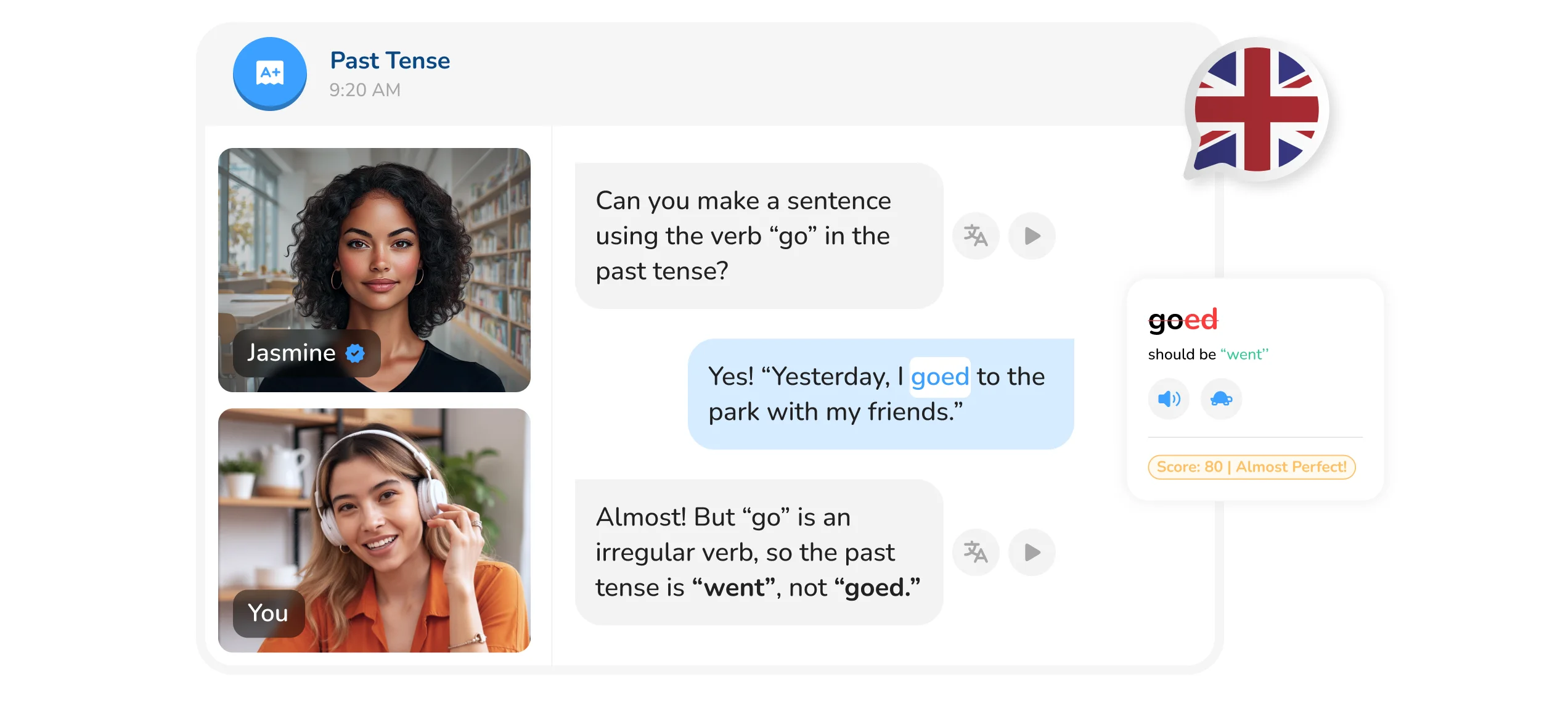
Top 25 Irregular Verbs for Everyday English Conversation
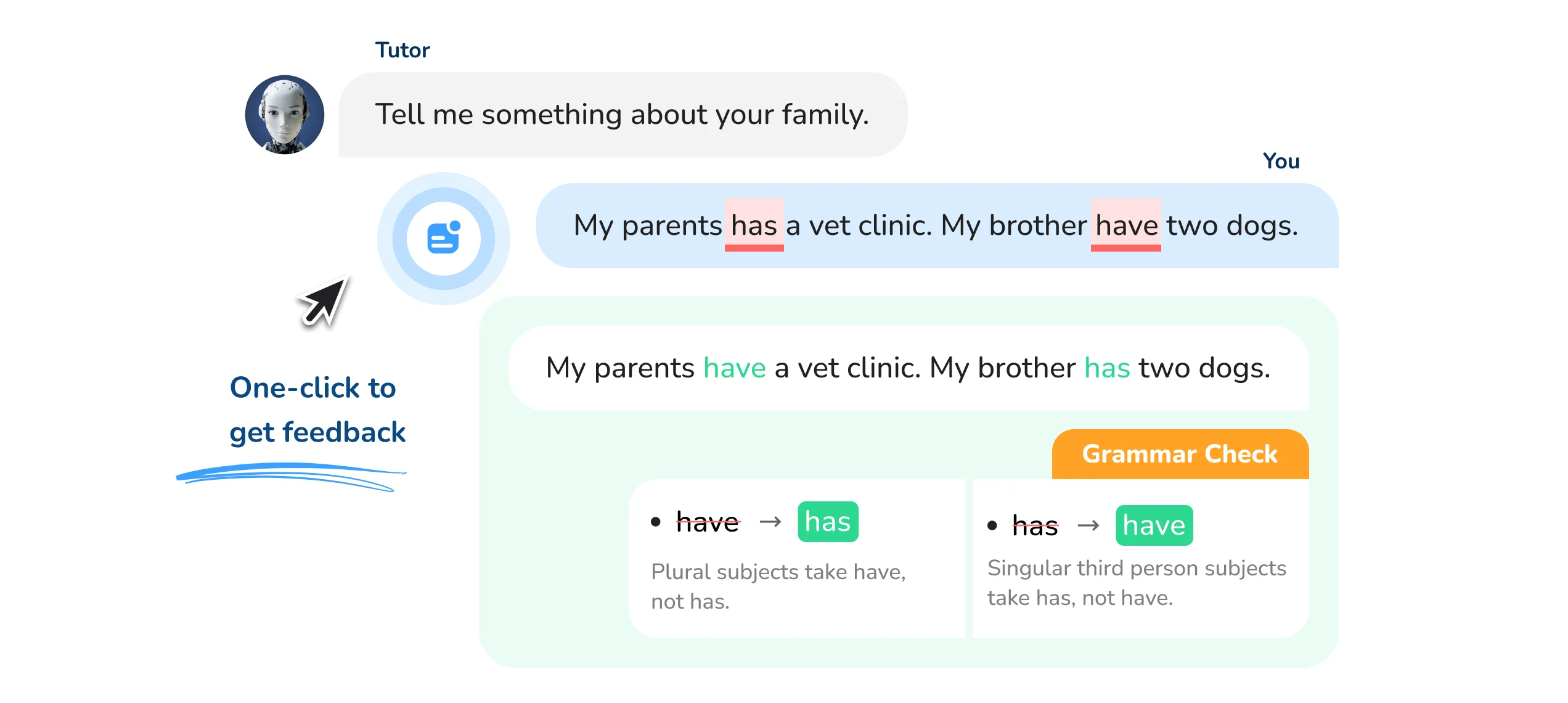
How to Use Has and Have Correctly in English
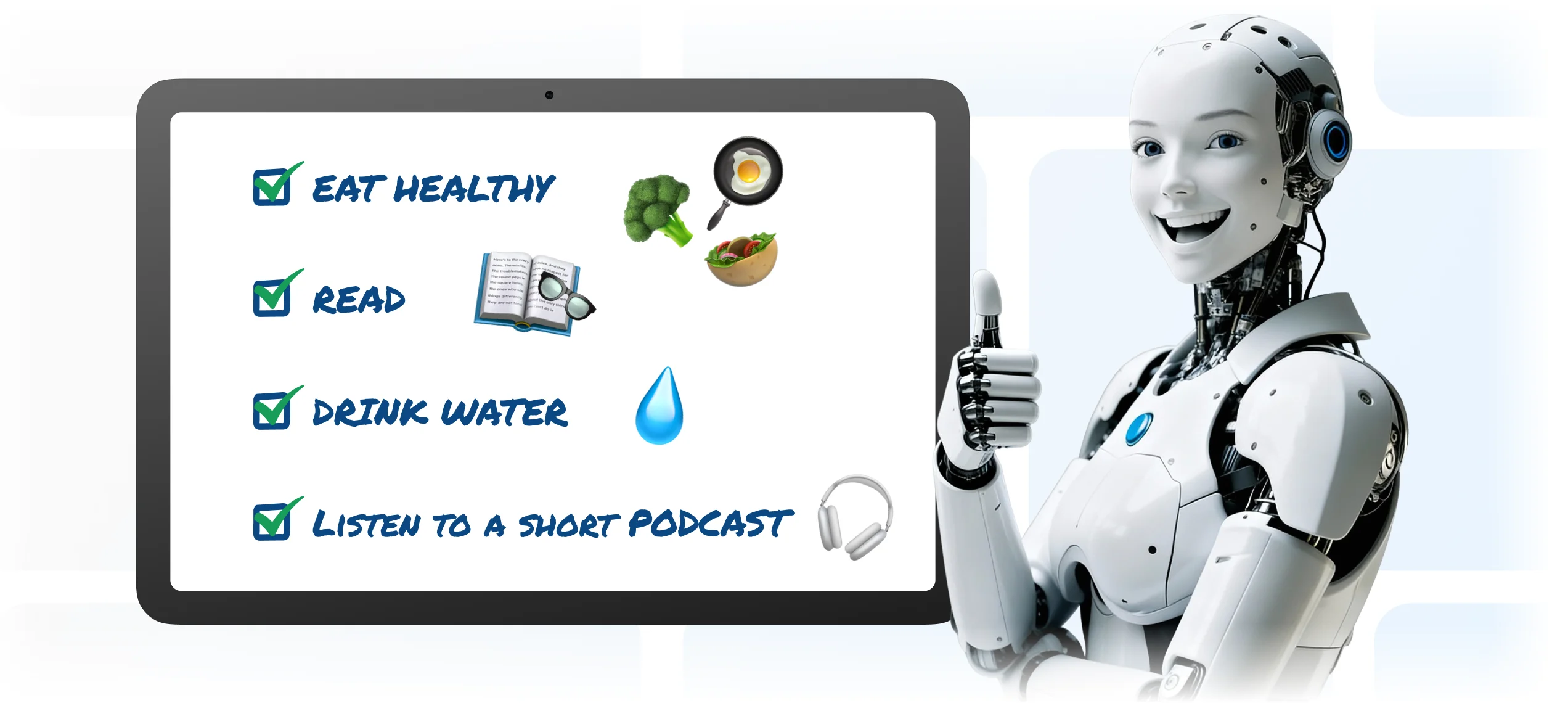
English Conversation Topics for Beginners
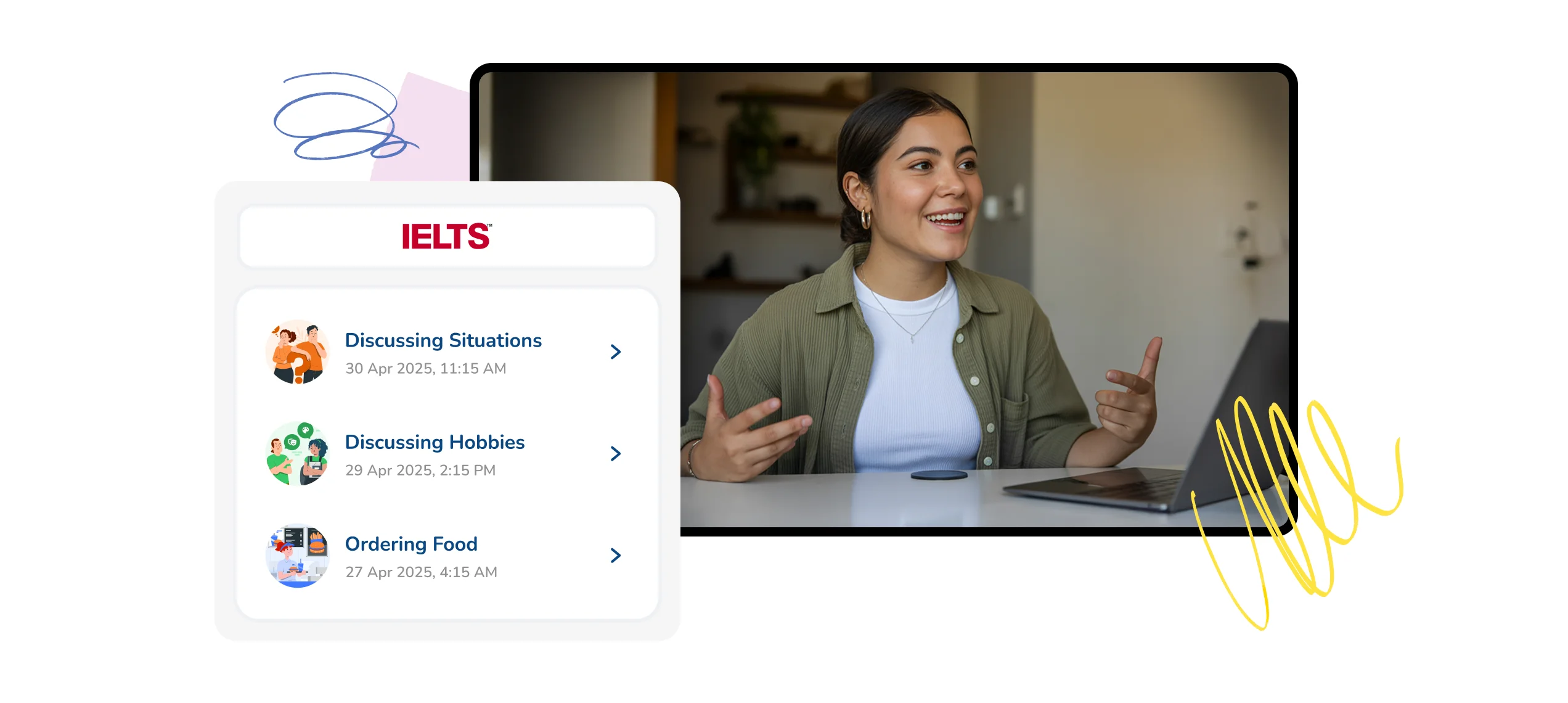
How to Practice IELTS Speaking at Home
AI English Tutor Vs Traditional Classes: What's Better?
Know Your Level. Now Build on It.
A CEFR result is a starting point, not a finish line. Answer a few questions about your goal and Learna will turn your English level into a daily practice plan.
Start Learning English Free.Frequently Asked Questions
How can I check my English level?

Take a CEFR aligned English level test that covers grammar and vocabulary across several levels. This free test places you between A1 and C1 in about ten minutes, and it needs no registration.
How do I know my English level?
Your level is defined by what you can do in English, not by how many years you studied. A test result plus an honest look at your speaking and listening gives an accurate picture.
How can I test my English level for free?
This English level test is completely free. There is no account, no payment, and no email address required. Your CEFR result appears on screen as soon as you answer the final question.
What are the English levels?
The CEFR defines six English levels: A1 beginner, A2 elementary, B1 intermediate, B2 upper intermediate, C1 advanced, and C2 proficiency. Each one describes real world ability rather than hours of study completed.
What is my English level?
Most adult learners who studied English at school test between A2 and B1. The only way to know your own level is to answer questions that go beyond your comfort zone.
What is B1 level English?
B1 is intermediate English. You can explain opinions, describe experiences, handle travel situations, and follow familiar conversations. Errors still happen at this level but they rarely stop the other person understanding you.
What is B2 level English?
B2 is upper intermediate English. You can talk with native speakers without strain, follow complex texts, and write detailed pieces. Many universities and employers treat B2 as the working threshold.
What is C1 level English?
C1 is advanced English. You use the language flexibly for social, academic, and professional purposes, understand implied meaning, and structure long arguments without visibly searching for the right words.
What is C2 English level?
C2 is proficiency, the highest CEFR level. You understand almost everything you read or hear and express yourself precisely in complex situations. It means near native command rather than perfection.
How long does the English level test take?
Around ten minutes for twenty questions. There is no timer, so you can think about each answer. Working slowly will not raise your score, but guessing at random makes the result less accurate.
Is this an official English proficiency test?
No. This is a CEFR aligned placement test that estimates your level. It is not an official exam and cannot be used as proof of language ability for visas, universities, or employers.
Does the English level test require registration?
No registration, no email address, and no payment. Answer the questions and your CEFR result appears immediately. You only create an account if you want a personalised study plan afterwards.
How does Learna use my English level test result?
Your level sets the starting difficulty of every conversation, correction, and grammar lesson. Learna then adjusts as your accuracy improves, so lessons stay slightly ahead of your current ability.
Can I retake the English level test with Learna later?
Yes. Retaking after a few months of practice is the clearest way to see progress. Learna also tracks accuracy inside lessons, so you can see movement between formal retests.