
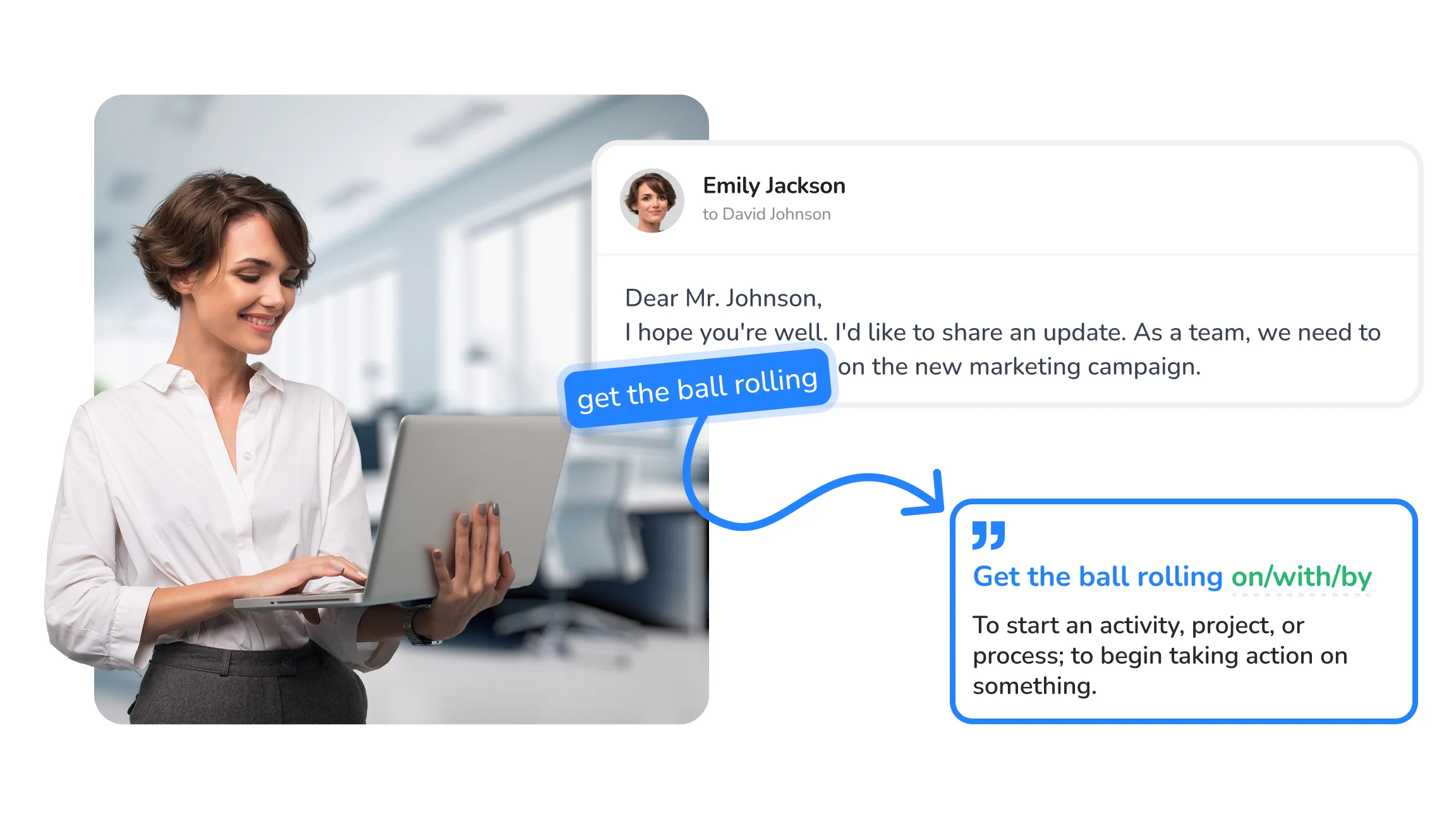
What Are Business English Idioms and Why Do They Matter?
Idioms are phrases whose meaning is not obvious from the individual words. In business settings, idioms appear in speech and writing to speed communication and give a natural tone. Learning idioms in English improves comprehension during meetings, helps learners respond more naturally, and reduces misunderstandings. For professionals, knowing these expressions supports clearer emails, smoother presentations, and more confident conversations.
12 Useful Business English Idioms (With Easy Examples)
1. Touch base
Definition: Make brief contact to check progress.
Explanation: Used to arrange a quick update or confirm details.
Example: "Let's touch base after the meeting."
Workplace: Quick status checks after a project milestone.
2. Circle back
Definition: Return to a topic later.
Explanation: Save a discussion for another time or follow up after gathering more information.
Example: "I'll circle back with the final numbers."
Workplace: Following up when more data is needed.
3. Loop someone in
Definition: Include someone in a conversation or email.
Explanation: Add a person to the communication chain so they stay informed.
Example: "Please loop the manager in on this thread."
Workplace: Keeping stakeholders updated on progress.
4. Think outside the box
Definition: Use creative or unconventional ideas.
Explanation: Encourage new solutions beyond standard approaches.
Example: "Try to think outside the box for marketing ideas."
Workplace: Brainstorming and innovation sessions.
5. Put something on the back burner
Definition: Delay or deprioritize a task.
Explanation: Move a task to be done later because something else is more urgent.
Example: "Put the redesign on the back burner for now."
Workplace: Reassigning priorities when deadlines change.
6. Get your ducks in a row
Definition: Get organized and prepared.
Explanation: Arrange tasks or documents before taking action.
Example: "Get the team’s reports in a row before the audit."
Workplace: Preparing materials for presentations or reviews.
7. Sunsetting
Definition: Phasing out a product or service.
Explanation: Gradually stop support or development for something.
Example: "The company is sunsetting the old platform next quarter."
Workplace: Product lifecycle and roadmap conversations.
8. Good to go
Definition: Ready to start or proceed.
Explanation: Confirms readiness after checks or approvals.
Example: "All approvals are done — the campaign is good to go."
Workplace: Launches, deployments, or event starts.
9. Sync
Definition: Coordinate or align with someone.
Explanation: Short for synchronize; used for aligning plans or calendars.
Example: "Can the team sync on the presentation slides?"
Workplace: Scheduling coordination and aligning messages.
10. Flesh something out
Definition: Add more detail to an idea or plan.
Explanation: Expand a rough concept with specifics.
Example: "Flesh out the proposal before sending it to clients."
Workplace: Turning outlines into detailed plans or reports.
11. No need to reinvent the wheel
Definition: Don’t redo what already works.
Explanation: Use existing solutions instead of building from scratch.
Example: "Use the template — no need to reinvent the wheel."
Workplace: Saving time by reusing proven methods or templates.
12. Bite the bullet
Definition: Accept an unpleasant task or decision.
Explanation: Do something difficult but necessary.
Example: "The team decided to bite the bullet and approve the cut."
Workplace: Making tough budget or staffing decisions.
How to Practise Business Idioms in Real Conversations
Practise idioms with short role-plays, rewrite sample emails using idioms naturally, and repeat phrases aloud in context. Use scenario-based exercises to place idioms inside meetings, presentations, or client calls. Learna helps users practise English idioms and phrases with roleplay dialogues, instant feedback, and tailored corrections so learners gain confidence using idioms for working in real situations.
- Record short role-plays and review corrections.
- Rewrite an email replacing plain phrases with idioms where natural.
- Repeat a chosen idiom in three different workplace contexts.
