
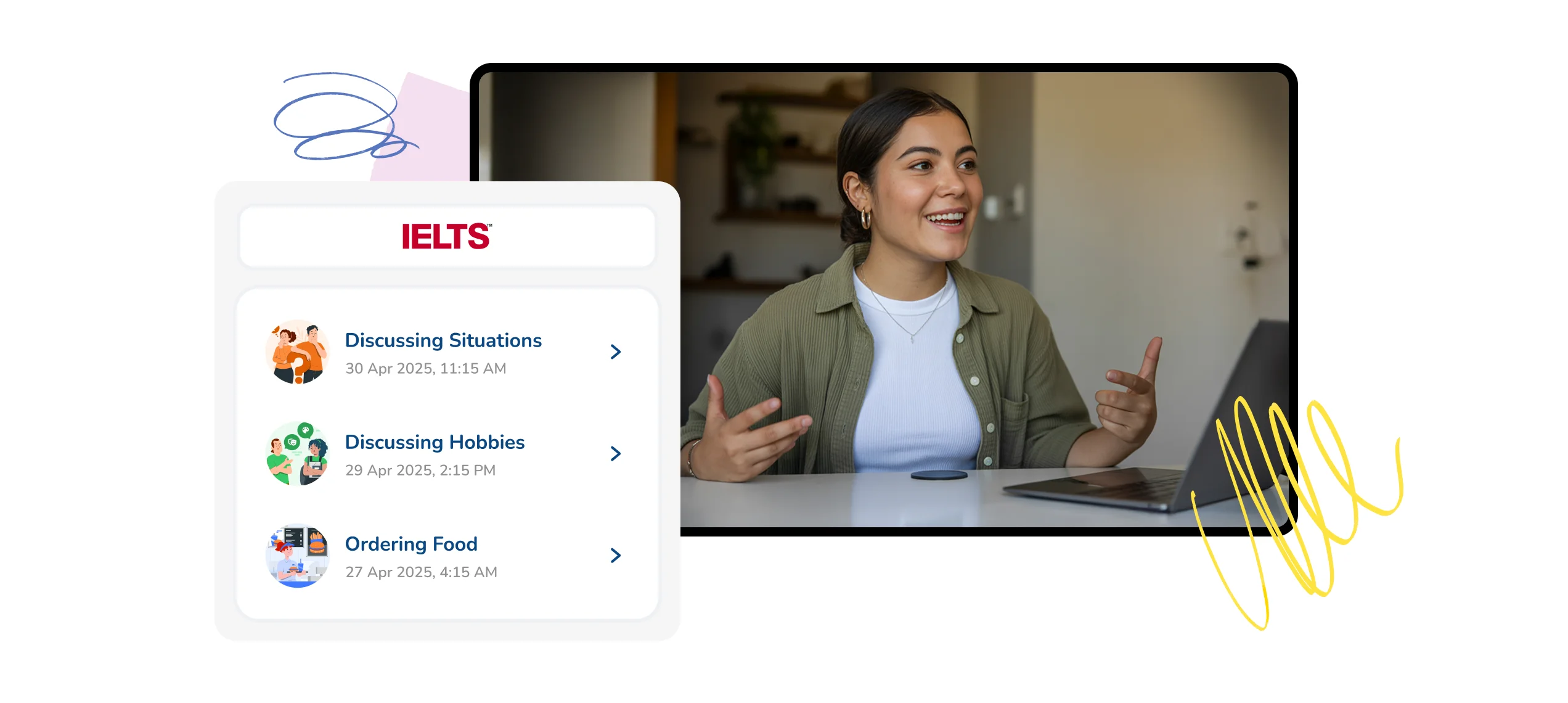
The IELTS Speaking test measures how well a person can speak English in real situations. Regular speaking practice is important for strong performance in the IELTS exam. Practicing at home helps build fluency, improve pronunciation, and reduce anxiety before the IELTS test. Short daily routines focused on common IELTS speaking topics lead to steady improvement. Recording responses to sample IELTS speaking questions, reviewing errors, and repeating answers helps internalize useful phrases and correct grammar. Using structured practice that mirrors a mock IELTS exam format builds familiarity with timing and task types. For guided and adaptive practice, Learna offers a tool made for speaking practice on phone or computer. Learna provides scenario-based sessions that mirror the IELTS speaking test, gives instant feedback on pronunciation and grammar, and tracks progress to support focused IELTS preparation. Start For Free with Learna and integrate daily speaking routines into a consistent study plan.
The Importance of Speaking Practice for IELTS
Speaking practice develops the skills the IELTS exam assesses: coherence, pronunciation, lexical range, and grammatical accuracy. Regular spoken practice trains the mind to produce language quickly under time limits similar to the IELTS speaking test. Practicing aloud exposes errors that remain hidden in written work, while recording and listening to responses reveals pronunciation issues and helps refine intonation. Timed prompts prepare learners for Part 1, Part 2, and Part 3 tasks in a realistic mock IELTS exam setting. Repeating real IELTS speaking topics builds a bank of ready phrases and ideas. Incorporating corrective feedback speeds progress by highlighting common mistakes, suggesting alternative expressions, and offering pronunciation tips. Learna combines interactive roleplays, targeted feedback, and practice aligned with typical IELTS speaking questions, enabling focused improvement in speaking performance.
Everyday Practice for IELTS Improvement
Daily routines of short, focused sessions produce measurable gains in IELTS preparation. A session can begin with warm-up pronunciation drills, proceed to answering practice prompts from common IELTS speaking topics, and end with recording responses for review. Simulated timed responses recreate pressure similar to the IELTS test, and recordings support self-review or tutor review. When partner practice is unavailable, structured tools and apps serve as speaking partners for IELTS test practice. Learna offers guided roleplays, sample answers, and instant corrections that match typical IELTS speaking questions. Regular use of such tools allows tracking progress through recorded sessions, evaluating improvements, and concentrating on weak areas. Combining self-recording, simulated mock IELTS exam tasks, and guided sessions creates a co
Practice Tips for Home Study
Begin with short daily sessions that focus on specific skills such as pronunciation or task response.
Use timed prompts and record answers to mimic the IELTS speaking test.
Review recordings to identify repeated errors and note vocabulary to reuse.
Practice a range of IELTS speaking topics to build flexibility and idea generation.
Include at least one full mock IELTS exam session weekly to train stamina and timing.
Common IELTS Speaking Topics to Practice
Part 1: Personal Topics
Practice brief answers about work, study, family, or daily routines. Aim for clear sentences and varied vocabulary.
Part 2: Long Turn
Prepare 1–2 minute monologues on familiar prompts. Structure responses with an opening, supporting details, and a short conclusion.
Part 3: Discussion
Practice extended responses on abstract or complex issues. Focus on explaining reasons, giving examples, and comparing ideas.
Consistent home practice, built around real IELTS speaking topics and honest self-review, is one of the most reliable ways to improve before test day. With guided roleplay, instant feedback, and progress tracking built around the actual IELTS format, Learna makes it easier to turn short daily sessions into steady, measurable speaking gains.
