
Future Continuous Tense: নিয়ম, সূত্র ও উদাহরণ
Future continuous tense, যাকে future progressive-ও বলা হয়, ভবিষ্যতের কোনো নির্দিষ্ট মুহূর্তে চলমান একটি কাজকে বোঝায়। অনেক শিক্ষার্থীই এই কালটি এড়িয়ে যান, অথচ সময়সূচি ও ভ্রমণ-সংক্রান্ত কথোপকথনে এটি বারবার কাজে লাগে। এই গাইডে রয়েছে এর সূত্র, সাধারণ ব্যবহার এবং বাকি future tense পরিবারের সঙ্গে এর তুলনা।
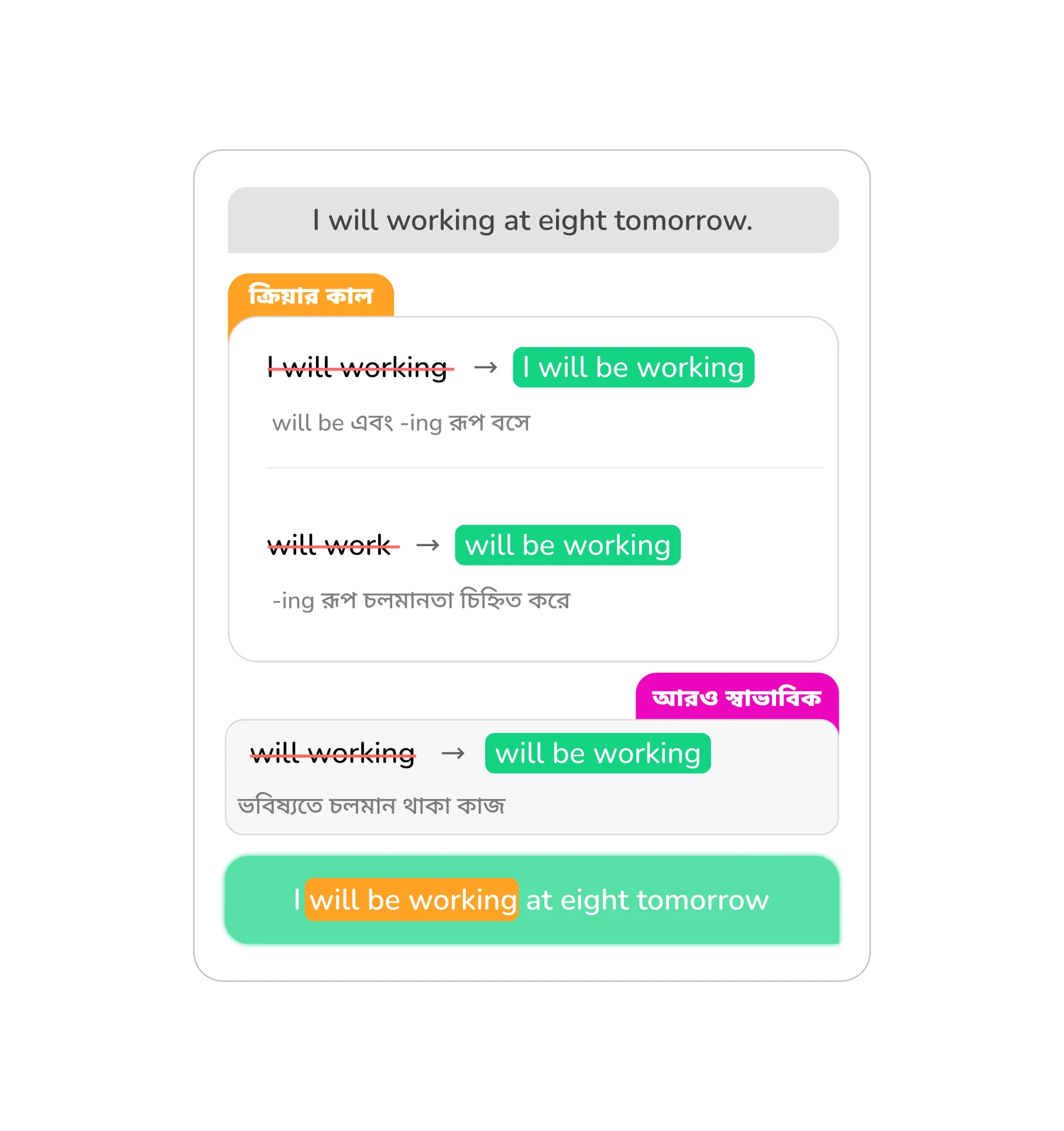
What Is the Future Continuous Tense?
You form it with will be plus the main verb ending in -ing. It is one of four future tenses, and the only one built to picture an action already underway at a future moment rather than a completed one.
The Future Tense Family at a Glance
Comparing the future continuous with other future tenses shows how it specifically focuses on actions in progress at a future point:
| Tense | Focus | Example |
|---|---|---|
| Future simple | A prediction or decision | I will wait for you. |
| Future continuous | Action in progress at a future moment | I will be waiting at 8 AM. |
| Future perfect | Action complete by a future point | I will have waited an hour by 9 AM. |
| Future perfect continuous | Duration up to a future point | I will have been waiting for an hour by 9 AM. |
An Action Already in Progress at a Future Moment
The distinguishing feature of this tense is picturing a moment in the future and describing what will already be underway at that point. "At 8 AM tomorrow, I will be eating breakfast" places you inside the action at that exact moment, rather than simply stating it will happen.
How to Form Sentences?
Forming future continuous sentences follows a consistent structure using will be and the -ing participle:
| Form | Rule | Example |
|---|---|---|
| Positive | will be + verb-ing | He will be working. |
| Negative | will not (won't) be + verb-ing | They won't be coming. |
| Question | Will + subject + be + verb-ing? | Will you be staying? |
When to Use the Future Continuous?
The future continuous tense is versatile and fits several practical future scenarios:
Describing an action underway at a specific moment tomorrow or later.
An ongoing future activity interrupted or overlapped by another event.
Inquiring gently about someone's future arrangements without pressing them.
Envisioning expected or routine future events happening as expected.
Describing a schedule already in motion: Used for pre-arranged flight or meeting timelines: "By 3 PM, they will be boarding the flight."
Future Continuous vs. Future Simple
Compare these examples to see how the continuous form adds a sense of action in progress:
| Sentence | Correct Form | Why |
|---|---|---|
| I ___ (work) at 9 AM tomorrow. | will be working | Action in progress at that moment |
| I ___ (finish) the report tomorrow. | will finish | Plain future fact |
| We ___ (travel) this time next week. | will be traveling | Ongoing at a specific future time |
Common Mistakes
Avoid these typical structure and usage errors when building future continuous sentences:
| Incorrect | Correct |
|---|---|
| I will working tomorrow. | I will be working tomorrow. |
| Will you working late tonight? | Will you be working late tonight? |
| At 8 AM, I eat breakfast. (meant as an ongoing plan) | At 8 AM, I will be eating breakfast. |
How Learna AI Teaches the Future Continuous?
Learna AI listens for a future moment paired with an ongoing action, and checks that will be plus -ing captures that in-progress sense instead of a plain future statement. It also nudges toward this tense for polite questions about someone's plans, since "Will you be joining us?" often sounds more natural than a plain future question, and it checks that be isn't dropped between will and the -ing verb. Learners planning schedules and itineraries with Learna report a 78% improvement in using future continuous naturally for overlapping events.
Once actions in progress at a future point feel steady, marking a full deadline instead belongs to future perfect, which shows something finished by that same moment rather than still happening.
আরও জানুন
Learna-র শেখার পথগুলোর সঙ্গে আপনার ব্যাকরণ জ্ঞানকে কাজে লাগান:
প্রায়শই জিজ্ঞাসিত প্রশ্ন
Future continuous tense কী, উদাহরণসহ বলুন?

এটি এমন একটি কাল যা ভবিষ্যতের নির্দিষ্ট মুহূর্তে চলমান কাজ বোঝায়, যেমন I will be waiting at 8 AM tomorrow বা She will be sleeping when you arrive।
Future continuous-এর সূত্র কী?
হ্যাঁ-বাচক: subject + will be + verb-ing। না-বাচক: subject + will not (won't) be + verb-ing। প্রশ্ন: Will + subject + be + verb-ing?
Future continuous আমরা কখন ব্যবহার করি?
ভবিষ্যতের নির্দিষ্ট সময়ে চলমান কাজ, ভবিষ্যতে একে অপরের সঙ্গে ছেদ করা দুটি কাজ, কিংবা কারও পরিকল্পনা নিয়ে ভদ্র প্রশ্ন করতে এটি ব্যবহার করুন।
Future continuous-এর একটি উদাহরণ কী?
At 8 AM tomorrow, I will be eating breakfast — এটি ঠিক সেই ভবিষ্যৎ মুহূর্তে কাজটিকে চলমান অবস্থায় দেখায়।
Future continuous আর future simple-এর পার্থক্য কী?
Future continuous দেখায় ভবিষ্যতের কোনো মুহূর্তে কাজটি ইতিমধ্যেই চলছে; future simple শুধু জানায় যে কিছু একটা ঘটবে।
Future continuous-এ প্রশ্ন গঠন করবেন কীভাবে?
শুরু করুন Will দিয়ে, তারপর subject, এরপর be, তারপর verb-ing রূপ: Will you be staying? Will she be working?
Future continuous tense-এ কোন শব্দগুলো বেশি ব্যবহৃত হয়?
at this time tomorrow, this time next week এবং by [নির্দিষ্ট সময়]-এর মতো সময়-নির্দেশক শব্দগুলো সাধারণত future continuous-এর সঙ্গে ব্যবহৃত হয়।
Future continuous নিয়ে একটি সাধারণ ভুল কী?
will আর verb-ing রূপের মাঝে be বাদ দিয়ে ফেলা, কিংবা চলমান কাজের বদলে সাধারণ ভবিষ্যৎ তথ্যের জন্য এটি ব্যবহার করা।
পরিকল্পনা নিয়ে ভদ্র প্রশ্ন করতে কি future continuous ব্যবহার করা যায়?
হ্যাঁ: অনেক ক্ষেত্রেই Will you be using the car tonight? শুনতে Are you going to use the car tonight?-এর চেয়ে নরম লাগে।
এই কাল দিয়ে কি ভবিষ্যতের দুটি কাজ একসঙ্গে দেখানো যায়?
হ্যাঁ: She will be sleeping when you arrive দেখায় দ্বিতীয় কাজটি যখন ঘটে, প্রথম কাজটি তখন ইতিমধ্যেই চলছে।
Future continuous আর future perfect-এর পার্থক্য কী?
Future continuous দেখায় ভবিষ্যতের কোনো সময়ে কাজটি তখনও চলছে; future perfect দেখায় সেই সময়ের মধ্যেই কাজটি শেষ হয়ে গেছে।
দৈনন্দিন ইংরেজিতে কি আসলেই future continuous ব্যবহার হয়?
হ্যাঁ, বিশেষ করে সময়সূচি, ভ্রমণ পরিকল্পনা এবং কারও সময় আছে কি না তা ভদ্রভাবে জানতে চাওয়ার ক্ষেত্রে—যদিও future simple-এর তুলনায় এর ব্যবহার কম।
Learna AI কীভাবে future continuous বাক্য যাচাই করে?
Learna AI বাক্যে উল্লেখিত ভবিষ্যৎ মুহূর্ত খুঁজে নেয় এবং দেখে, বর্ণিত কাজটিকে নিছক ভবিষ্যদ্বাণী নয় বরং চলমান হিসেবে দেখানো উচিত কি না।
Learna কি future continuous দিয়ে আমার সময়সূচি বর্ণনা করতে সাহায্য করতে পারে?
হ্যাঁ। Learna AI ভ্রমণপথ ও সময়সূচি বর্ণনার অনুশীলন করায়, আর যখনই কোনো চলমান ভবিষ্যৎ কাজকে সাধারণ তথ্য হিসেবে বলা হয়, তখনই রূপটি শুধরে দেয়।