
미래진행형: 규칙, 공식 및 예문
미래진행형(future continuous), 즉 미래진행 시제는 미래의 특정 순간에 진행되고 있는 행동을 나타냅니다. 일정이나 여행에 관한 대화에서 끊임없이 등장하는데도 많은 학습자가 그냥 지나치는 시제이기도 합니다. 이 가이드에서는 공식과 주요 용법, 그리고 다른 미래 시제들과의 차이를 살펴봅니다.
What Is the Future Continuous Tense?
You form it with will be plus the main verb ending in -ing. It is one of four future tenses, and the only one built to picture an action already underway at a future moment rather than a completed one.
The Future Tense Family at a Glance
Comparing the future continuous with other future tenses shows how it specifically focuses on actions in progress at a future point:
| Tense | Focus | Example |
|---|---|---|
| Future simple | A prediction or decision | I will wait for you. |
| Future continuous | Action in progress at a future moment | I will be waiting at 8 AM. |
| Future perfect | Action complete by a future point | I will have waited an hour by 9 AM. |
| Future perfect continuous | Duration up to a future point | I will have been waiting for an hour by 9 AM. |
An Action Already in Progress at a Future Moment
The distinguishing feature of this tense is picturing a moment in the future and describing what will already be underway at that point. "At 8 AM tomorrow, I will be eating breakfast" places you inside the action at that exact moment, rather than simply stating it will happen.
How to Form Sentences?
Forming future continuous sentences follows a consistent structure using will be and the -ing participle:
| Form | Rule | Example |
|---|---|---|
| Positive | will be + verb-ing | He will be working. |
| Negative | will not (won't) be + verb-ing | They won't be coming. |
| Question | Will + subject + be + verb-ing? | Will you be staying? |
When to Use the Future Continuous?
The future continuous tense is versatile and fits several practical future scenarios:
Describing an action underway at a specific moment tomorrow or later.
An ongoing future activity interrupted or overlapped by another event.
Inquiring gently about someone's future arrangements without pressing them.
Envisioning expected or routine future events happening as expected.
Describing a schedule already in motion: Used for pre-arranged flight or meeting timelines: "By 3 PM, they will be boarding the flight."
Future Continuous vs. Future Simple
Compare these examples to see how the continuous form adds a sense of action in progress:
| Sentence | Correct Form | Why |
|---|---|---|
| I ___ (work) at 9 AM tomorrow. | will be working | Action in progress at that moment |
| I ___ (finish) the report tomorrow. | will finish | Plain future fact |
| We ___ (travel) this time next week. | will be traveling | Ongoing at a specific future time |
Common Mistakes
Avoid these typical structure and usage errors when building future continuous sentences:
| Incorrect | Correct |
|---|---|
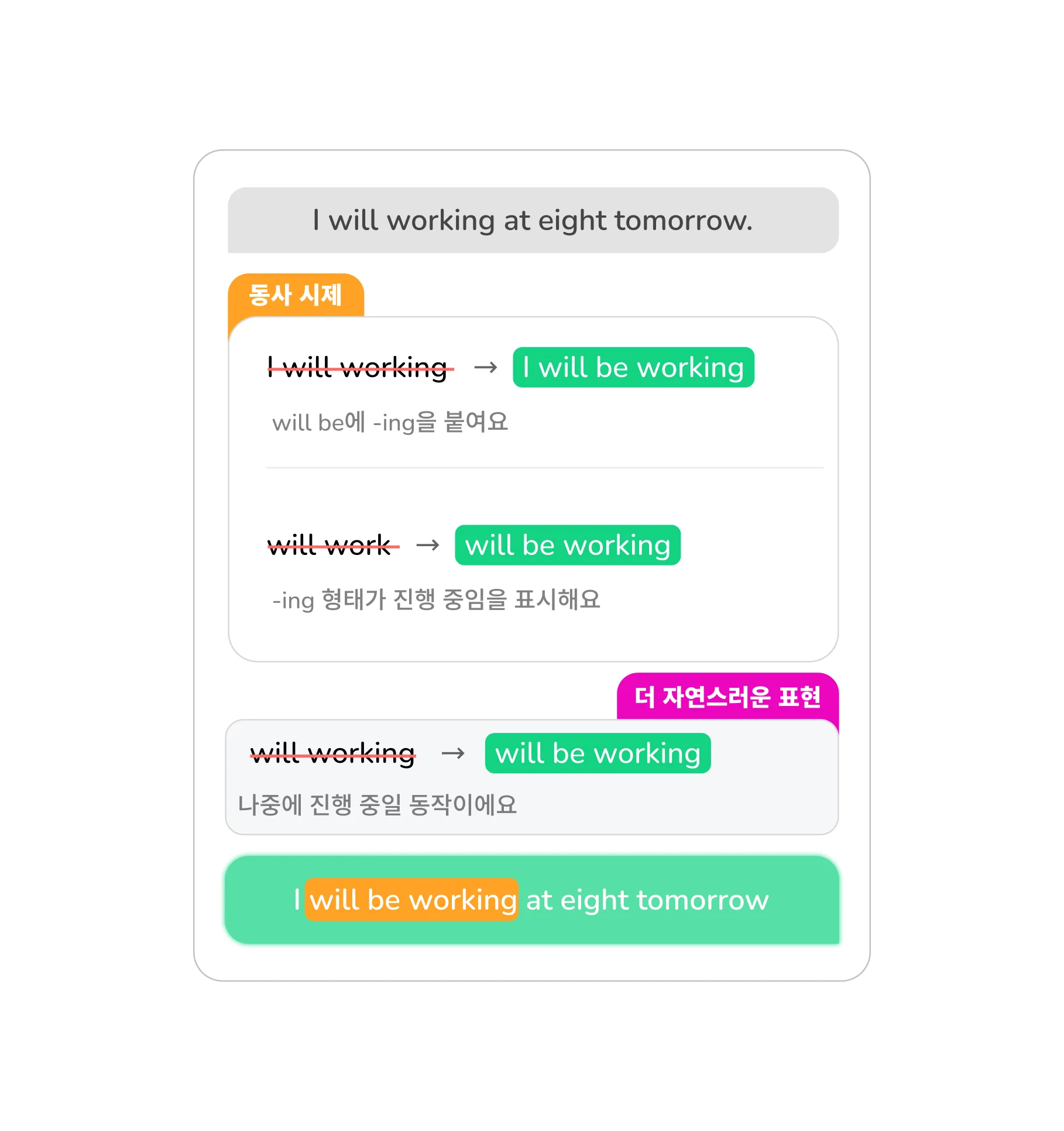
| I will working tomorrow. | I will be working tomorrow. |
| Will you working late tonight? | Will you be working late tonight? |
| At 8 AM, I eat breakfast. (meant as an ongoing plan) | At 8 AM, I will be eating breakfast. |
How Learna AI Teaches the Future Continuous?
Learna AI listens for a future moment paired with an ongoing action, and checks that will be plus -ing captures that in-progress sense instead of a plain future statement. It also nudges toward this tense for polite questions about someone's plans, since "Will you be joining us?" often sounds more natural than a plain future question, and it checks that be isn't dropped between will and the -ing verb. Learners planning schedules and itineraries with Learna report a 78% improvement in using future continuous naturally for overlapping events.
Once actions in progress at a future point feel steady, marking a full deadline instead belongs to future perfect, which shows something finished by that same moment rather than still happening.
더 살펴보기
Learna의 학습 경로로 문법 지식을 실제로 활용해 보세요:
자주 묻는 질문
미래진행형이란 무엇이며 예문은 어떤 것이 있나요?

미래의 특정 순간에 진행되고 있는 행동을 나타내는 시제입니다. 예를 들어 I will be waiting at 8 AM tomorrow나 She will be sleeping when you arrive 같은 문장이 있습니다.
미래진행형의 공식은 무엇인가요?
긍정문: 주어 + will be + 동사-ing. 부정문: 주어 + will not(won't) be + 동사-ing. 의문문: Will + 주어 + be + 동사-ing?
미래진행형은 언제 사용하나요?
미래의 특정 시점에 진행 중인 행동, 서로 겹치는 두 가지 미래 행동, 또는 상대의 계획을 정중하게 물을 때 사용합니다.
미래진행형의 예문 하나를 알려주세요.
At 8 AM tomorrow, I will be eating breakfast는 바로 그 미래의 순간에 행동이 진행 중임을 나타냅니다.
미래진행형과 단순미래의 차이는 무엇인가요?
미래진행형은 미래의 한 순간에 이미 진행되고 있는 행동을 보여 주고, 단순미래는 어떤 일이 일어날 것이라는 사실만 전달합니다.
미래진행형 의문문은 어떻게 만드나요?
Will로 시작해 주어, be, 그리고 동사-ing 형태를 차례로 씁니다: Will you be staying? Will she be working?
미래진행형에 자주 쓰이는 핵심 표현은 무엇인가요?
at this time tomorrow, this time next week, by [특정 시각]과 같은 시간 표현이 미래진행형과 자주 함께 쓰입니다.
미래진행형에서 흔히 하는 실수는 무엇인가요?
will과 동사-ing 사이에 be를 빠뜨리거나, 진행 중인 행동이 아닌 단순한 미래 사실에 이 시제를 쓰는 것입니다.
미래진행형으로 계획에 대해 정중하게 물어볼 수 있나요?
네. 많은 상황에서 Will you be using the car tonight?는 Are you going to use the car tonight?보다 부드럽게 들립니다.
이 시제로 두 가지 미래 행동이 겹치는 상황을 나타낼 수 있나요?
네. She will be sleeping when you arrive는 두 번째 일이 일어날 때 첫 번째 행동이 이미 진행 중임을 보여 줍니다.
미래진행형과 미래완료의 차이는 무엇인가요?
미래진행형은 미래의 한 시점에 여전히 일어나고 있는 행동을, 미래완료는 그 시점까지 이미 끝난 행동을 나타냅니다.
일상 영어에서 미래진행형을 실제로 자주 쓰나요?
네. 단순미래보다는 덜 쓰이지만, 일정이나 여행 계획을 말할 때, 그리고 상대의 시간이 되는지 정중히 물을 때 특히 많이 사용됩니다.
Learna AI는 미래진행형 문장을 어떻게 점검하나요?
Learna AI는 문장에 미래 시점이 제시되었는지 살피고, 해당 행동을 단순한 예측이 아니라 진행 중인 것으로 표현해야 하는지 확인합니다.
Learna로 미래진행형을 써서 내 일정을 설명하는 연습을 할 수 있나요?
네. Learna AI와 여행 일정이나 스케줄 설명을 연습하면서, 진행 중인 미래 행동을 단순한 사실로 말할 때마다 형태를 바로잡아 줍니다.