
未来進行形: ルール・公式・例文
未来進行形(future continuous、future progressiveとも呼ばれます)は、未来のある特定の瞬間に進行中の動作を表します。多くの学習者が後回しにしがちな時制ですが、予定や旅行の会話では頻繁に登場します。このガイドでは、形の作り方、よく使われる場面、そして他の未来時制との違いを解説します。
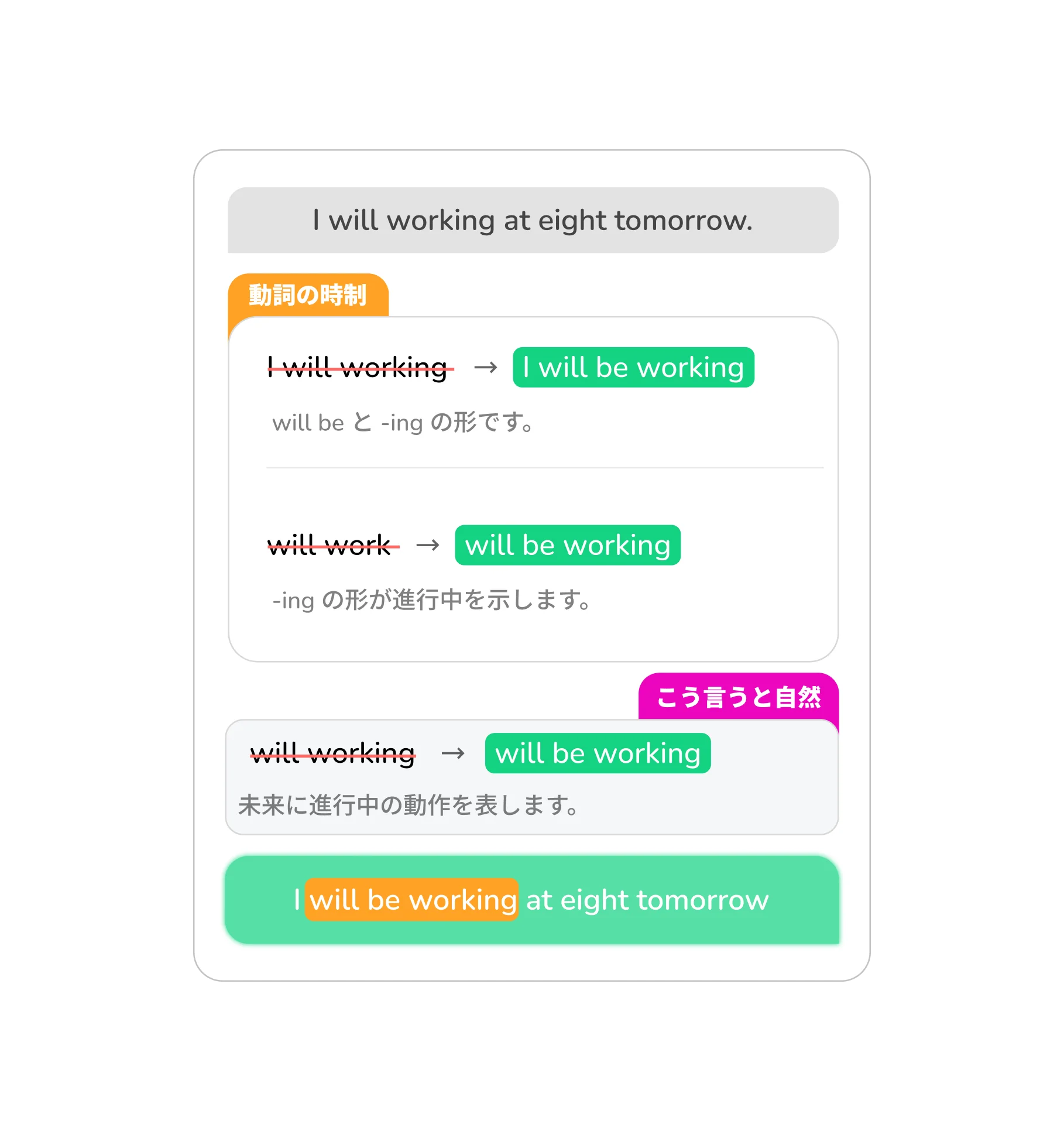
What Is the Future Continuous Tense?
You form it with will be plus the main verb ending in -ing. It is one of four future tenses, and the only one built to picture an action already underway at a future moment rather than a completed one.
The Future Tense Family at a Glance
Comparing the future continuous with other future tenses shows how it specifically focuses on actions in progress at a future point:
| Tense | Focus | Example |
|---|---|---|
| Future simple | A prediction or decision | I will wait for you. |
| Future continuous | Action in progress at a future moment | I will be waiting at 8 AM. |
| Future perfect | Action complete by a future point | I will have waited an hour by 9 AM. |
| Future perfect continuous | Duration up to a future point | I will have been waiting for an hour by 9 AM. |
An Action Already in Progress at a Future Moment
The distinguishing feature of this tense is picturing a moment in the future and describing what will already be underway at that point. "At 8 AM tomorrow, I will be eating breakfast" places you inside the action at that exact moment, rather than simply stating it will happen.
How to Form Sentences?
Forming future continuous sentences follows a consistent structure using will be and the -ing participle:
| Form | Rule | Example |
|---|---|---|
| Positive | will be + verb-ing | He will be working. |
| Negative | will not (won't) be + verb-ing | They won't be coming. |
| Question | Will + subject + be + verb-ing? | Will you be staying? |
When to Use the Future Continuous?
The future continuous tense is versatile and fits several practical future scenarios:
Describing an action underway at a specific moment tomorrow or later.
An ongoing future activity interrupted or overlapped by another event.
Inquiring gently about someone's future arrangements without pressing them.
Envisioning expected or routine future events happening as expected.
Describing a schedule already in motion: Used for pre-arranged flight or meeting timelines: "By 3 PM, they will be boarding the flight."
Future Continuous vs. Future Simple
Compare these examples to see how the continuous form adds a sense of action in progress:
| Sentence | Correct Form | Why |
|---|---|---|
| I ___ (work) at 9 AM tomorrow. | will be working | Action in progress at that moment |
| I ___ (finish) the report tomorrow. | will finish | Plain future fact |
| We ___ (travel) this time next week. | will be traveling | Ongoing at a specific future time |
Common Mistakes
Avoid these typical structure and usage errors when building future continuous sentences:
| Incorrect | Correct |
|---|---|
| I will working tomorrow. | I will be working tomorrow. |
| Will you working late tonight? | Will you be working late tonight? |
| At 8 AM, I eat breakfast. (meant as an ongoing plan) | At 8 AM, I will be eating breakfast. |
How Learna AI Teaches the Future Continuous?
Learna AI listens for a future moment paired with an ongoing action, and checks that will be plus -ing captures that in-progress sense instead of a plain future statement. It also nudges toward this tense for polite questions about someone's plans, since "Will you be joining us?" often sounds more natural than a plain future question, and it checks that be isn't dropped between will and the -ing verb. Learners planning schedules and itineraries with Learna report a 78% improvement in using future continuous naturally for overlapping events.
Once actions in progress at a future point feel steady, marking a full deadline instead belongs to future perfect, which shows something finished by that same moment rather than still happening.
もっと見る
Learnaの学習コースで、身につけた文法を実践に活かしましょう:
言語を学ぶ
よくある質問
未来進行形とは何ですか?例文も教えてください。

未来のある特定の時点で進行中の動作を表す時制です。例:I will be waiting at 8 AM tomorrow(明日の8時に待っています)、She will be sleeping when you arrive(あなたが着くころ彼女は眠っているでしょう)。
未来進行形の公式は?
肯定文:主語 + will be + 動詞-ing。否定文:主語 + will not(won't)be + 動詞-ing。疑問文:Will + 主語 + be + 動詞-ing?
未来進行形はどんなときに使いますか?
未来の特定の時点で進行中の動作、重なり合う2つの未来の動作、または相手の予定を丁寧に尋ねるときに使います。
未来進行形の例文を教えてください。
At 8 AM tomorrow, I will be eating breakfast. は、その未来の瞬間にまさに進行している動作を表しています。
未来進行形と単純未来の違いは?
未来進行形は未来のある時点ですでに進行している動作を表し、単純未来は単に「何かが起こる」と述べるだけです。
未来進行形の疑問文はどう作りますか?
Will で始め、主語、be、動詞-ing の順に続けます:Will you be staying? / Will she be working?
未来進行形でよく使われるキーワードは?
at this time tomorrow、this time next week、by[特定の時刻]などの時を表す表現が未来進行形とよく組み合わされます。
未来進行形でよくある間違いは?
will と動詞-ing の間の be を抜かしてしまうことや、進行中の動作ではなく単なる未来の事実に使ってしまうことです。
未来進行形で予定を丁寧に尋ねられますか?
はい。Will you be using the car tonight? は、多くの場面で Are you going to use the car tonight? よりやわらかく響きます。
この時制で2つの未来の動作が重なることを表せますか?
はい。She will be sleeping when you arrive は、2つ目の出来事が起きたときに1つ目の動作がすでに進行中であることを示します。
未来進行形と未来完了形の違いは?
未来進行形は未来のある時点でまだ続いている動作を、未来完了形はその時点までにすでに終わっている動作を表します。
日常英語で未来進行形は実際に使われますか?
はい。単純未来ほど頻繁ではありませんが、予定や旅行プランの説明、相手の都合を丁寧に尋ねる場面などでよく使われます。
Learna AIは未来進行形の文をどのようにチェックしますか?
Learna AIは文中に示された未来の時点を見つけ、その動作を単なる予測ではなく進行中として表すべきかどうかを確認します。
Learnaは未来進行形を使った予定の説明を手伝ってくれますか?
はい。Learna AIは旅程やスケジュールの描写を練習でき、進行中の未来の動作を単なる事実として述べてしまったときには、その都度正しい形に直してくれます。