
Future Continuous Tense: Kurallar, Formül & Örnekler
Future progressive olarak da bilinen future continuous tense, gelecekte belirli bir anda sürmekte olan bir eylemi anlatır. Birçok öğrenci bu zamanı atlayıp geçer; oysa program yapma ve seyahat konuşmalarında sürekli karşımıza çıkar. Bu rehberde formülü, yaygın kullanımlarını ve diğer gelecek zamanlarla karşılaştırmasını bulacaksınız.
What Is the Future Continuous Tense?
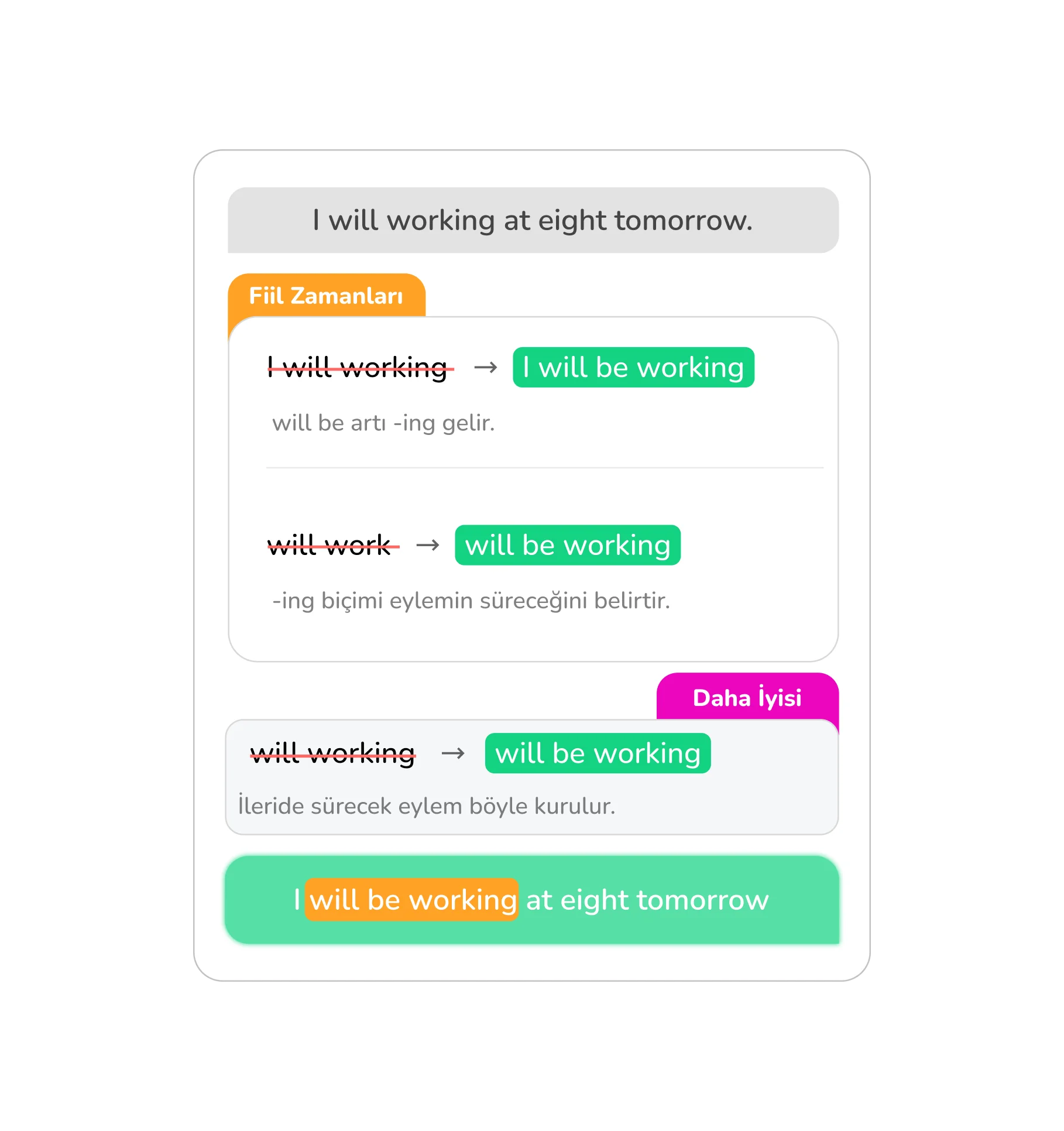
You form it with will be plus the main verb ending in -ing. It is one of four future tenses, and the only one built to picture an action already underway at a future moment rather than a completed one.
The Future Tense Family at a Glance
Comparing the future continuous with other future tenses shows how it specifically focuses on actions in progress at a future point:
| Tense | Focus | Example |
|---|---|---|
| Future simple | A prediction or decision | I will wait for you. |
| Future continuous | Action in progress at a future moment | I will be waiting at 8 AM. |
| Future perfect | Action complete by a future point | I will have waited an hour by 9 AM. |
| Future perfect continuous | Duration up to a future point | I will have been waiting for an hour by 9 AM. |
An Action Already in Progress at a Future Moment
The distinguishing feature of this tense is picturing a moment in the future and describing what will already be underway at that point. "At 8 AM tomorrow, I will be eating breakfast" places you inside the action at that exact moment, rather than simply stating it will happen.
How to Form Sentences?
Forming future continuous sentences follows a consistent structure using will be and the -ing participle:
| Form | Rule | Example |
|---|---|---|
| Positive | will be + verb-ing | He will be working. |
| Negative | will not (won't) be + verb-ing | They won't be coming. |
| Question | Will + subject + be + verb-ing? | Will you be staying? |
When to Use the Future Continuous?
The future continuous tense is versatile and fits several practical future scenarios:
Describing an action underway at a specific moment tomorrow or later.
An ongoing future activity interrupted or overlapped by another event.
Inquiring gently about someone's future arrangements without pressing them.
Envisioning expected or routine future events happening as expected.
Describing a schedule already in motion: Used for pre-arranged flight or meeting timelines: "By 3 PM, they will be boarding the flight."
Future Continuous vs. Future Simple
Compare these examples to see how the continuous form adds a sense of action in progress:
| Sentence | Correct Form | Why |
|---|---|---|
| I ___ (work) at 9 AM tomorrow. | will be working | Action in progress at that moment |
| I ___ (finish) the report tomorrow. | will finish | Plain future fact |
| We ___ (travel) this time next week. | will be traveling | Ongoing at a specific future time |
Common Mistakes
Avoid these typical structure and usage errors when building future continuous sentences:
| Incorrect | Correct |
|---|---|
| I will working tomorrow. | I will be working tomorrow. |
| Will you working late tonight? | Will you be working late tonight? |
| At 8 AM, I eat breakfast. (meant as an ongoing plan) | At 8 AM, I will be eating breakfast. |
How Learna AI Teaches the Future Continuous?
Learna AI listens for a future moment paired with an ongoing action, and checks that will be plus -ing captures that in-progress sense instead of a plain future statement. It also nudges toward this tense for polite questions about someone's plans, since "Will you be joining us?" often sounds more natural than a plain future question, and it checks that be isn't dropped between will and the -ing verb. Learners planning schedules and itineraries with Learna report a 78% improvement in using future continuous naturally for overlapping events.
Once actions in progress at a future point feel steady, marking a full deadline instead belongs to future perfect, which shows something finished by that same moment rather than still happening.
Daha Fazlasını Keşfedin
Learna'nın öğrenme yollarıyla dilbilgisi bilginizi pratiğe dökün:
Sıkça Sorulan Sorular
Future continuous tense nedir, örneklerle nasıl kullanılır?

Gelecekte belirli bir anda devam eden bir eylemi anlatmak için kullanılan zamandır; örneğin I will be waiting at 8 AM tomorrow ya da She will be sleeping when you arrive.
Future continuous formülü nedir?
Olumlu: özne + will be + fiil-ing. Olumsuz: özne + will not (won't) be + fiil-ing. Soru: Will + özne + be + fiil-ing?
Future continuous'u ne zaman kullanırız?
Gelecekte belirli bir anda devam eden bir eylem, birbiriyle örtüşen iki gelecek eylem ya da birinin planlarına dair kibar sorular için kullanın.
Future continuous'a bir örnek verir misiniz?
At 8 AM tomorrow, I will be eating breakfast cümlesi, eylemi gelecekteki tam o anda devam ediyor olarak konumlandırır.
Future continuous ile future simple arasındaki fark nedir?
Future continuous, gelecekteki bir anda çoktan sürmekte olan bir eylemi gösterir; future simple ise yalnızca bir şeyin olacağını belirtir.
Future continuous'ta soru cümleleri nasıl kurulur?
Will ile başlayın, sonra özne, ardından be ve fiilin -ing hâli gelir: Will you be staying? Will she be working?
Future continuous tense'te hangi anahtar kelimeler kullanılır?
at this time tomorrow, this time next week ve by [belirli bir saat] gibi zaman belirteçleri genellikle future continuous ile birlikte kullanılır.
Future continuous'ta sık yapılan bir hata nedir?
will ile fiilin -ing hâli arasında be'yi atlamak ya da devam eden bir eylem yerine düz bir gelecek bilgisi için bu zamanı kullanmak.
Future continuous ile planlar hakkında kibar soru sorulabilir mi?
Evet: Will you be using the car tonight? birçok bağlamda Are you going to use the car tonight? ifadesinden daha yumuşak gelir.
Bu zamanla iki gelecek eylem örtüşebilir mi?
Evet: She will be sleeping when you arrive cümlesi, ikinci eylem gerçekleştiğinde birinin çoktan sürmekte olduğunu gösterir.
Future continuous ile future perfect arasındaki fark nedir?
Future continuous, gelecekteki bir noktada hâlâ süren bir eylemi gösterir; future perfect ise o noktaya kadar çoktan tamamlanmış bir eylemi anlatır.
Future continuous günlük İngilizcede gerçekten kullanılıyor mu?
Evet; future simple kadar yaygın olmasa da özellikle programları ve seyahat planlarını anlatırken, ayrıca birinin müsaitliğini kibarca sorarken kullanılır.
Learna AI, future continuous cümlelerini nasıl kontrol eder?
Learna AI, belirtilen bir gelecek anı arar ve anlatılan eylemin yalnızca tahmin edilmek yerine devam ediyor olarak gösterilmesi gerekip gerekmediğini denetler.
Learna, programımı future continuous ile anlatmama yardım edebilir mi?
Evet. Learna AI, rota ve program anlatımlarını çalıştırır; gelecekte devam eden bir eylem düz bir bilgi gibi ifade edildiğinde yapıyı düzeltir.