
Parts of Speech: Prepositions
A preposition is a short word that shows the relationship between a noun or pronoun and other words in a sentence, usually indicating place, time, or direction. Words like in, on, at, to, and with are all prepositions. This guide covers every major type, the in/on/at rules that trip people up most, and the sentence-ending myth you can stop worrying about.
What Is a Preposition?
A preposition connects a noun, pronoun, or noun phrase to the rest of the sentence, showing how they relate in space, time, or logic.
"She succeeded because of hard work." (cause)
What Is a Prepositional Phrase?
A preposition never works alone. It always pairs with a noun or pronoun, called its object, to form a prepositional phrase.
"The cat is on the mat." Here, on is the preposition and the mat is its object. Together, on the mat is the prepositional phrase.
Prepositional phrases can describe nouns ("the cat on the shelf") or verbs ("run through the grass"), and they often include a determiner or adjective along with the object: "on the wooden table."
Types of Prepositions
There's no single official system for categorizing prepositions, but most fall into these groups.
| Type | Shows | Examples |
|---|---|---|
| Place | Where something is | in, at, on, under, near, between |
| Time | When something happens | at, in, on, before, during, since |
| Direction / Movement | Which way something moves | to, into, through, across, toward |
| Manner, Cause, or Purpose | How or why something happens | by, with, for, like, because of |
| Possession | Ownership or a trait | of, with |
| Source | Where something came from | from, by |
| Measurement | Quantity or amount | by, of |
A single preposition often belongs to more than one category depending on context. On can show place ("on the table"), time ("on Monday"), or even manner ("on purpose").
In vs. On vs. At: The Rule That Actually Matters
This is the single biggest source of preposition mistakes, and the rule changes depending on whether you're talking about time or place.
For time:
| Preposition | Use With | Example |
|---|---|---|
| at | exact times | at 5 PM, at noon, at midnight |
| on | days and dates | on Monday, on July 4th |
| in | months, years, seasons, parts of the day | in July, in 2026, in the evening |
For place:
| Preposition | Use With | Example |
|---|---|---|
| at | a specific point | at the door, at the corner |
| on | a surface | on the table, on the wall |
| in | an enclosed space or area | in the room, in the city |
Prepositions After Verbs and Adjectives
Many verbs and adjectives pair with a specific preposition, and that pairing usually has to be memorized rather than reasoned out. Changing the preposition can sound wrong even when the meaning seems clear.
| Word | Preposition | Example |
|---|---|---|
| interested | in | She's interested in learning French. |
| depend | on | It depends on the weather. |
| afraid | of | He's afraid of heights. |
| good | at | They're good at chess. |
| different | from | This version is different from the last one. |
These fixed pairings are called collocations. When in doubt, it's more reliable to look up the exact phrase than to guess based on meaning alone.
Ending a Sentence With a Preposition
The rule against ending a sentence with a preposition is a myth borrowed from Latin grammar, and it doesn't hold up in modern English. Rewriting a sentence just to avoid a trailing preposition often makes it sound stiff and unnatural.
In formal academic writing, some writers still choose to restructure the sentence for a more traditional tone, but it's a style preference, not a grammar rule.
Common Preposition Mistakes
Unnecessary prepositions are one of the most frequent errors, especially in casual speech. Extra prepositions add clutter without adding meaning.
- "Where is your brother at?" → "Where is your brother?"
- "She jumped off of the beam." → "She jumped off the beam."
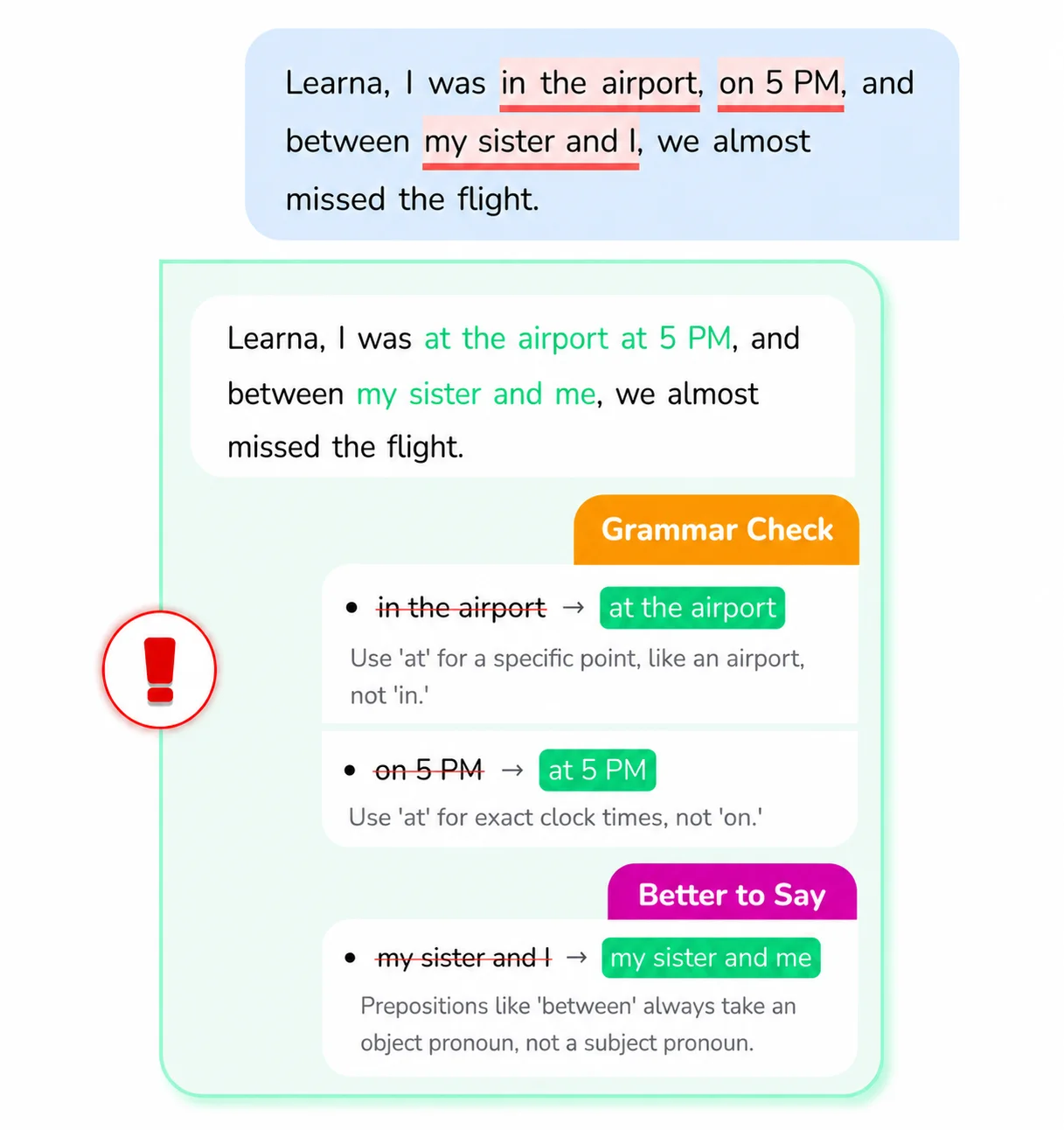
Wrong pronoun case after a preposition is another common slip. Prepositions always take an object pronoun, never a subject pronoun.
How to Identify a Preposition?
If you're unsure whether a word is a preposition, check these signals:
- Is it followed by a noun or pronoun? A preposition needs an object to complete a phrase.
- Does it show place, time, or direction? These are the three most common relationships a preposition expresses.
- Can you ask "where," "when," or "how" and get this word's phrase as the answer? If so, it's likely functioning as a preposition.
- Is it part of a fixed phrasal verb? Words like up in "give up" function differently than a standalone preposition.
Is ___ a Preposition? Quick Answers
Several small, high-frequency words shift categories depending on the sentence.
| Word | Answer |
|---|---|
| since | A preposition of time ("since 2005") or a conjunction introducing a reason ("since you asked"). |
| before | A preposition ("before noon"), a conjunction ("before you go"), or an adverb ("I've seen it before"). |
| but | Usually a conjunction ("I like it, but it's expensive"), though it works as a preposition meaning "except" ("everyone but me"). |
| off | A preposition ("off the table"), an adverb ("turn it off"), or an adjective ("the milk is off"). |
| down | A preposition ("down the street"), an adverb ("sit down"), or an adjective ("feeling down"). |
How Learna AI Teaches Prepositions?
Prepositions are famously idiomatic, meaning the correct choice often depends on a fixed expression rather than a logical rule, which makes them one of the hardest parts of speech to self-correct. Learna AI catches preposition mistakes as you speak and explains the collocation behind the correction, rather than asking you to memorize a list. Learners practicing with Learna report an 88% improvement in natural preposition use after regular conversation practice, since hearing the correct pairing in context builds the instinct faster than a worksheet.
Explore More
Put your grammar knowledge into practice with Learna's learning paths:
Frequently Asked Questions
What is a preposition?

A preposition is a word that shows the relationship between a noun or pronoun and other words in a sentence, usually indicating place, time, or direction.
What are the main types of prepositions?
The main types are prepositions of place, time, direction or movement, and manner, cause, or purpose. Possession, source, and measurement are less common additional types.
What is a prepositional phrase?
A prepositional phrase is a preposition plus its object, the noun or pronoun that follows it, such as "on the table" or "before dinner."
Is it okay to end a sentence with a preposition?
Yes. The rule against it is an outdated myth borrowed from Latin grammar. Restructuring a sentence to avoid it often sounds unnatural.
What is the difference between "in," "on," and "at"?
For time, use at for exact times, on for days and dates, and in for months, years, and seasons. For place, use at for a specific point, on for a surface, and in for an enclosed space.
What is the golden rule of prepositions?
There's no single official rule, but the most useful guideline is to memorize prepositions as part of fixed phrases (like "interested in") rather than trying to translate them literally from another language.
What comes after a preposition?
A preposition is always followed by a noun, pronoun, or noun phrase, known as its object. Pronouns after a preposition always take the object form, like me or them.
How do you identify a preposition in a sentence?
Check whether the word is followed by a noun or pronoun and shows place, time, or direction. If it answers "where," "when," or "how," it's likely a preposition.
What's the difference between a preposition and a phrasal verb?
A phrasal verb combines a verb with a preposition or adverb to create a new meaning, like "give up." The preposition there isn't showing a standalone relationship; it's part of the verb itself.
Can the same word be a preposition and a conjunction?
Yes. Words like since, before, and but function as prepositions when followed by a noun, and as conjunctions when introducing a clause with its own subject and verb.
Does Learna help me memorize which preposition goes with which verb or adjective?
Yes. Learna corrects preposition mistakes in conversation and reinforces fixed pairings like "interested in" through repeated natural use.
Can Learna explain the difference between in, on, and at as I practice?
Yes. When you misuse one of these, Learna explains the specific time or place rule behind the correct choice, right in the moment.