
品詞:副詞
副詞とは、動詞・形容詞・他の副詞、さらには文全体を修飾する語です。どのように、いつ、どこで、どの程度、どのくらいの頻度でといった情報を加えて、文を詳しくします。多くの副詞は-lyで終わりますが(quickly、softly)、そうでないものもたくさんあります(fast、well、always)。このガイドでは、副詞のすべての種類、意味を変えてしまう語順のルール、そして自信のある書き手さえ引っかかる落とし穴である「副詞と形容詞の違い」を取り上げます。
What Is an Adverb?
An adverb gives more detail about how, when, where, to what extent, or how often something happens.
"They waited outside." (where) | "I'm almost finished." (to what extent)
"We rarely eat out." (how often)
What Can an Adverb Modify?
Unlike adjectives, which only describe nouns and pronouns, adverbs can modify four different things.
Describes how or in what manner the action takes place.
Adds intensity, degree, or qualification to an adjective.
Intensifies or clarifies another adverb sitting next to it.
Conveys the speaker's overall attitude toward everything that follows.
Types of Adverbs
Adverbs are grouped by the kind of information they provide.
| Type | Answers | Examples |
|---|---|---|
| Manner | How? | quickly, carefully, loudly |
| Time | When? | now, soon, yesterday |
| Frequency | How often? | always, rarely, never |
| Duration | For how long? | briefly, forever, permanently |
| Place | Where? | here, outside, everywhere |
| Degree | To what extent? | very, almost, extremely |
| Purpose | Why? | therefore, thus, consequently |
| Conjunctive | Connects clauses | however, moreover, meanwhile |
Flat Adverbs: When an Adverb Looks Like an Adjective
Some adverbs keep the exact same form as their adjective counterpart instead of adding -ly. These are called flat adverbs: fast, hard, straight, slow, early, late, well.
A few flat adverbs have an alternate -ly form that's equally correct: slow/slowly, bright/brightly, safe/safely. "Drive safe" and "drive safely" are both acceptable.
Adverbs vs. Adjectives
This is the single most common mix-up involving adverbs, and it almost always happens with linking verbs. Adjectives describe nouns and pronouns. Adverbs describe verbs, adjectives, and other adverbs. The confusion sets in with verbs like feel, look, smell, and sound, which can act as either a linking verb or an action verb.
Degrees of Comparison
Like adjectives, many adverbs show comparison across three degrees.
- Absolute: the base form ("He smiled warmly.").
- Comparative: compares two things, usually formed with more ("He smiled more warmly than the others.").
- Superlative: compares three or more, usually formed with most ("He smiled most warmly of them all.").
Flat adverbs follow the same comparative and superlative pattern as their matching adjective, using -er and -est instead of more/most: "The cheetah runs fastest."
Where Does an Adverb Go?
Placement changes meaning more with adverbs than with almost any other part of speech.
- Modifying a verb: usually goes right before or after it ("He quickly ran" or "He ran quickly").
- Modifying an adjective or adverb: goes directly before the word it modifies ("She is extremely smart").
- With a transitive verb: place the adverb after the object, never between the verb and its object ("They decorated the hall elaborately" — NOT: "decorated elaborately the hall").
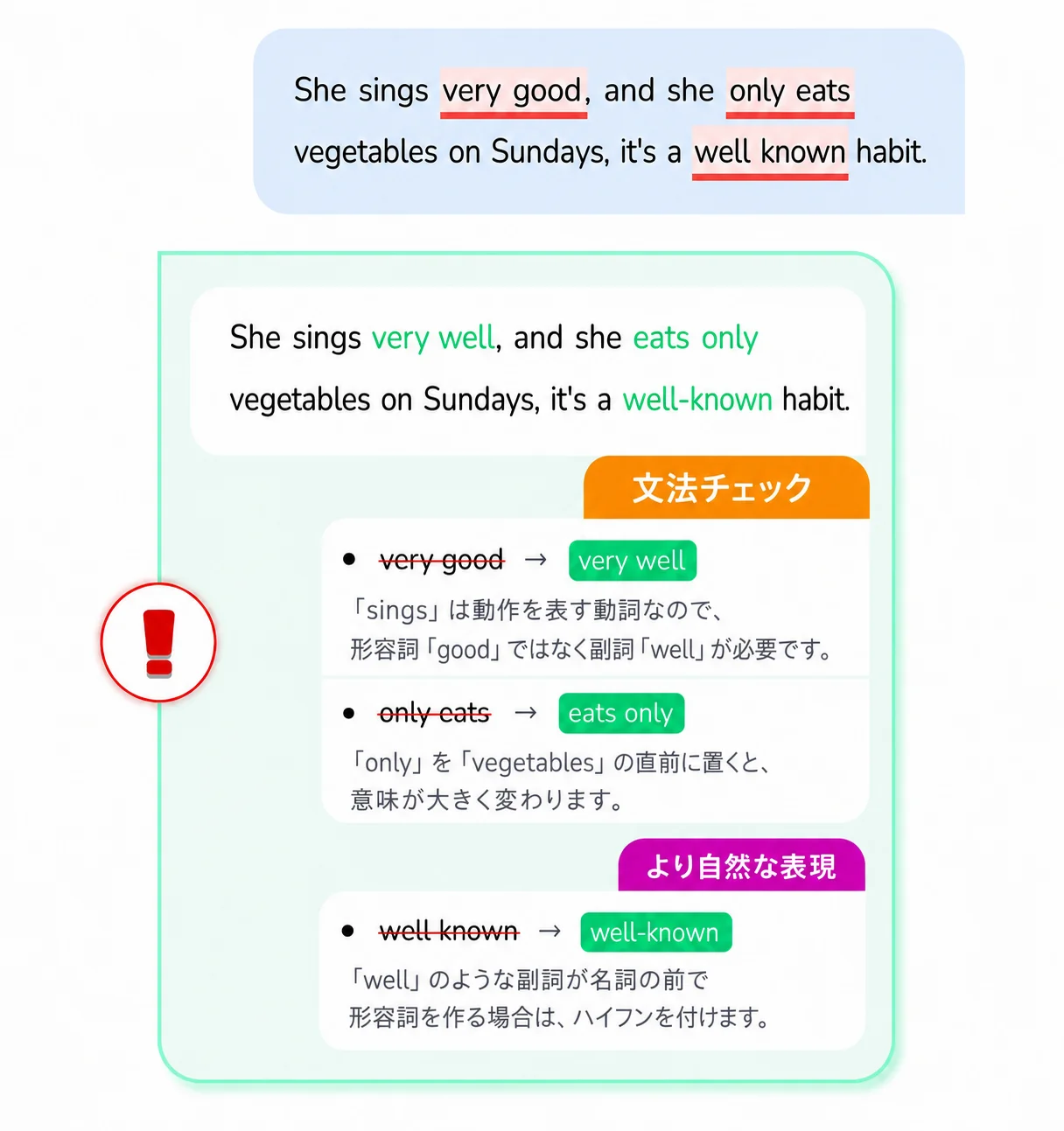
The "only" trap: only is one of the most frequently misplaced words in English, and moving it changes the meaning entirely.
- "Phillip only fed the cat." (all he did was feed it)
- "Phillip fed only the cat." (he fed the cat and nothing else)
A misplaced adverb can also create a squinting modifier, where it's unclear which word it's modifying: "Singing quickly improved his stammer" leaves it ambiguous whether quickly refers to singing or improved.
The Hyphen Rule for Adverbs Before Adjectives
Most -ly adverbs never take a hyphen when modifying an adjective, since there's no risk of confusion: "a happily married couple."
A small number of adverbs that look identical to adjectives, like well and fast, do take a hyphen before the adjective to prevent misreading:
- "A well-known author." (famous, not necessarily in good health)
- "A fast-growing company." (growing quickly)
How to Identify an Adverb?
If you're unsure whether a word is an adverb, check these signals:
- Does it answer how, when, where, why, or to what extent? These are the core adverb questions.
- Can you remove it without breaking the sentence? Most adverbs are optional extra detail, unlike verbs and nouns.
- Does it modify a verb, adjective, or another adverb rather than a noun? If it describes a noun instead, it's an adjective.
- Does it end in -ly? A strong hint, but not proof. Words like friendly and lovely end in -ly and are still adjectives.
Is ___ an Adverb? Quick Answers
Some of the most common words in English shift categories or carry a meaning that isn't obvious from their form.
| Word | Answer |
|---|---|
| fast | Can be either. "A fast car" (adjective) vs. "She runs fast" (adverb, flat form). |
| hardly | An adverb of degree meaning "barely," not "in a hard manner." "I hardly slept" means I slept very little. |
| there | An adverb of place ("I live there"), but functions as a dummy subject in "There is a problem," where it isn't modifying anything. |
| well | Usually an adverb of manner ("sings well"), but an adjective when it means "in good health" ("I am well"). |
| near | Can be an adverb ("come near"), a preposition ("near the station"), or an adjective ("the near future"). |
How Learna AI Teaches Adverbs?
Adverb placement is one of the few grammar rules that can completely flip a sentence's meaning without any word actually being wrong, which makes it especially hard to self-correct. Learna AI catches misplaced adverbs and adjective-adverb mix-ups as you speak, explaining why the position or form matters rather than just marking it wrong. Learners practicing with Learna report a 90% drop in misplaced-modifier mistakes, since hearing the corrected sentence in context builds the right instinct faster than memorizing a rule.
さらに見る
Learna の学習コースで、身につけた文法を実践に活かしましょう:
言語を学ぶ
よくある質問
副詞とは何ですか?

副詞とは、動詞・形容詞・他の副詞、または文全体を修飾し、「どのように」「いつ」「どこで」「どの程度」「どのくらいの頻度で」に答える語です。
副詞の主な種類は何ですか?
主な種類は、様態・時・頻度・継続・場所・程度・目的・接続副詞です。
副詞と形容詞の違いは何ですか?
形容詞は名詞と代名詞を説明し、副詞は動詞・形容詞・他の副詞を説明します。「a fast car」のfastは形容詞ですが、「she runs fast」では副詞です。
副詞はすべて -ly で終わりますか?
いいえ。fast、well、always、never のようによく使う副詞は -ly で終わりません。逆に friendly のような -ly で終わる語が形容詞であることもあります。
平易副詞(flat adverb)とは何ですか?
平易副詞とは、-lyを付けずに対応する形容詞と同じ形のまま使われる副詞のことで、fast、hard、straightなどがあります。
副詞は文のどこに置けばよいですか?
修飾する語のできるだけ近くに置きます。特にonlyのような副詞は、位置を誤ると文全体の意味が変わってしまいます。
接続副詞とは何ですか?
接続副詞は2つの独立した節や文をつなぐ副詞で、however、moreover、thereforeなどがあります。
副詞の比較級はどう作りますか?
ほとんどの副詞はmoreを使って比較級を作りますが(more quickly)、平易副詞は形容詞と同じく-erを付けます(faster)。
文の中で副詞を見分けるにはどうすればよいですか?
「どのように・いつ・どこで・なぜ・どの程度」に答えているか、そして名詞ではなく動詞・形容詞・副詞を修飾しているかを確認しましょう。
形容詞の前でハイフンが必要な副詞があるのはなぜですか?
wellやfastのような副詞は形容詞と同じ形なので、ハイフンを付けることで(well-known)、2つの別々の形容詞ではなく、ひとまとまりの修飾語であることがはっきりします。
話している最中に、Learna は副詞の位置の誤りを直してくれますか?
はい。Learna は「only」の落とし穴のような位置の問題を聞き取り、その語をどこに置くべきか、なぜ意味が変わるのかを示します。
副詞を使いすぎず、自然に使えるように Learna は助けてくれますか?
はい。Learna は文脈に沿って副詞の使い方をフィードバックし、不自然な言い回しや繰り返しを避ける手助けをします。