
Parts of Speech: Adverbs
An adverb is a word that modifies a verb, an adjective, another adverb, or even an entire sentence. It adds detail by answering how, when, where, to what extent, or how often. Many adverbs end in -ly (quickly, softly), but plenty don't (fast, well, always). This guide covers every type of adverb, the placement rules that change meaning, and the trap that catches even confident writers: adverbs vs. adjectives.
What Is an Adverb?
An adverb gives more detail about how, when, where, to what extent, or how often something happens.
"They waited outside." (where) | "I'm almost finished." (to what extent)
"We rarely eat out." (how often)
What Can an Adverb Modify?
Unlike adjectives, which only describe nouns and pronouns, adverbs can modify four different things.
Describes how or in what manner the action takes place.
Adds intensity, degree, or qualification to an adjective.
Intensifies or clarifies another adverb sitting next to it.
Conveys the speaker's overall attitude toward everything that follows.
Types of Adverbs
Adverbs are grouped by the kind of information they provide.
| Type | Answers | Examples |
|---|---|---|
| Manner | How? | quickly, carefully, loudly |
| Time | When? | now, soon, yesterday |
| Frequency | How often? | always, rarely, never |
| Duration | For how long? | briefly, forever, permanently |
| Place | Where? | here, outside, everywhere |
| Degree | To what extent? | very, almost, extremely |
| Purpose | Why? | therefore, thus, consequently |
| Conjunctive | Connects clauses | however, moreover, meanwhile |
Flat Adverbs: When an Adverb Looks Like an Adjective
Some adverbs keep the exact same form as their adjective counterpart instead of adding -ly. These are called flat adverbs: fast, hard, straight, slow, early, late, well.
A few flat adverbs have an alternate -ly form that's equally correct: slow/slowly, bright/brightly, safe/safely. "Drive safe" and "drive safely" are both acceptable.
Adverbs vs. Adjectives
This is the single most common mix-up involving adverbs, and it almost always happens with linking verbs. Adjectives describe nouns and pronouns. Adverbs describe verbs, adjectives, and other adverbs. The confusion sets in with verbs like feel, look, smell, and sound, which can act as either a linking verb or an action verb.
Degrees of Comparison
Like adjectives, many adverbs show comparison across three degrees.
- Absolute: the base form ("He smiled warmly.").
- Comparative: compares two things, usually formed with more ("He smiled more warmly than the others.").
- Superlative: compares three or more, usually formed with most ("He smiled most warmly of them all.").
Flat adverbs follow the same comparative and superlative pattern as their matching adjective, using -er and -est instead of more/most: "The cheetah runs fastest."
Where Does an Adverb Go?
Placement changes meaning more with adverbs than with almost any other part of speech.
- Modifying a verb: usually goes right before or after it ("He quickly ran" or "He ran quickly").
- Modifying an adjective or adverb: goes directly before the word it modifies ("She is extremely smart").
- With a transitive verb: place the adverb after the object, never between the verb and its object ("They decorated the hall elaborately" — NOT: "decorated elaborately the hall").
The "only" trap: only is one of the most frequently misplaced words in English, and moving it changes the meaning entirely.
- "Phillip only fed the cat." (all he did was feed it)
- "Phillip fed only the cat." (he fed the cat and nothing else)
A misplaced adverb can also create a squinting modifier, where it's unclear which word it's modifying: "Singing quickly improved his stammer" leaves it ambiguous whether quickly refers to singing or improved.
The Hyphen Rule for Adverbs Before Adjectives
Most -ly adverbs never take a hyphen when modifying an adjective, since there's no risk of confusion: "a happily married couple."
A small number of adverbs that look identical to adjectives, like well and fast, do take a hyphen before the adjective to prevent misreading:
- "A well-known author." (famous, not necessarily in good health)
- "A fast-growing company." (growing quickly)
How to Identify an Adverb?
If you're unsure whether a word is an adverb, check these signals:
- Does it answer how, when, where, why, or to what extent? These are the core adverb questions.
- Can you remove it without breaking the sentence? Most adverbs are optional extra detail, unlike verbs and nouns.
- Does it modify a verb, adjective, or another adverb rather than a noun? If it describes a noun instead, it's an adjective.
- Does it end in -ly? A strong hint, but not proof. Words like friendly and lovely end in -ly and are still adjectives.
Is ___ an Adverb? Quick Answers
Some of the most common words in English shift categories or carry a meaning that isn't obvious from their form.
| Word | Answer |
|---|---|
| fast | Can be either. "A fast car" (adjective) vs. "She runs fast" (adverb, flat form). |
| hardly | An adverb of degree meaning "barely," not "in a hard manner." "I hardly slept" means I slept very little. |
| there | An adverb of place ("I live there"), but functions as a dummy subject in "There is a problem," where it isn't modifying anything. |
| well | Usually an adverb of manner ("sings well"), but an adjective when it means "in good health" ("I am well"). |
| near | Can be an adverb ("come near"), a preposition ("near the station"), or an adjective ("the near future"). |
How Learna AI Teaches Adverbs?
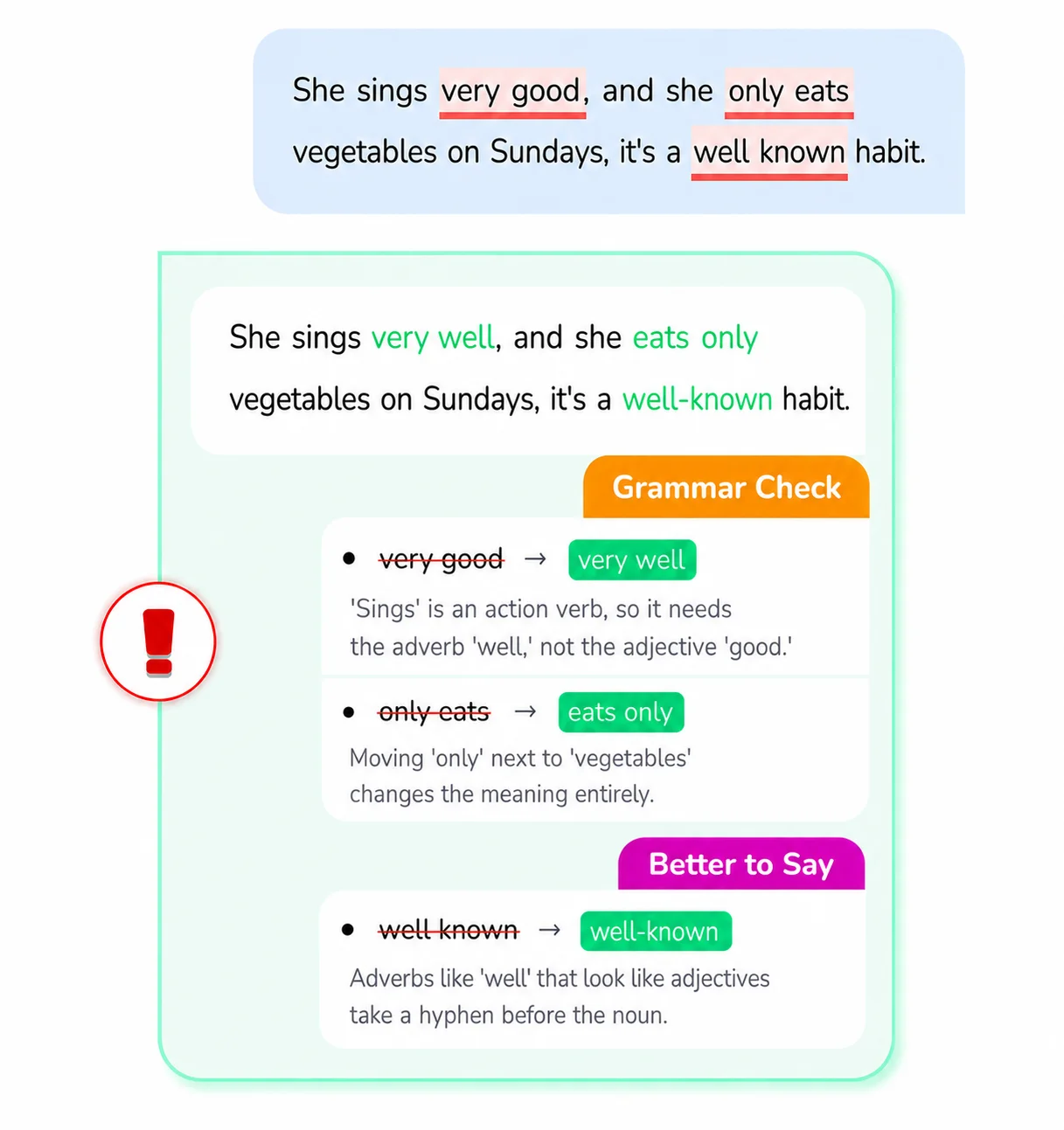
Adverb placement is one of the few grammar rules that can completely flip a sentence's meaning without any word actually being wrong, which makes it especially hard to self-correct. Learna AI catches misplaced adverbs and adjective-adverb mix-ups as you speak, explaining why the position or form matters rather than just marking it wrong. Learners practicing with Learna report a 90% drop in misplaced-modifier mistakes, since hearing the corrected sentence in context builds the right instinct faster than memorizing a rule.
Explore More
Put your grammar knowledge into practice with Learna's learning paths:
Frequently Asked Questions
What is an adverb?

An adverb is a word that modifies a verb, adjective, another adverb, or a whole sentence, answering how, when, where, to what extent, or how often.
What are the main types of adverbs?
The main types are manner, time, frequency, duration, place, degree, purpose, and conjunctive adverbs.
What is the difference between an adverb and an adjective?
Adjectives describe nouns and pronouns. Adverbs describe verbs, adjectives, and other adverbs. In "a fast car," fast is an adjective; in "she runs fast," it's an adverb.
Do all adverbs end in -ly?
No. Common adverbs like fast, well, always, and never don't end in -ly, while some -ly words, like friendly, are actually adjectives.
What is a flat adverb?
A flat adverb keeps the same form as its related adjective instead of adding -ly, such as fast, hard, and straight.
Where should an adverb go in a sentence?
As close as possible to the word it modifies. Misplacing an adverb, especially only, can change the entire meaning of a sentence.
What is a conjunctive adverb?
A conjunctive adverb connects two independent clauses or sentences, such as however, moreover, or therefore.
What is the comparative form of an adverb?
Most adverbs form the comparative with more (more quickly), while flat adverbs use -er like adjectives do (faster).
How do you identify an adverb in a sentence?
Check whether it answers how, when, where, why, or to what extent, and whether it modifies a verb, adjective, or adverb rather than a noun.
Why do some adverbs need a hyphen before an adjective?
Adverbs like well and fast look identical to adjectives, so a hyphen (well-known) makes it clear they're working together as one modifier rather than being read as two separate adjectives.
Will Learna correct misplaced adverbs while I'm speaking?
Yes. Learna listens for placement issues, like the "only" trap, and shows you where the word should go and why it changes the meaning.
Can Learna help me use adverbs more naturally instead of overusing them?
Yes. Learna gives feedback on adverb usage in context, helping you avoid awkward or repetitive phrasing.