
Parts of Speech: Adjectives
An adjective is a word that describes or modifies a noun or pronoun, telling us what kind, how many, or which one. Words like big, red, happy, and fast are all adjectives. This guide covers where adjectives go in a sentence, the comparison rules that trip people up most, and how to tell an adjective apart from an adverb.
What Is an Adjective?
An adjective gives more information about a noun or pronoun. It can describe size, color, shape, quantity, or quality.
Where Adjectives Go in a Sentence
Adjectives can sit in two different positions, and knowing both helps you spot them even when they're not right next to the noun.
- Attributive adjectives sit directly before the noun they describe: "The tall building."
- Predicative adjectives follow a linking verb like is, seem, or feel, connecting back to the subject: "The building is tall."
Most adjectives work in both positions, but a few don't. Main only works attributively ("the main reason", never "the reason is main"), while asleep only works predicatively ("the man is asleep", never "the asleep man").
Comparative & Superlative Adjectives
Adjectives change form to show comparison, and this is where most real mistakes happen.
- Absolute: describes one thing on its own (tall, happy, expensive).
- Comparative: compares two things (taller, happier, more expensive).
- Superlative: compares three or more things, showing the highest degree (tallest, happiest, most expensive).
Formation rules:
| Adjective Length | Comparative | Superlative |
|---|---|---|
| One syllable | add -er (tall → taller) | add -est (tall → tallest) |
| Two syllables ending in -y | replace -y with -ier (happy → happier) | replace -y with -iest (happy → happiest) |
| Two or more syllables (most others) | use more (careful → more careful) | use most (careful → most careful) |
Irregular comparatives and superlatives don't follow any pattern and have to be memorized:
| Absolute | Comparative | Superlative |
|---|---|---|
| good | better | best |
| bad | worse | worst |
| far | farther / further | farthest / furthest |
| little | less | least |
| many / much | more | most |
The Order of Multiple Adjectives
When you stack more than one adjective before a noun, English speakers follow an order almost automatically, even without knowing the rule:
"A lovely (opinion) small (size) old (age) round (shape) brown (color) French (origin) wooden (material) table."
Breaking this order, even while keeping every word grammatically correct, is what makes a phrase sound subtly "off" to a native speaker.
Types of Adjectives
Beyond the basic descriptive adjective, English has several specialized types worth recognizing.
Describe a quality or characteristic. These are the main words used to describe appearance or personality.
Describe an amount, number, or quantity of a noun.
Point directly to a specific noun (used right before a noun).
Show ownership or relationship to a noun.
Formed from a proper noun and are always capitalized.
Look like a verb's -ing or -ed form but function entirely as an adjective.
Compound Adjectives
A compound adjective combines two or more words to act as a single descriptor. The hyphenation rule depends on position:
- Before the noun: hyphenate — "A well-known author."
- After the noun: usually no hyphen — "The author is well known."
- Adverb ending in -ly + adjective: never hyphenate, regardless of position — "A highly respected official."
Adjectives vs. Adverbs
This is the mistake even confident speakers make. Adjectives modify nouns and pronouns; adverbs modify verbs, adjectives, and other adverbs. The confusion usually shows up with linking verbs.
How to Identify an Adjective?
If you're unsure whether a word is an adjective, check these signals:
- Does it describe a noun or pronoun? If it answers what kind, how many, or which one, it's likely an adjective.
- Does it follow a linking verb? Words after is, seem, feel, become that describe the subject are predicative adjectives.
- Can it take -er/-est or pair with more/most? Most true adjectives can be compared this way; verbs and nouns generally can't.
- Would an adverb test fail? If replacing it with an -ly word breaks the sentence's meaning around a noun, you're looking at an adjective, not an adverb.
Is ___ an Adjective? Quick Answers
Some words shift categories depending on how they're used, or only work in one position.
| Word | Answer |
|---|---|
| main | Adjective, but only before a noun ("the main reason"). It can't follow a linking verb. |
| asleep | Adjective, but only after a linking verb ("The man is asleep"). It can't sit before a noun. |
| fast | Can be either an adjective ("a fast car") or an adverb ("she runs fast"). |
| well | Usually an adverb ("sings well"), but an adjective when it means "in good health" ("I am well"). |
| rich | Usually an adjective ("rich people"), but functions as a noun when it describes a group as a whole ("the rich"). |
How Learna AI Teaches Adjectives?
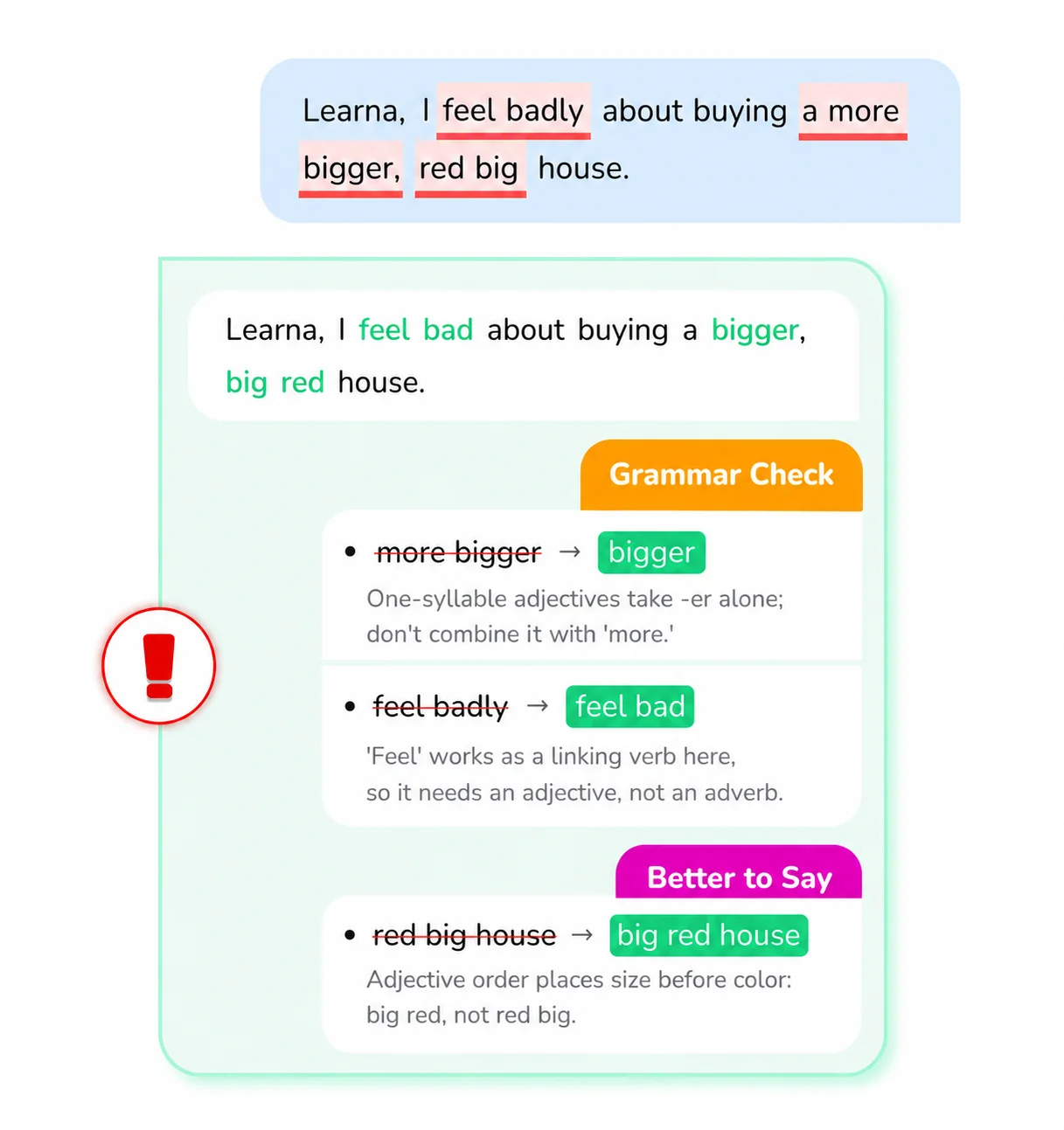
Adjective order and the adjective-versus-adverb trap are two of the most common mistakes learners make even at advanced levels, since they rarely break communication but still sound noticeably off. Learna AI catches these slips mid-conversation and explains the reasoning, rather than just flagging an error. Learners practicing with Learna report a 91% improvement in natural-sounding sentence structure, since hearing the correct adjective order in context builds intuition faster than memorizing the rule.
Explore More
Put your grammar knowledge into practice with Learna's learning paths:
Frequently Asked Questions
What is an adjective?

An adjective is a word that describes or modifies a noun or pronoun, telling us what kind, how many, or which one.
What are examples of adjectives?
Descriptive words like beautiful, smooth, and heavy are adjectives, along with numbers used to describe quantity, like twelve eggs.
What is the difference between comparative and superlative adjectives?
Comparative adjectives compare two things, usually adding -er or more (taller). Superlative adjectives compare three or more things, usually adding -est or most (tallest).
What is the difference between adjectives and adverbs?
Adjectives modify nouns and pronouns. Adverbs modify verbs, adjectives, and other adverbs. In "a fast car," fast is an adjective; in "she runs fast," it's an adverb.
What is a proper adjective?
A proper adjective is formed from a proper noun and is always capitalized, such as French in "French cheese" or Shakespearean in "Shakespearean drama."
How many types of adjectives are there?
Most grammars recognize around 7 main types: descriptive, quantitative, demonstrative, possessive, proper, participial, and compound adjectives. Some sources list more by splitting these further.
What order do adjectives go in?
English generally follows this order: opinion, size, age, shape, color, origin, and material. Native speakers usually follow it automatically without memorizing the rule.
How do you identify an adjective in a sentence?
Check whether the word describes a noun or pronoun, follows a linking verb, or can take -er/-est endings. If it answers "what kind" or "how many," it's likely an adjective.
Are numbers adjectives?
Yes. Numbers used to describe quantity, like three in "three apples," function as quantitative adjectives.
Does Learna catch the difference between adjectives and adverbs in conversation?
Yes. Learna flags mix-ups like "feel bad" versus "feel badly," explaining why a linking verb calls for an adjective.
Can Learna help me get adjective order right without memorizing the rule?
Yes. Learna corrects adjective order mistakes as you speak, letting you absorb the pattern through repeated, natural correction.