
What the Grand Départ Actually Means?
The Grand Départ is the official opening stage of the Tour de France. In French, the phrase means simply "the big start," and it functions both as the ceremonial launch of the race and the first competitive stage. The city that hosts it bids for the privilege, pays a significant fee to race organiser Amaury Sport Organisation, and spends months preparing for the arrival of teams, media, and hundreds of thousands of spectators.
The Grand Départ rotates between locations each year. It has been held in cities across France and in a long list of countries including the United Kingdom, Denmark, the Netherlands, Spain, Belgium, and Ireland. In 2026, the race begins in Barcelona, Spain, with a team time trial as the opening stage. In 2027, the Grand Départ moves to Edinburgh in the United Kingdom.
Hosting the Grand Départ is considered a major economic and cultural event. The city gains international exposure, and the race typically generates significant visitor spending in the region. For the riders, it is the moment months of preparation finally becomes competition.
A Race That Belongs to the World
The Tour de France was first organised in 1903 to sell copies of a French sports newspaper. Today it is something far larger. The race has completed 112 editions and typically features 20 to 23 teams from across the world. Riders compete under flags from Slovenia, the United Kingdom, Denmark, Belgium, Colombia, Australia, and many more nations.
The current era of the race has been defined by Tadej Pogačar of Slovenia, who won in 2020, 2021, 2024, and 2025, becoming one of only a handful of riders to claim four titles. His victories follow a long line of international champions that includes Miguel Induráin of Spain, Greg LeMond of the United States, and Chris Froome of Great Britain.
Twenty-one stages are raced over 23 to 24 days, covering approximately 3,500 kilometres in total. The course changes each year, alternating between clockwise and counterclockwise circuits of France and regularly crossing into neighbouring countries. Throughout it all, the race retains its French identity in its terminology, its culture, and its calendar.
The French Words Every Tour Follower Learns Without Realising
One of the quieter effects of following the Tour de France is that you absorb French vocabulary without intending to. The race has introduced a specific set of French terms to global sports broadcasting, and they appear in every English-language commentary, article, and social media post about the race.
Here are the most important ones, with their meanings and a usage example for each:
Peloton: the main group of riders: "The breakaway gained four minutes on the peloton before being caught on the final climb."
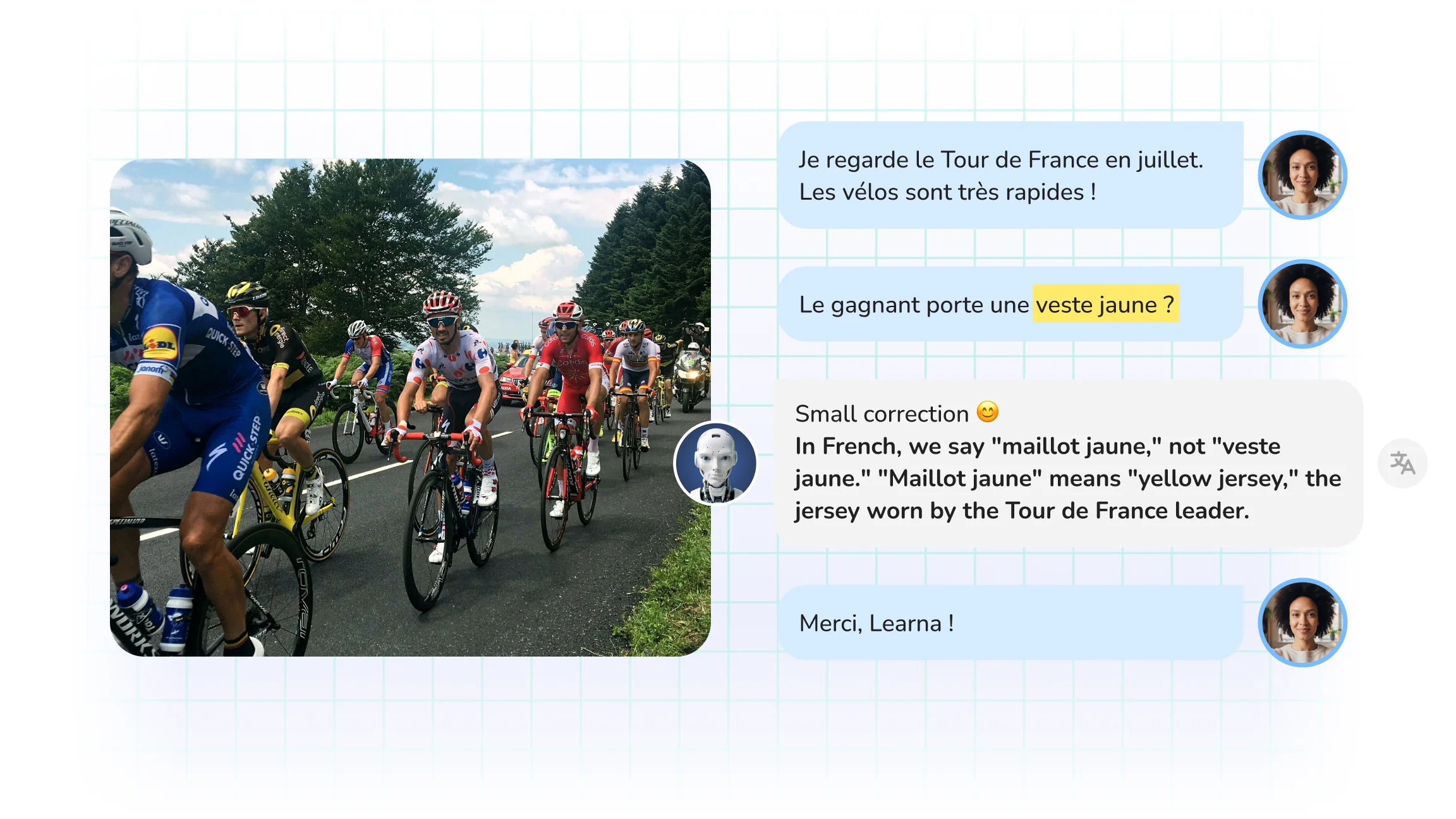
Maillot jaune: the yellow jersey worn by the overall race leader: "Pogačar pulled on the maillot jaune after winning the opening time trial."
Étape: a stage of the race: "The sixteenth étape crossed three mountain passes before finishing at altitude."
Domestique: a rider who works in support of a team leader rather than competing for individual glory: "The domestiques rode at the front of the peloton to control the pace and protect their leader."
Lanterne rouge: the last-placed rider in the general classification, literally "the red lantern": "Finishing as the lanterne rouge still means completing one of the most demanding races in sport."
Hors catégorie: the highest category of mountain climb, meaning "beyond category": "The Col du Galibier is rated hors catégorie and is one of the most feared ascents in the race."
Peloton alone has crossed fully into English. You will hear it used in fitness contexts, in business language, and in everyday conversation to describe any tight moving group. Learning where these words come from gives you a richer understanding of both languages.
Why Following the Tour Is Good for Your Language Learning?
Sport is one of the most effective contexts for incidental language learning. When you follow an event you genuinely care about, you encounter vocabulary repeatedly, in meaningful situations, without the effort feeling like study. The Tour de France offers this in concentrated form.
English language coverage of the race is extensive. Broadcasters, podcasts, written journalism, and social media provide hours of authentic English input across the three weeks of racing. You hear the same specialist terms used correctly in context, you follow complex tactical discussions, and you encounter a wide range of accents and registers from formal broadcast commentary to rider interviews conducted in a second or third language.
The race also introduces cultural vocabulary that extends beyond cycling. Stage towns, mountain passes, and finish-line cities each carry their own cultural references. Understanding them deepens your command of the language as it is actually used by educated native speakers discussing European culture and geography.
For learners of French, the Tour provides something rarer: exposure to French terms being used by English speakers in an English-language context. You hear the correct pronunciation modelled by broadcasters, you see the terms written and defined, and you understand them through the context of the action on screen. This is how vocabulary becomes natural rather than memorised.
Practice the Language of the Tour with Learna AI
The Tour de France is a reminder that language and culture are inseparable. Every term the race has given to English carries a piece of French history and sporting identity with it. Learna AI helps you take that kind of real-world vocabulary and turn it into speaking confidence, through conversation practice built around topics and scenarios that feel relevant to your actual life. When you describe a news event, discuss a cultural phenomenon, or explain a concept you have just encountered, you develop the kind of fluent, contextual English that comes from using the language rather than memorising it. Consistent practice with Learna AI on topics like these builds vocabulary that stays with you.
