
Tools for Building Daily Vocabulary Habits
Duolingo is built around short, gamified lessons that take a few minutes a day, which makes it easy to build a daily habit even if you only have a small window of free time. Its strength is repetition: the app resurfaces words and phrases at intervals designed to keep them in your memory, and streak tracking gives many learners a reason to keep coming back.
Busuu takes a similar bite-sized approach but adds structured units organized around real-life topics like ordering food or making small talk. It also includes a community feature where native speakers can review short writing exercises you submit, which is useful for catching mistakes that an app alone wouldn't flag. Both tools are strongest for building vocabulary recognition and basic sentence patterns, not for producing spoken language under pressure.
Tools for Understanding How a Language Works
Language Transfer takes a completely different approach from app-based drilling. It's a free audio course that walks you through the logic of a language step by step, explaining why sentences are built the way they are instead of asking you to memorize phrases without context.
This matters because many learners can recite vocabulary lists but still struggle to construct an original sentence on the spot. Language Transfer's method of reasoning through grammar out loud helps close that gap, particularly for learners who want to understand the underlying structure of a language rather than just recognize set phrases.
Tools for Reading and Long-Term Vocabulary Retention
Anki is a spaced-repetition flashcard system, and it remains one of the most effective tools for long-term vocabulary retention because it schedules reviews right before you're likely to forget a word, rather than reviewing everything equally. It requires more manual setup than most apps, but that flexibility is also its advantage: you can build decks around exactly the vocabulary you're struggling with.
Beelinguapp takes a different angle by pairing audio with side-by-side text in your target language and your native language, so you can read and listen at the same time. This dual-text format is particularly useful for building reading fluency and picking up natural sentence rhythm, something flashcards alone don't teach.
How Learna Supports Real Speaking Practice?
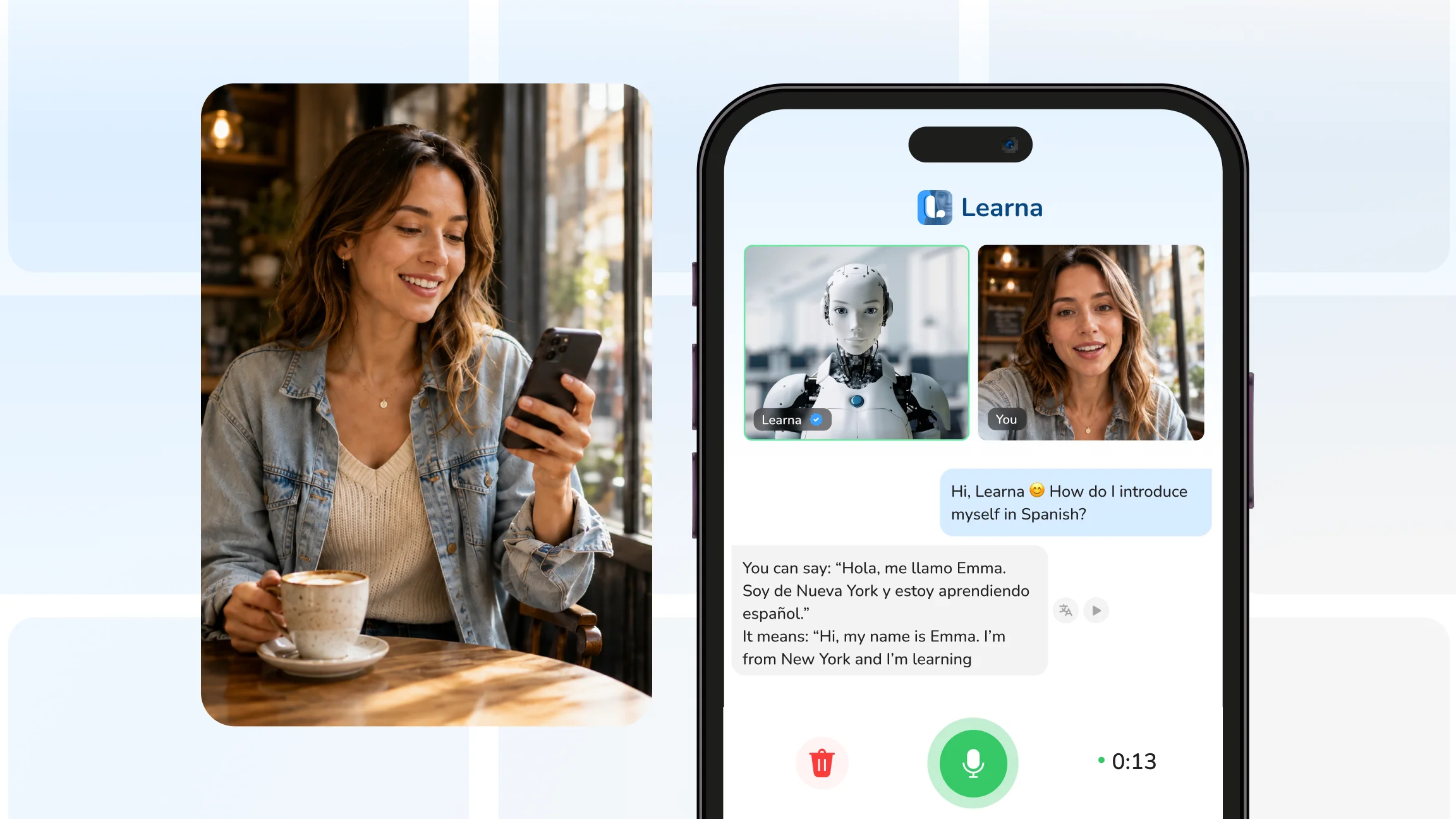
Every tool above is genuinely useful, and none of them is designed to get you talking. Vocabulary apps build recognition, audio courses explain structure, and flashcards build retention, but speaking a language under real conversational pressure is a different skill that only develops through practice, and that's the gap Learna's AI English tutor is built to close.
Learna works as a conversational AI tutor: instead of static lessons, you have an actual spoken exchange, and the system listens as you speak, not just as you type. When you mispronounce a word or use the wrong verb tense, Learna corrects it in the moment and explains why, drawing on the same rules covered in Learna's grammar reference, so the correction happens while the mistake is still fresh instead of days later in a review session.
Roleplay scenarios are where this becomes most practical. You can rehearse ordering food, handling a Business English meeting, or navigating everyday small talk, and the conversation adapts based on how you actually respond rather than following a fixed script.
If your goal is consistent, low-pressure conversation practice, Learna's Daily Life English track is built specifically for that kind of everyday exchange. Learners packing for a trip instead can rehearse the same kind of scenario in the Travel English track, covering situational phrases a flashcard deck won't teach, like asking for directions or checking into a hotel.
The difficulty also adjusts automatically. If you're breezing through basic exchanges, the system introduces more complex phrasing and follow-up questions; if you're struggling with a particular structure, it resurfaces that pattern in new contexts until it sticks.
None of this replaces the tools above, it completes them. Vocabulary apps and flashcards give you the raw material, and Learna gives you a place to put it into practice out loud, with feedback you'd otherwise only get from a private tutor.
Free tools each solve one piece of language learning, but speaking confidently requires practicing out loud with real feedback, which is exactly the gap Learna's conversational AI tutor is built to fill for learners at any stage.
