
Everything You Need to Know About the 2026 World Cup
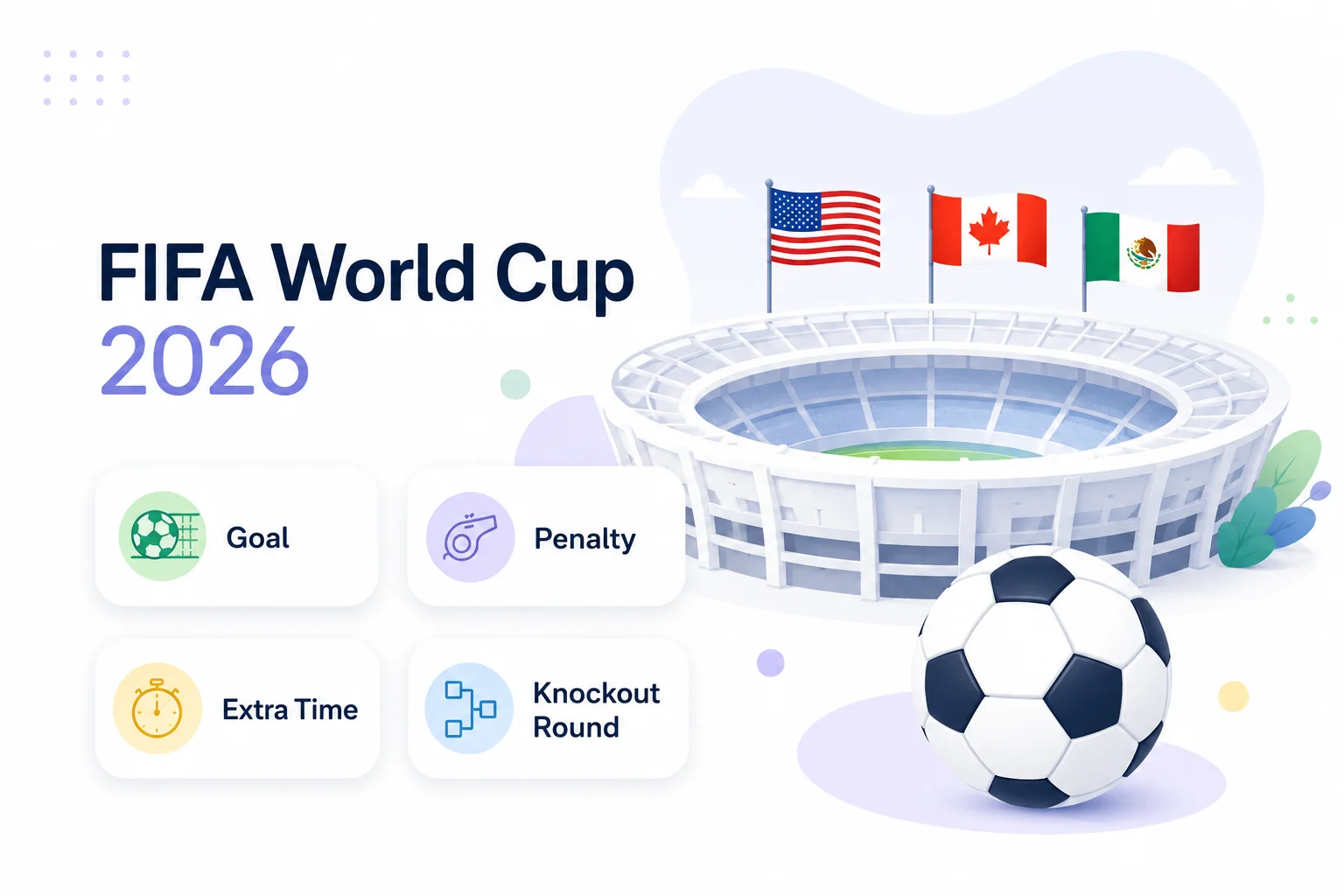
The 2026 FIFA World Cup is the largest edition of the tournament in history. For the first time, 48 national teams are competing, up from the 32 teams that participated in previous editions. The expanded format means 104 matches in total, spread across 16 host cities in three countries.
In the United States, matches are being played in cities including New York, Los Angeles, Dallas, Miami, and Seattle. Canada is hosting games in Toronto and Vancouver, while Mexico is contributing venues in Mexico City, Guadalajara, and Monterrey. The final will take place at MetLife Stadium in East Rutherford, New Jersey, on July 19, 2026.
The tournament follows a group stage format followed by knockout rounds. In the group stage, teams are placed into groups of three, with the top two teams from each group advancing. From there, the competition moves through the Round of 32, Round of 16, quarterfinals, semifinals, and the final.
Key Football Terms You Will Hear During the World Cup
Understanding football vocabulary in English makes it much easier to follow live commentary, read match reports, and join conversations with other fans. The following terms appear frequently across broadcasts and sports news coverage.
Goalkeeper: the player whose role is to stop the ball from entering the net. Example: "The goalkeeper made three crucial saves to keep his team in the match."
Striker: an attacking player whose primary responsibility is to score goals. Example: "The striker scored twice in the second half to lead his country to victory."
Penalty: a direct free kick taken from the penalty spot, awarded when a foul is committed inside the penalty area. Example: "The referee awarded a penalty after the defender handled the ball."
Group stage: the opening phase of the tournament where teams are divided into groups and play a set number of matches. Example: "Four teams were eliminated during the group stage before the knockout rounds began."
Knockout round: a phase of the tournament where the losing team is eliminated immediately. Example: "Every match in the knockout round is decisive because there are no second chances."
Extra time: two additional 15 minute periods played when a knockout match ends level after 90 minutes. Example: "Neither team scored during extra time, so the match was decided by a penalty shootout."
Hat-trick: when a single player scores three goals in one match. Example: "The forward completed a hat-trick in the final 20 minutes of the game."
Offside: a rule that prevents attacking players from positioning themselves ahead of the last defender when the ball is played to them. Example: "The goal was disallowed because the striker was in an offside position."
Corner kick: a method of restarting play awarded when the ball crosses the goal line last touched by a defending player. Example: "The team scored directly from a corner kick in the opening minute."
Clean sheet: a result in which a goalkeeper or team concedes no goals during a match. Example: "The defense kept a clean sheet in three consecutive group stage matches."
How to Talk About the World Cup in English?
Discussing football in English becomes natural once a few core expressions are in place. The phrases below cover the most common conversation topics: supporting a team, making predictions, and reacting to results.
Talking about your team:
"I support [country]. They have a strong chance of going far in the tournament."
"My team made it through the group stage without losing a single match."
Making predictions:
"I think [country] will win the World Cup this year because of their midfield."
"It is hard to predict the winner when there are so many strong teams in the competition."
Reacting to results:
"That was a completely unexpected result. Nobody saw that coming."
"The match ended in a draw, so both teams advance on points."
"They lost on penalties after a goalless draw, it was heartbreaking to watch."
Talking about players:
"He is the standout player of this tournament."
"Her performances in the group stage were some of the best at the World Cup."
"The captain has been in exceptional form throughout the competition."
Describing a match:
"It was a tense game from start to finish."
"The first half was slow, but the second half had four goals in 20 minutes."
"The winning goal came in stoppage time at the end of the match."
These expressions can be used in conversations with colleagues, classmates, and fellow fans. Practicing them in real situations helps build fluency far more quickly than memorizing vocabulary lists alone. Learners who want to expand beyond sports vocabulary can also explore everyday expressions through daily life English.
Why Is Everyone Talking About the 2026 World Cup?
Several factors are making the 2026 tournament stand out from all previous editions.
The most significant change is the expansion to 48 teams. This means that nations that had never qualified for the World Cup before are now competing on the global stage for the first time. Fans from more countries than ever before have a reason to follow the tournament closely.
The three country hosting arrangement is also generating considerable attention. Supporters are traveling across borders to attend matches, and the sheer geographic scale of the tournament is unlike anything in World Cup history.
Ticket demand has been exceptionally high since the draw was announced. Matches in major cities sold out within hours of going on sale, and secondary market prices have reflected the level of interest worldwide.
From a playing perspective, the tournament features several of the world's most watched footballers, all competing at the peak of their careers. Performances in tournaments of this scale define legacies, and the expanded format gives more players and teams the chance to make their mark on the competition. Fans following matches across three countries may also find it useful to build their travel English alongside football vocabulary.
Practice Speaking About Sports in English
Sports conversations are one of the most effective contexts for building spoken English skills. Discussing football involves expressing opinions, making comparisons, narrating events, and reacting to outcomes all of which are core speaking competencies that transfer directly to other areas of communication.
A few conversation prompts to practice independently:
"Which team do you think will win the 2026 FIFA World Cup, and why?"
"Describe the best match you have watched during the tournament."
"What football vocabulary did you learn during the World Cup?"
Learna AI includes speaking exercises and roleplay scenarios built around real world topics, including sports, current events, and everyday conversations. Learners can practice discussing match results, using football vocabulary in context, and building the kind of fluent, natural speech that comes from talking about topics they genuinely follow. Consistent practice with topics that hold personal interest accelerates both vocabulary retention and speaking confidence.
Start for free and practice English through real conversations about sports and current events with Learna AI.
