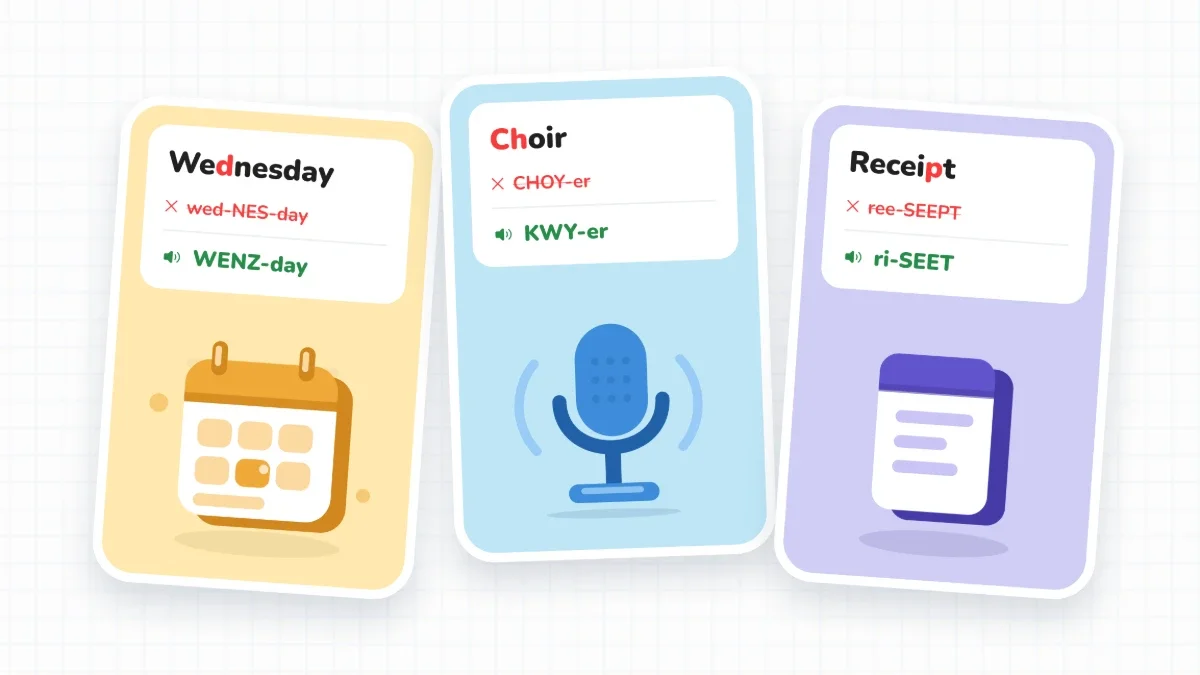
These commonly mispronounced words highlight a few patterns that come up again and again: silent consonants, shortened syllables, unusual spellings, and misplaced stress. They are useful pronunciation mistakes examples because the same approach can help with many similar words.
When learning tricky English words, do not depend only on the spelling. Listen to the whole word, notice which syllable is stressed, and repeat it in a complete sentence. A word is much easier to remember when you can picture yourself using it in a real conversation.
Silent Letters That Trip Up Learners
A silent letter appears in the spelling but is not pronounced. In answer, the w is silent, so the word sounds like “AN ser.” In honest, the h is silent, meaning the word begins with a vowel sound. That is why we say “an honest person,” not “a honest person.”
The s in island is silent, while the first d in Wednesday is not normally pronounced. Similar patterns appear in listen, castle, knee, write, lamb, and receipt. When you read aloud, it is easy to see the letter and accidentally add a sound that native speakers do not use.
One simple practice method is to cross out the silent letter in a written copy of the word. Then say the word slowly without adding that sound. Finally, use it at normal speed in a short sentence. This helps connect the spelling you see with the pronunciation you need.
How Can You Fix Your Own Pronunciation Mistakes?
Helpful pronunciation mistakes and solutions start with careful listening. Choose a short clip from a clear speaker, listen to one sentence, and repeat it while copying the rhythm, stress, and pauses. This is known as shadowing. It helps you practise how English sounds in real speech, not just as individual words.
Recording yourself can also be revealing. Read a sentence that includes one of the words commonly mispronounced, then compare your recording with a reliable model. Listen for one difference at a time, such as a missing final consonant, a vowel sound, or the wrong syllable stress.
Minimal pairs are useful when similar sounds change a word’s meaning. Practise pairs such as ship and sheep, rice and lice, or fan and van. Say each word on its own first, then put it into a sentence.
These English pronunciation tips are most useful when you practise in short, regular sessions:
Practise one sound or two words at a time.
Mark the stressed syllable before reading aloud.
Repeat each corrected word in three different sentences.
Record the same sentence again after making a correction.
Use new vocabulary during Business English practice, including meetings, presentations, and professional introductions.
If you are learning how to improve English pronunciation, focus on accuracy before speed. Speaking slowly gives your mouth time to learn a new movement. Speed usually comes later, once the sound feels familiar.
Learna supports pronunciation practice through realistic conversations and real-time feedback. It can point out unclear pronunciation and suggest corrections while the word is still fresh, helping you build stronger speaking habits over time.