
What Is the IELTS Speaking Test Format?
The IELTS Speaking test has three parts and lasts 11 to 14 minutes. It is a recorded, face-to-face conversation with an examiner, and it is the same in both IELTS Academic and IELTS General Training.
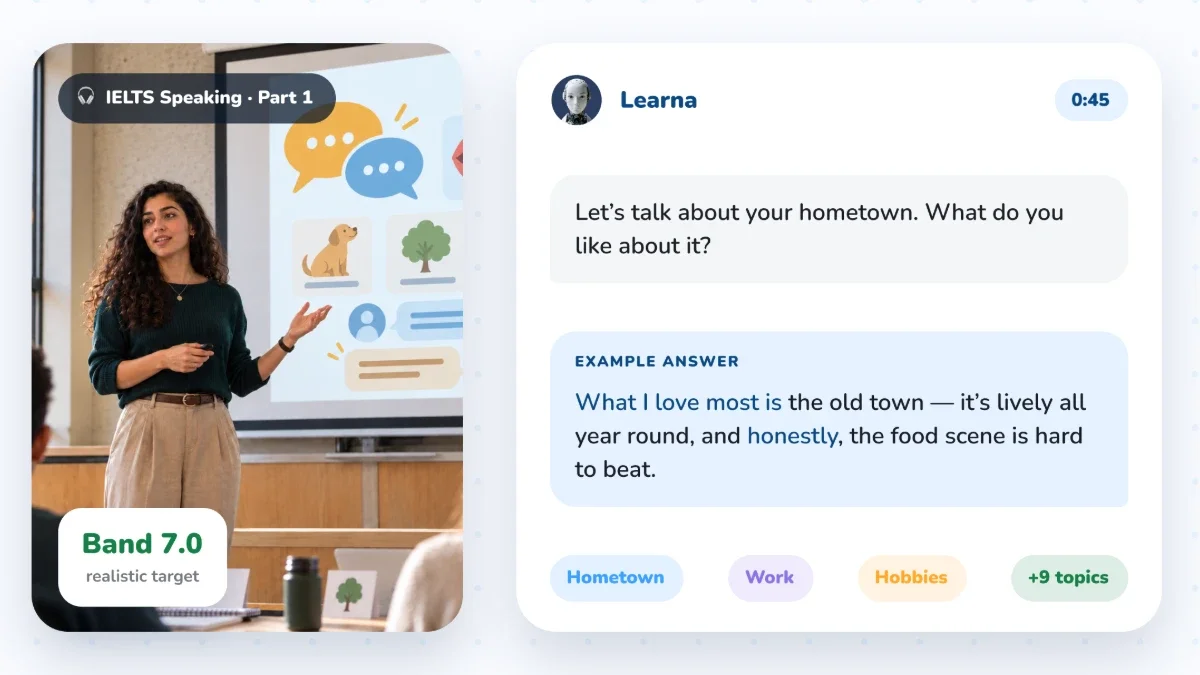
The IELTS Speaking test has three parts and lasts 11 to 14 minutes. It is a recorded, face-to-face conversation with an examiner, and it is the same in both IELTS Academic and IELTS General Training.
| Part | Duration | What happens |
|---|---|---|
| Part 1 | 4 to 5 minutes | Short questions about familiar subjects such as your hometown, studies, work, interests or daily routine. |
| Part 2 | 3 to 4 minutes | You receive a cue card, prepare for one minute, then speak for up to two minutes. |
| Part 3 | 4 to 5 minutes | A broader discussion linked to the Part 2 topic, where you explain, compare and evaluate ideas. |
Your performance is assessed against four criteria, and each one carries equal weight in your final band score.
| Criterion | What the examiner listens for |
|---|---|
| Fluency and coherence | Speaking at length without long pauses and linking ideas in a logical order. |
| Lexical resource | Topic vocabulary used accurately, plus the ability to paraphrase when you are missing a word. |
| Grammatical range and accuracy | A mix of simple and complex sentences, with errors that rarely affect meaning. |
| Pronunciation | Clear sounds, natural word stress and intonation that make you easy to understand. |
Because all four criteria count equally, a balanced IELTS and TOEFL Tutor practice plan works better than memorising long vocabulary lists. Strong answers come from combining clear ideas, flexible grammar and natural delivery.
Part 1 usually opens with questions about your work or studies, your hometown or your home, then moves on to two other everyday topics. Part 2 and Part 3 use the same pool of themes but ask you to describe experiences and discuss wider issues. The table below shows how each common topic typically appears across the test.
| Topic | Typical Part 1 question | Typical Part 2 cue card | Typical Part 3 angle |
|---|---|---|---|
| Work | Do you enjoy your job? | Describe a job you would like to do in the future. | Should salaries reflect how useful a job is to society? |
| Studies | Why did you choose your subject? | Describe a course you found useful. | Should university education be free? |
| Hometown | What is your hometown known for? | Describe a place in your city you like to visit. | Why do people move from villages to cities? |
| Home and accommodation | Do you live in a house or an apartment? | Describe your ideal home. | Why are housing costs rising in many cities? |
| Family | Do you spend much time with your family? | Describe a family member you admire. | How have family roles changed over time? |
| Friends | How often do you see your friends? | Describe a childhood friend. | Can social media replace face-to-face friendship? |
| Daily routine | What is the busiest part of your day? | Describe a typical day you enjoy. | Do people today have less free time than before? |
| Hobbies | What do you do in your free time? | Describe a hobby you started recently. | Should schools teach practical hobbies? |
| Sport and exercise | Do you play any sports? | Describe a sport you would like to try. | Should governments spend more on public sports facilities? |
| Food and cooking | Do you like cooking? | Describe a meal you remember well. | How has fast food changed eating habits? |
| Health | What do you do to stay healthy? | Describe a time you changed a habit. | Who is more responsible for public health, individuals or governments? |
| Shopping | Do you prefer shopping online or in stores? | Describe something you bought and were happy with. | Is consumer culture harmful? |
| Clothes and fashion | What kind of clothes do you usually wear? | Describe an item of clothing that is special to you. | Why do some people follow fashion trends closely? |
| Music | What kind of music do you like? | Describe a song that means a lot to you. | Should music be a compulsory school subject? |
| Films and TV | How often do you watch films? | Describe a film that made an impression on you. | Have streaming services changed how people watch films? |
| Books and reading | Do you read more on paper or on screens? | Describe a book you would recommend. | Will printed books disappear? |
| Art | Did you enjoy art lessons at school? | Describe a piece of art you like. | Should governments fund museums and galleries? |
| Technology | Which app do you use most? | Describe a piece of technology you find useful. | Does technology make people less social? |
| Social media | How much time do you spend on social media? | Describe an online video that interested you. | Should social media companies control what users share? |
| Travel and holidays | Where did you go on your last holiday? | Describe a journey you remember well. | Does tourism always benefit local communities? |
| Transport | How do you usually get to work or school? | Describe a trip on public transport. | Should cities limit private cars? |
| Environment | Do you recycle at home? | Describe a time you helped protect the environment. | Should businesses pay for the pollution they cause? |
| Weather | What is your favourite type of weather? | Describe a day when the weather affected your plans. | How does climate change affect daily life? |
| Animals and pets | Did you have pets as a child? | Describe an animal you find interesting. | Is it right to keep animals in zoos? |
| Celebrations | What is the most important festival in your country? | Describe a celebration you enjoyed. | Are traditional celebrations losing their meaning? |
| Childhood | What did you enjoy doing as a child? | Describe a happy childhood memory. | Do children today have better lives than past generations? |
| People you admire | Who did you look up to as a child? | Describe a person who has influenced you. | What makes someone a good role model? |
| Learning languages | Are you learning any other languages? | Describe a skill that took you a long time to learn. | Is learning foreign languages still necessary when translation apps exist? |
| Neighbours and community | Do you know your neighbours well? | Describe a helpful neighbour. | Why do people know their neighbours less than before? |
| Future plans | Where do you see yourself in five years? | Describe a goal you want to achieve. | Should young people plan their careers early? |
Lists labelled IELTS Speaking topics 2026 can help you spot recent trends, but no public list can guarantee the exact questions in your test. Use the table to cover every major theme, then practise answering in your own words.
In the real test, Part 3 builds directly on your Part 2 topic. Practising each theme as a full chain prepares you for how the conversation actually develops. The four chains below move from short personal answers to a full cue card and then to broader discussion.
Part 1: Where is your hometown?
My hometown is a medium-sized coastal city in the south of my country. It is known for its long promenade and relaxed atmosphere. Although the city has become busier in recent years, it still feels peaceful outside the main tourist season.
Part 1: What do you like most about your hometown?
I especially like having easy access to the sea. After a long day, I can walk along the coast and clear my mind. The city also has several small restaurants serving fresh local food, which gives the area a strong sense of identity.
Part 2 cue card: Describe a place in your city you like to visit.
You should say:
where it is
how often you go there
what you do there
and explain why you like it
Sample answer:
The place I'd like to talk about is a small park on a hill near the old part of my city. It isn't famous, so most tourists never find it, which is partly why I like it so much.
I usually go there once or twice a week, often in the early evening after classes. It takes about fifteen minutes to walk there from my apartment, and the last part of the route is quite steep, so I always arrive a little out of breath.
There isn't much to do there in a conventional sense. There are a few benches, an old tea garden and a wide view over the rooftops towards the sea. Sometimes I bring a book, but more often I just sit with a cup of tea and watch the city lights come on. At weekends I occasionally meet friends there, and we end up talking for hours.
I think I like it because it gives me a sense of distance from my daily routine without having to travel anywhere. When I'm stressed about deadlines, half an hour up there helps me put things into perspective. It's also one of the few places in the city that hasn't changed since I was a child.
Part 3: Why do people move from villages to cities?
Mainly for work and education. Cities tend to offer a wider range of jobs and universities, and young people in particular may feel their options are limited in rural areas. That said, the trend isn't one-directional. Since remote work became more common, some families have moved back to smaller towns for lower living costs and a quieter lifestyle.
Part 3: Should cities protect old buildings or replace them?
I think the most valuable historic buildings should be protected because they give a city its character and attract visitors. However, protecting every old structure isn't realistic, especially when cities need more housing. A sensible approach might be to preserve key landmarks while allowing modern development around them.
Part 1: What do you study?
I study business administration at university, with a particular interest in marketing. I chose the subject because it combines analysis with creativity. I also enjoy group projects because they teach me how to explain ideas clearly and listen to different opinions.
Part 1: Do you prefer studying alone or with others?
It depends on the task. For memorising definitions or revising for an exam, I prefer to study alone because I can work at my own pace. For projects, though, I find group study more productive, since other people often notice things I've missed.
Questions about your studies often lead to themes such as presentations, research and campus life. Building Academic English vocabulary makes it easier to discuss these topics with precision instead of repeating general words like "good" or "interesting".
Part 2 cue card: Describe a course you found useful.
You should say:
what the course was
when you took it
what you learned
and explain why it was useful
Sample answer:
I'd like to talk about a short data analysis course I took during my second year at university. It was an optional six-week course, and to be honest I only signed up because a friend persuaded me to.
The classes were held on Saturday mornings, which wasn't ideal, but the instructor made the sessions very practical. Instead of long lectures, we worked with real data sets from local businesses and learned how to clean the data, build simple charts and explain what the numbers actually meant. By the final week, each of us had to present a short analysis to the group.
The technical skills were useful, of course, but the biggest benefit was learning how to explain data to people who aren't experts. Before the course, I tended to fill presentations with figures. Afterwards, I started focusing on the one or two findings that really mattered.
Looking back, it was useful because it changed the way I approach almost every project. I use what I learned in my main courses, in my internship and even when I'm comparing prices before a big purchase. It's a good example of how a small decision can have a lasting effect.
Part 3: Should university education be free?
There's a strong argument for it, because free education gives talented students from low-income families the same opportunities as everyone else. On the other hand, someone has to pay, and that usually means higher taxes. A middle ground that many countries use is lower tuition combined with grants for students who need financial support.
Part 3: Will AI change the skills people need for work?
Almost certainly. As AI tools take over routine tasks such as drafting simple reports or sorting data, employers will probably value skills that are harder to automate, like judgement, communication and creativity. I don't think this means everyone needs to become a programmer, but people will need to understand how to work alongside these tools effectively.
Part 1: Do you use technology for your studies?
Yes, I use technology every day to access articles, organise notes and communicate with classmates. Digital tools save time when I am working on a shared project. However, I sometimes turn off notifications because they can break my concentration.
Part 1: Which app do you use most?
Probably a note-taking app. I use it for everything from lecture notes to shopping lists, and because it syncs across my phone and laptop, I never lose track of anything. I've tried a few alternatives, but I always come back to it because it's so simple.
Part 2 cue card: Describe a piece of technology you find useful.
You should say:
what it is
when you started using it
how you use it
and explain why it is useful to you
Sample answer:
The piece of technology I'd like to describe is a pair of noise-cancelling headphones that I bought about two years ago, just before I started commuting to university by bus.
At first, I bought them mainly for listening to music, but I soon realised they were far more useful than that. My commute takes around forty minutes each way, and the buses are often crowded and noisy. With the noise cancellation switched on, I can actually concentrate, so I use the journey to listen to podcasts, review my notes or simply rest.
I also use them at home when I'm studying, because I share an apartment and it can get quite loud in the evenings. Sometimes I don't even play anything through them. I just switch on the noise cancellation, and the silence helps me focus.
The main reason they're so useful is that they turn wasted time into productive time. If I add up all the hours I've spent on buses over the past two years, being able to use that time properly has made a real difference to my studies. They weren't cheap, but I'd say they were one of the best purchases I've made.
Part 3: Does technology make people less social?
In some ways, yes. You often see groups of friends sitting together while everyone looks at their own phone. However, technology also helps people maintain relationships across long distances, which wasn't easy a few decades ago. So I'd say technology changes the way people socialise rather than simply reducing it.
Part 3: Should children have limited screen time?
I think some limits are sensible, particularly for younger children, because screen time can replace physical activity and sleep. That said, not all screen time is equal. Video calls with grandparents or educational games are quite different from hours of passive scrolling, so the type of content probably matters as much as the number of hours.
Part 1: Where did you go on your last holiday?
My last holiday was a long weekend in a small seaside town about three hours from where I live. We didn't plan much, which was really the point. We spent most of the time swimming, eating seafood and walking around the harbour in the evenings.
Part 2 cue card: Describe a journey that you remember well.
You should say:
where you went
who you travelled with
what happened during the journey
and explain why you remember it well
Sample answer:
I would like to describe a train journey I took with two university friends about a year ago. We travelled to a historic city in the north of the country for a weekend break after finishing our final exams.
The journey took around five hours, which was longer than we expected. At first, we talked about our summer plans and watched the landscape change from crowded suburbs to open countryside. Halfway through the trip, the train stopped because of a technical problem. We had to wait for nearly an hour, but the delay did not ruin the experience. We bought some snacks, played a word game and started chatting with another passenger who recommended several places to visit.
When we finally arrived, it was already dark. We walked from the station to our accommodation because there were very few buses at that time. The streets were quiet, and many of the old buildings were lit up, so the city made a strong first impression.
I remember this journey because an inconvenient delay turned into an enjoyable part of the trip. It reminded me that travelling is not only about arriving at your destination. Sometimes the unexpected moments are the ones people still talk about years later.
This answer covers the cue card without treating every prompt as a separate question. Specific details make the story easy to follow, while varied past forms show grammatical range.
Part 3: Does tourism always benefit local communities?
Tourism can create jobs and support restaurants, shops and cultural sites. However, rapid growth can increase housing costs or put pressure on local infrastructure. The result depends partly on how tourism is managed and whether the income reaches local residents rather than staying with a small number of businesses.
Part 3: Should governments encourage people to use public transport?
Governments should make public transport convenient and reliable because it can reduce traffic congestion and urban pollution. Encouragement works best when services are frequent, safe and reasonably priced. Restrictions on private cars may receive little support if commuters do not have a practical alternative.
Knowing the topics is only half the job. The other half is answering in a way that shows range and control. Here is the same Part 3 question answered at two different levels.
Question: Do you think people read less than they used to?
Simpler answer (around Band 6): Yes, I think people read less now. Because they use phone a lot. They watch videos and they don't have time for read books. I think it is bad because books are good for learning.
Stronger answer (around Band 8): I'd say people probably read just as much as before, but the format has changed. Most of what people read now is short-form content on their phones, such as news updates or social media posts, rather than long novels. The concern, I think, is that skimming short texts all day may make it harder to concentrate on something more demanding, which is why some schools now encourage reading for pleasure.
| What changed | Why it scores higher |
|---|---|
| Position | The speaker qualifies the question instead of giving a flat yes, which shows critical thinking. |
| Linking | Phrases such as "rather than" and "which is why" connect ideas logically. |
| Vocabulary | Words like "short-form content", "skimming" and "demanding" are precise and topic-specific. |
| Grammar | A relative clause, a comparison and the modal "may" show range without errors. |
| Development | The answer moves from opinion to example to consequence. |
Much of this improvement comes from controlling longer sentences. Our guide to English sentence structure shows how to combine clauses accurately, which is exactly what Part 3 rewards.
A few reliable phrases help you start answers, move between ideas and handle difficult questions. Use them naturally and sparingly, because examiners quickly notice phrases that sound memorised.
| Part | Purpose | Example phrases |
|---|---|---|
| Part 1 | Giving a direct answer with a reason | "Mostly, yes, because…" / "Not really. I'd rather…" |
| Part 1 | Buying a moment to think | "That's an interesting question. I suppose…" |
| Part 2 | Opening your talk | "I'd like to talk about…" / "This happened about two years ago…" |
| Part 2 | Moving between cue card points | "What I remember most is…" / "As for why it mattered…" |
| Part 2 | Closing your talk | "Looking back, I think…" |
| Part 3 | Giving an opinion | "From my point of view…" / "I'd argue that…" |
| Part 3 | Balancing an argument | "That said…" / "On the other hand…" / "It depends largely on…" |
| Part 3 | Speculating about the future | "It's likely that…" / "In the long run, we may see…" |
| Part 3 | Handling an unfamiliar topic | "I haven't thought about this much, but I'd guess…" |
You cannot memorise an answer for every possible question, and you do not need to. A more reliable approach is a simple pattern: answer the question, give a reason, add an example, then mention a result or contrast. This gives you a clear path even when an unfamiliar topic comes up.
Build vocabulary in connected groups instead of isolated lists. For a topic such as cities, collect words and phrases related to transport, housing, public spaces, employment and pollution. Then use them in spoken answers until they feel natural.
| Practice task | How to do it |
|---|---|
| Part 1 rounds | Pick three topics from the table above and answer four questions on each in 20 to 30 seconds. |
| Part 2 timed talks | Take one minute to write keywords, then record a full two-minute talk without stopping. |
| Part 3 discussions | Answer three questions per topic, adding a reason, an example and a contrasting view. |
| Review and repeat | Listen for long pauses, repeated words and grammar slips, then record the same answer again. |
When you listen back to a Part 2 recording, check whether your English verb tenses stay consistent. Stories about past experiences often move between the past simple, past continuous and past perfect, and small tense slips are a common reason answers lose accuracy.
If a topic feels unfamiliar, it is fine to admit that you have limited experience and reason from what you know. Saying "I haven't thought about this issue much before, but I think…" sounds far more natural than forcing a memorised answer. Examiners assess your English, not your specialist knowledge.
Learna lets you practise realistic speaking roleplays, respond aloud and receive feedback on grammar, pronunciation and phrasing. Regular practice with both familiar and unexpected themes makes common IELTS Speaking topics much easier to handle under test conditions.

The most frequent themes include work, study, hometown, home, family, hobbies, technology, travel, health, food and the environment. Part 1 usually begins with your work or studies, your hometown or your home before moving to other everyday subjects.
Aim to speak at length without frequent hesitation, use some less common vocabulary accurately, and combine simple and complex sentences with only occasional errors. Practising all three parts under realistic time limits builds this consistency.
At this level, you need sustained fluency, precise and natural vocabulary, a wide range of accurate structures and pronunciation that stays easy to follow. Record full answers, review recurring weaknesses and practise discussing unfamiliar issues without scripts.
Many candidates find Part 3 the most challenging. Its abstract questions require quick idea development, clear reasoning and examples, rather than personal description alone.
Choose a topic, set a timer and record your answers for all three parts. Listen back for long pauses, repeated words and grammar slips, then answer the same questions again with clearer organisation.
Typical mistakes include memorising scripts, giving very short answers, using difficult words incorrectly, losing focus, speaking too quickly and neglecting pronunciation. Clear communication matters more than trying to impress the examiner.
Memorised answers usually work against you. Examiners are trained to recognise scripted speech, and a prepared answer rarely fits the exact question. It is better to prepare ideas and vocabulary for each topic and practise expressing them in different ways.
You are not penalised directly, and the examiner may ask a short follow-up question. However, stopping early gives less evidence of your fluency and range. Covering every point on the cue card with details and examples helps you use the full time.
A 7.5 score generally shows effective and confident English use. Fluency involves more than one test result, but this band suggests you can communicate successfully in most academic, professional and social situations.
Band 9 requires expert language use, precise expression, flexible grammar, natural coherence and pronunciation that is effortless to understand. Small slips may happen, but they are rare and have almost no effect on communication.
Yes. Learna offers spoken roleplays based on exam style situations and common themes. You can practise organising answers, expressing ideas aloud and responding without depending on a prepared script.
Learna identifies grammar mistakes, pronunciation issues and unclear phrasing, then suggests corrections. This feedback helps you spot recurring problems and improve your response before practising the topic again.
Learna AI is a personal AI language tutor that turns daily practice into real speaking confidence. Through scenario based roleplay and instant feedback, learners build fluency in English, Spanish, and French at their own pace, anytime, on any device. To experience how consistent, daily speaking practice can fit into your routine, you can begin your personalized journey today and start speaking with greater confidence, learn more about Learna AI.