
เรียนรู้ Present Perfect Tense: กฎและตัวอย่าง
Present perfect tense เชื่อมอดีตเข้ากับปัจจุบัน ใช้บอกเหตุการณ์ในอดีตที่ยังสำคัญอยู่ในตอนนี้ ไม่ว่าจะเป็นงานที่ทำเสร็จแล้ว ประสบการณ์ในชีวิต หรือสิ่งที่เริ่มต้นมาก่อนและยังเป็นจริงอยู่ คู่มือนี้จะพาคุณไปดูสูตรการสร้างประโยค คำบอกใบ้สำคัญ กริยาช่อง 3 รูปอปกติที่สร้างปัญหามากที่สุด และความแตกต่างข้อเดียวที่ผู้เรียนสับสนที่สุด
What Is the Present Perfect Tense?
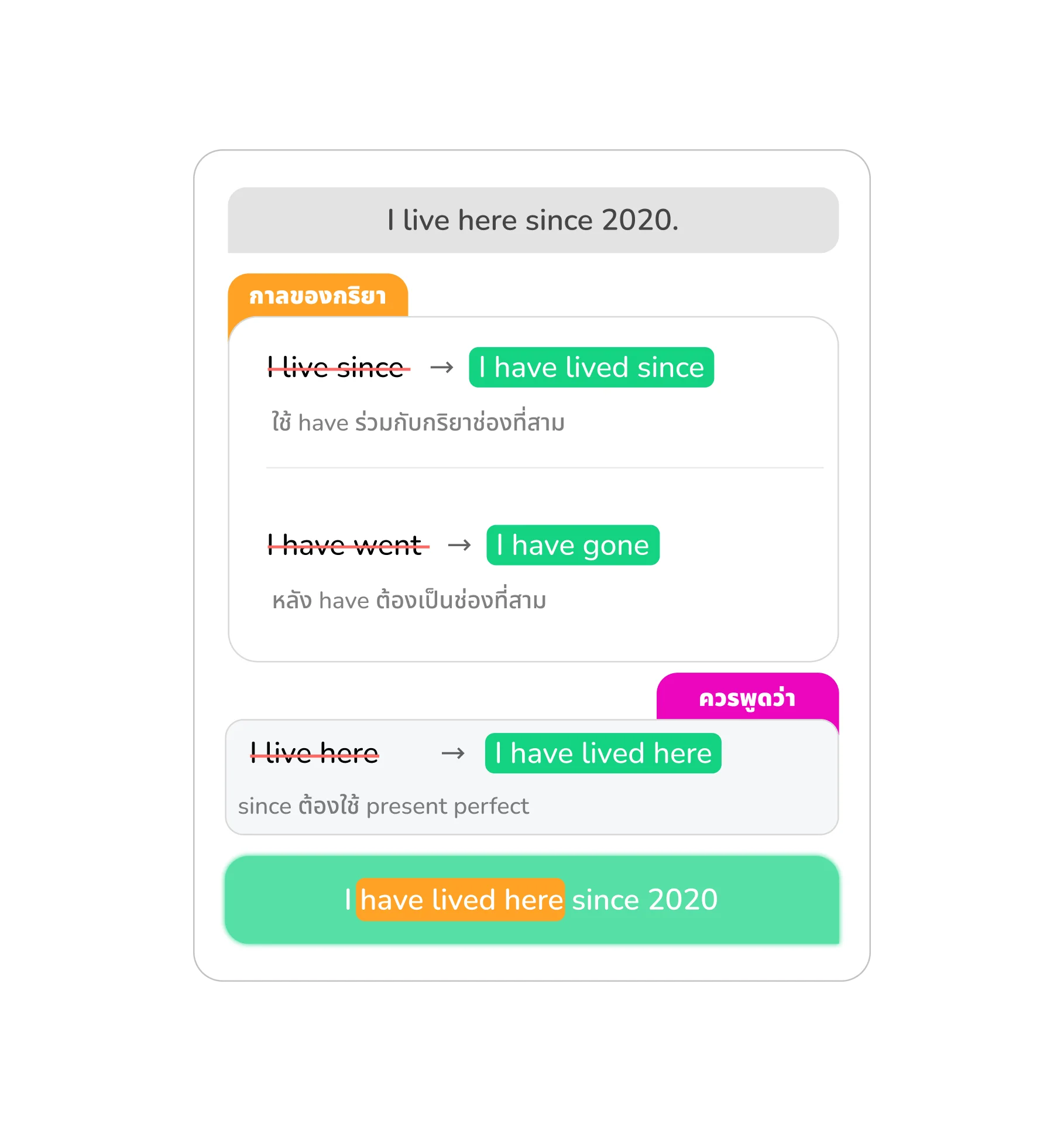
You form the present perfect with have or has plus the past participle of a main verb. Regular verbs end in -ed; irregular verbs change form, like eat becoming eaten. It is one of four present tenses, and the only one built around an unspecified timeline rather than a stated moment, which is part of why it is considered one of the harder tenses to master.
The Present Tense Family at a Glance
Comparing the present perfect with other present forms highlights its role in connecting past experiences to the present:
| Tense | Focus | Example |
|---|---|---|
| Present simple | Habits, facts, schedules | She works at a hospital. |
| Present continuous | Actions happening now | She is working right now. |
| Present perfect | Past action connected to now | She has worked here for years. |
| Present perfect continuous | Duration of an ongoing action | She has been working since 8 AM. |
Present Perfect vs. Past Simple
This is the distinction that causes the most confusion, and it is also one of the most searched grammar questions in English. Past simple is for a finished action at a specific, named time (I visited Paris last year). Present perfect is for an action at an unspecified time in your life, or one that still connects to now (I have visited Paris). If a specific past date or time appears in the sentence, switch to past simple. Learners who already feel confident with the past simple tense often still stumble here, because both tenses describe something that already happened.
How to Form Sentences?
Use have for I, you, we, they, and has for he, she, it. Everyday speech contracts these into I've, she's, and haven't.
| Form | Rule | Example |
|---|---|---|
| Positive | have / has + past participle | I have eaten. She has gone. |
| Negative | have / has + not + past participle | I haven't eaten. She hasn't gone. |
| Question | Have / Has + subject + past participle? | Have you eaten? Has she gone? |
When to Use the Present Perfect?
The present perfect covers several distinct situations where the past connects to the present moment:
Events that happened at an unmentioned time in your life.
Actions completed recently where the result still matters now.
States or actions that started in the past and continue into the present.
Actions happening in time frames that are not over yet (today, this week).
Change Over Time: It is also used to describe gradual progress or development: "Prices have gone up." / "Her English has improved a lot."
Key Signal Words
Certain words frequently signal that you should use the present perfect tense:
| Word | Use | Example |
|---|---|---|
| already | Finished sooner than expected | I have already finished my work. |
| yet | Not finished, usually in negatives/questions | She hasn't eaten dinner yet. |
| ever / never | At any time / at no time | Have you ever been there? I have never seen that. |
| for / since | For a length of time / since a starting point | for three days, since Monday |
| just | Very recently | He has just left. |
| still | Continuing up to now, usually negative | I still haven't heard back. |
Present Perfect vs. Past Simple, Side by Side
Compare these examples to see how specific time markers force a choice between tenses:
| Sentence | Correct Tense | Why |
|---|---|---|
| I visited Paris last year. | visited | Named past time |
| I have visited Paris three times. | have visited | Unspecified time, life experience |
| She has finished her homework already. | has finished | Result matters now |
| She finished her homework at 6 PM. | finished | Named past time |
| We have known each other since college. | have known | Ongoing state, connects to now |
| We met at a conference in 2019. | met | Named past time |
Been vs. Gone: A Common Mix-Up
Both been and gone are past participles of go, but they mean different things in present perfect. Has been means the person went somewhere and came back. Has gone means the person went somewhere and is still there now.
| Sentence | Been or Gone? | Why |
|---|---|---|
| He has ___ to London twice. | been | Life experience, he is back now |
| She has ___ to the supermarket. | gone | She is still there, not back yet |
| Have you ever ___ to Japan? | been | Asking about life experience |
| He has ___ home. (He left.) | gone | He is at home now, not here |
Irregular Participles Worth Memorizing First
Been, gone, done, seen, written, and eaten cover a huge share of everyday present perfect sentences, and they are worth mastering before moving on to less common irregular forms. The full irregular verbs list covers every base, past, and past participle combination.
How Learna AI Teaches the Present Perfect?
Learna AI listens for the exact moment a learner reaches for past simple when present perfect fits better, and explains the timing difference right there in conversation, instead of waiting until the end of a lesson. It also flags a specific date or time word sitting next to have or has, since that is the clearest sign the wrong tense has been chosen, and it catches been/gone mix-ups by checking whether the person is back or still away. Learners working through life-experience prompts with Learna report a 97% improvement in choosing the correct participle form on the first try.
Once have and has feel natural, the next step most learners take is layering in duration with present perfect continuous, which adds an ongoing sense of time to the same idea.
สำรวจเพิ่มเติม
นำความรู้ไวยากรณ์ของคุณไปฝึกใช้จริงกับเส้นทางการเรียนของ Learna:
คำถามที่พบบ่อย
Present perfect tense คืออะไร และมีตัวอย่างอย่างไร?

คือกาลที่สร้างจาก have หรือ has ตามด้วย past participle ใช้กับเหตุการณ์ในอดีตที่ยังสำคัญอยู่ในตอนนี้ เช่น I have visited Japan หรือ She has just left
สูตรของ present perfect คืออะไร?
บอกเล่า: have/has + past participle ปฏิเสธ: have/has + not + past participle คำถาม: Have/Has + ประธาน + past participle?
present perfect กับ present simple ต่างกันอย่างไร?
Present simple ใช้บอกความเคยชินและข้อเท็จจริง ส่วน present perfect เชื่อมเหตุการณ์ในอดีตเข้ากับช่วงเวลาปัจจุบัน โดยมักไม่ระบุว่าเกิดขึ้นเมื่อไหร่แน่ ๆ
ควรใช้ present perfect แทน past simple เมื่อไหร่?
ใช้ present perfect เมื่อไม่ได้ระบุเวลาที่แน่นอนหรือเวลานั้นไม่สำคัญ และใช้ past simple เมื่อคุณบอกเวลาในอดีตชัดเจน เช่น yesterday หรือ in 2020
จะอธิบาย present perfect ให้เด็กเข้าใจได้อย่างไร?
บอกว่ามันใช้กับสิ่งที่เกิดขึ้นแล้วแต่เวลาไม่สำคัญ หรือสิ่งที่ยังเป็นจริงอยู่ตอนนี้ เช่น "I have lost my pencil" ที่หมายความว่าตอนนี้ก็ยังไม่มีดินสอ
คำสำคัญที่ใช้กับ present perfect มีอะไรบ้าง?
already, yet, ever, never, just, for และ since ล้วนปรากฏบ่อยกับ present perfect และเป็นสัญญาณว่าต้องใช้กาลนี้ ไม่ใช่ past simple
ใช้ already กับ yet อย่างไร?
already มักอยู่ในประโยคบอกเล่าเพื่อบอกว่าบางสิ่งเสร็จเร็วกว่าที่คาด ส่วน yet อยู่ในประโยคปฏิเสธและคำถามเพื่อถามว่าสิ่งนั้นเกิดขึ้นแล้วหรือยัง
กฎการใช้ for กับ since เป็นอย่างไร?
ใช้ for กับระยะเวลา เช่น for three years และใช้ since กับจุดเริ่มต้น เช่น since 2020
past participle รูปอปกติคืออะไร?
คือ past participle ที่ไม่ลงท้ายด้วย -ed เช่น gone, eaten, written และ seen ซึ่งต้องจำเป็นคำ ๆ ไปพร้อมกับรูปพื้นฐานและรูปอดีตของมัน
present perfect ใช้บอกการกระทำที่ยังเกิดขึ้นอยู่ได้ไหม?
ได้ โดยเฉพาะเมื่อใช้กับ for หรือ since เช่น I have lived here for ten years แสดงว่าการกระทำเริ่มในอดีตและยังดำเนินอยู่ในตอนนี้
ข้อผิดพลาดที่พบบ่อยของ present perfect คืออะไร?
การใช้กับเวลาในอดีตที่ระบุชัดเจน เช่น "I have visited Paris last year" ซึ่งต้องเปลี่ยนเป็น past simple: "I visited Paris last year"
ในบทสนทนาประจำวัน simple past กับ present perfect ต่างกันอย่างไร?
เจ้าของภาษาใช้ past simple บ่อยกว่ามากในการเล่าเรื่องและพูดถึงเหตุการณ์ที่ระบุเวลา ขณะที่ present perfect มักใช้กับประสบการณ์ที่ไม่ระบุเวลาหรือเรื่องที่เพิ่งเกิดขึ้น
Learna AI ช่วยแก้ข้อผิดพลาดเรื่อง present perfect อย่างไร?
Learna AI จะเตือนทันทีที่มีวันหรือเวลาในอดีตที่ระบุชัดเจนปรากฏข้าง have หรือ has แล้วอธิบายว่าทำไม past simple จึงเหมาะกว่าในประโยคนั้น
Learna AI ติดตามความเชี่ยวชาญ past participle รูปอปกติในระยะยาวด้วยไหม?
ใช่ Learna AI จะจับได้ว่าผู้เรียนยังสับสน past participle รูปอปกติตัวไหน แล้วนำกลับมาให้ฝึกในครั้งถัด ๆ ไปจนกว่าจะจำรูปนั้นได้แม่น