
현재진행형 배우기: 규칙과 예문
현재진행형(present progressive라고도 합니다)은 지금 이 순간 일어나는 행동, 일시적인 상황, 또는 이미 확정된 미래 계획을 나타냅니다. 많은 학습자가 가장 어려운 시제 중 하나로 꼽는데, 그 이유는 문장 구조와는 전혀 상관없는 한 가지 규칙 때문입니다.
What Is the Present Continuous Tense?
The present continuous (also called present progressive) is built with am, is, or are plus the -ing form of a verb. It describes actions happening right now, temporary situations, and arrangements already set for the near future. It is one of four present tenses and one of the first structures a learner needs for real-time conversation.
The Present Tense Family at a Glance
Comparing the present continuous with other present forms highlights its unique focus on actions that are happening right now or are already arranged:
| Tense | Focus | Example |
|---|---|---|
| Present simple | Habits, facts, schedules | She reads every evening. |
| Present continuous | Actions happening now, temporary situations | She is reading right now. |
| Present perfect | Past action connected to now | She has read that book before. |
| Present perfect continuous | Duration of an ongoing action | She has been reading for two hours. |
Habits vs. Actions Happening Right Now
This is the choice that confuses learners most, because both tenses describe something true in the present. Present simple is for permanent facts and routines; present continuous is for actions in progress at this moment or temporary situations that will change.
How to Form Sentences?
All three sentence types use the same core: a form of be plus the verb's -ing form. Questions and negatives simply rearrange or add not to be.
| Form | Rule | Example |
|---|---|---|
| Positive | am / is / are + verb-ing | I am reading. She is working. |
| Negative | am / is / are + not + verb-ing | I am not reading. She isn't working. |
| Question | Am / Is / Are + subject + verb-ing? | Are you reading? Is she working? |
Spelling Rules for -ing Forms
When adding -ing, a few standard spelling adjustments apply:
| Rule | Example |
|---|---|
| Drop silent -e, then add -ing | make → making, write → writing |
| Double the final consonant after a short vowel | run → running, sit → sitting |
| Change -ie to -y, then add -ing | lie → lying, die → dying |
| Just add -ing to most other verbs | play → playing, read → reading |
When to Use the Present Continuous?
The present continuous covers several specific situations that all share a sense of something in progress or temporary:
Actions taking place at the exact moment of speaking.
States that are true now but expected to change.
Plans already confirmed with a specific time or place.
Gradual changes or developing trends over time.
Repeated annoyance: Present continuous with always signals frustration or complaint about a habit: "He is always leaving the door open."
State Verbs to Avoid in -ing Form
Certain verbs describe states rather than actions and rarely take the continuous form:
| Category | Verbs | Why Not Continuous |
|---|---|---|
| Feelings | love, hate, want, need, prefer | These describe ongoing states, not actions in progress. |
| Mental states | know, believe, understand, remember | They describe what your mind holds, not what it is doing. |
| Possession | have (own), own, belong, possess | Ownership is a state that doesn't start or stop. |
| Senses | see, hear, smell, taste (perception) | Involuntary perception is a state, not a deliberate action. |
Verbs That Can Be Both State and Action
Some verbs switch between state and action meaning depending on context. When they describe an action, they can take the continuous form. When they describe a state, they stay simple. This is one of the trickiest parts of present continuous, because the same verb follows different rules in different sentences.
| Verb | State (Simple Only) | Action (Continuous OK) |
|---|---|---|
| think | I think you're right. (opinion) | I'm thinking about changing jobs. (mental process) |
| have | They have a car. (possession) | They're having dinner. (eating) |
| see | I see what you mean. (understand) | I'm seeing the doctor tomorrow. (meeting) |
| taste | This cake tastes great. (perception) | She's tasting the soup. (action of trying) |
| look | You look tired. (appearance) | She's looking out the window. (action of gazing) |
| smell | The flowers smell wonderful. (perception) | He's smelling the flowers. (deliberate action) |
| weigh | She weighs 60 kilos. (measurement/state) | The nurse is weighing the baby. (action) |
Is This Present Continuous?
Practice identifying whether a sentence needs present simple or present continuous:
| Sentence | Correct Tense | Why |
|---|---|---|
| She ___ (work) every Monday. | works | Regular schedule, present simple |
| She ___ (work) from home today. | is working | Temporary situation, happening now |
| I ___ (not / understand) the question. | don't understand | State verb, no continuous form |
| They ___ (fly) to Tokyo next Friday. | are flying | Arranged future plan |
| He ___ (think) about moving to Berlin. | is thinking | Mental process (action), not opinion (state) |
| He ___ (think) you are right. | thinks | Opinion (state), no continuous form |
Common Mistakes
Avoid these frequent present continuous errors in your writing and speaking:
| Incorrect | Correct |
|---|---|
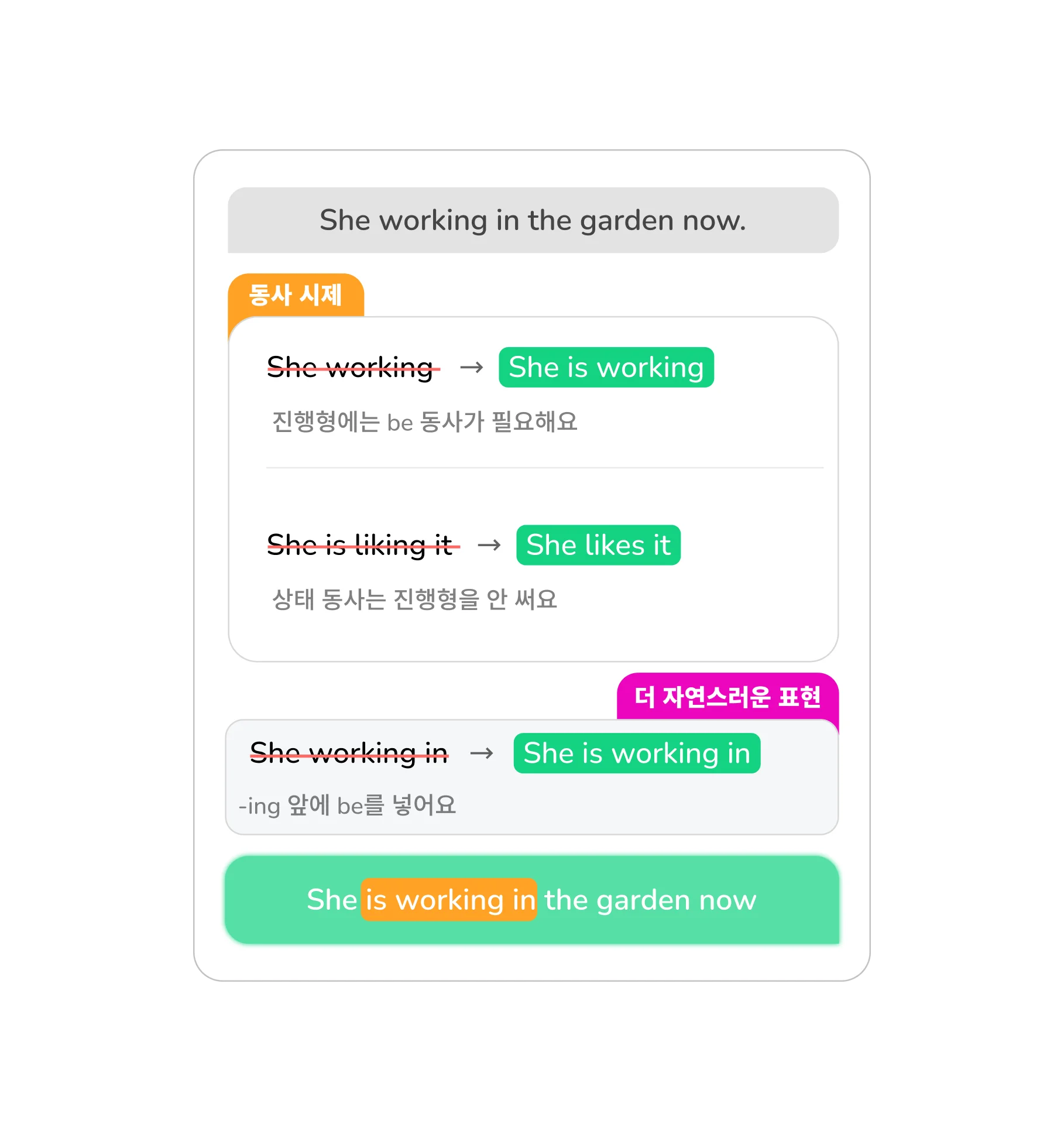
| She reading a book right now. | She is reading a book right now. |
| I am wanting a coffee. | I want a coffee. |
| They are having a car. | They have a car. |
| We are go to the park now. | We are going to the park now. |
| He is work at the office today. | He is working at the office today. |
| This cake is tasting great. | This cake tastes great. |
How Learna AI Teaches the Present Continuous?
Learna AI listens for missing be verbs and catches a bare -ing form instantly, walking through why "she reading" needs "she is reading." It also flags state verbs used in continuous form, like "I am wanting," and explains the state-versus-action distinction, including double-role verbs where the meaning decides the form: "They're having dinner" is correct but "They're having a car" is not, because the first have is an action and the second is possession. Learners describing their daily routine with Learna report a 93% improvement in choosing between simple and continuous on the first attempt.
Once present continuous feels steady, the next step is present perfect, which adds a sense of connection between a past event and the current moment.
더 살펴보기
Learna의 학습 코스로 배운 문법을 직접 활용해 보세요:
자주 묻는 질문
현재진행형이란 무엇이며 예문은 무엇인가요?

지금 일어나는 행동, 일시적인 상황, 또는 예정된 미래의 일을 나타내는 시제입니다. 예를 들어 She is cooking dinner나 We are flying to Paris tomorrow처럼 씁니다.
현재진행형의 공식은 무엇인가요?
긍정문: 주어 + am/is/are + 동사-ing. 부정문: 주어 + am/is/are + not + 동사-ing. 의문문: Am/Is/Are + 주어 + 동사-ing?
현재진행형은 언제 사용하나요?
지금 이 순간 일어나는 행동, 짧게 지속되는 일시적인 상황, 이미 계획된 미래의 일, 그리고 변화하고 있는 상황에 씁니다.
아이에게 현재진행형을 어떻게 설명하면 좋을까요?
지금 바로 이 순간 일어나는 일을 말할 때 쓰며, 동작을 나타내는 말에 "ing"를 붙인다고 알려주세요. 실제로 뛰면서 "I am jumping"이라고 말해보면 좋습니다.
현재진행형으로 미래를 표현할 수 있나요?
네, 이미 정해진 약속이라면 가능합니다. We are flying to Paris tomorrow는 단순한 예측이 아니라 확정된 계획을 나타냅니다.
상태동사란 무엇인가요?
감정, 생각, 감각, 소유를 나타내는 동사로 want, know, love, own 등이 있습니다. 현재의 일을 말할 때도 보통 단순형 그대로 씁니다.
현재진행형에서 자주 하는 실수는 무엇인가요?
"I want" 대신 "I am wanting"처럼 상태동사를 -ing 형태로 쓰거나, be 동사를 아예 빠뜨리는 경우입니다.
현재진행형의 부정문은 어떻게 만드나요?
am/is/are 뒤에 not을 붙이고 동사는 -ing 형태로 유지하면 됩니다: He is not sleeping, they aren't coming.
현재진행형과 단순현재의 차이는 무엇인가요?
현재진행형은 지금 일어나는 일이나 일시적인 상황을, 단순현재는 습관과 일과, 일반적인 사실을 나타냅니다.
현재진행형으로 질문은 어떻게 하나요?
Am, Is, Are로 시작한 뒤 주어, 그다음 동사-ing 형태를 씁니다: Are they playing? Is she coming?
두 가지 행동을 동시에 현재진행형으로 쓸 수 있나요?
네, 특히 while과 함께 씁니다. She is cooking while he is setting the table은 두 가지 일이 동시에 일어나고 있음을 나타냅니다.
현재진행형은 배우기 어려운 시제인가요?
상태동사 때문에 처음에는 까다롭게 느끼는 학습자가 많지만, am/is/are에 -ing를 붙이는 기본 구조 자체는 영어에서 가장 단순한 편에 속합니다.
Learna AI는 상태동사 실수를 어떻게 잡아내나요?
Learna AI는 말하는 문장에서 상태동사가 -ing 형태로 나오는 순간 이를 표시하고, 올바른 단순형과 함께 간단한 이유를 알려줍니다.
Learna AI는 이 시제로 미래 계획을 말하는 연습도 도와주나요?
네. Learna AI는 여행 일정이나 약속처럼 이미 정해진 계획을 말하는 문장을 연습시키며, 확정된 미래의 일에 진행형을 올바르게 쓰고 있는지 확인해 줍니다.