
품사: 부사
부사는 동사, 형용사, 다른 부사, 심지어 문장 전체를 수식하는 말입니다. 어떻게, 언제, 어디서, 어느 정도로, 얼마나 자주에 답하며 의미를 더 구체적으로 만들어 줍니다. 많은 부사가 -ly로 끝나지만(quickly, softly), 그렇지 않은 부사도 많습니다(fast, well, always). 이 가이드에서는 부사의 모든 종류, 의미를 바꾸는 위치 규칙, 그리고 영어에 익숙한 사람도 자주 빠지는 함정인 부사와 형용사의 구분까지 다룹니다.
What Is an Adverb?
An adverb gives more detail about how, when, where, to what extent, or how often something happens.
"They waited outside." (where) | "I'm almost finished." (to what extent)
"We rarely eat out." (how often)
What Can an Adverb Modify?
Unlike adjectives, which only describe nouns and pronouns, adverbs can modify four different things.
Describes how or in what manner the action takes place.
Adds intensity, degree, or qualification to an adjective.
Intensifies or clarifies another adverb sitting next to it.
Conveys the speaker's overall attitude toward everything that follows.
Types of Adverbs
Adverbs are grouped by the kind of information they provide.
| Type | Answers | Examples |
|---|---|---|
| Manner | How? | quickly, carefully, loudly |
| Time | When? | now, soon, yesterday |
| Frequency | How often? | always, rarely, never |
| Duration | For how long? | briefly, forever, permanently |
| Place | Where? | here, outside, everywhere |
| Degree | To what extent? | very, almost, extremely |
| Purpose | Why? | therefore, thus, consequently |
| Conjunctive | Connects clauses | however, moreover, meanwhile |
Flat Adverbs: When an Adverb Looks Like an Adjective
Some adverbs keep the exact same form as their adjective counterpart instead of adding -ly. These are called flat adverbs: fast, hard, straight, slow, early, late, well.
A few flat adverbs have an alternate -ly form that's equally correct: slow/slowly, bright/brightly, safe/safely. "Drive safe" and "drive safely" are both acceptable.
Adverbs vs. Adjectives
This is the single most common mix-up involving adverbs, and it almost always happens with linking verbs. Adjectives describe nouns and pronouns. Adverbs describe verbs, adjectives, and other adverbs. The confusion sets in with verbs like feel, look, smell, and sound, which can act as either a linking verb or an action verb.
Degrees of Comparison
Like adjectives, many adverbs show comparison across three degrees.
- Absolute: the base form ("He smiled warmly.").
- Comparative: compares two things, usually formed with more ("He smiled more warmly than the others.").
- Superlative: compares three or more, usually formed with most ("He smiled most warmly of them all.").
Flat adverbs follow the same comparative and superlative pattern as their matching adjective, using -er and -est instead of more/most: "The cheetah runs fastest."
Where Does an Adverb Go?
Placement changes meaning more with adverbs than with almost any other part of speech.
- Modifying a verb: usually goes right before or after it ("He quickly ran" or "He ran quickly").
- Modifying an adjective or adverb: goes directly before the word it modifies ("She is extremely smart").
- With a transitive verb: place the adverb after the object, never between the verb and its object ("They decorated the hall elaborately" — NOT: "decorated elaborately the hall").
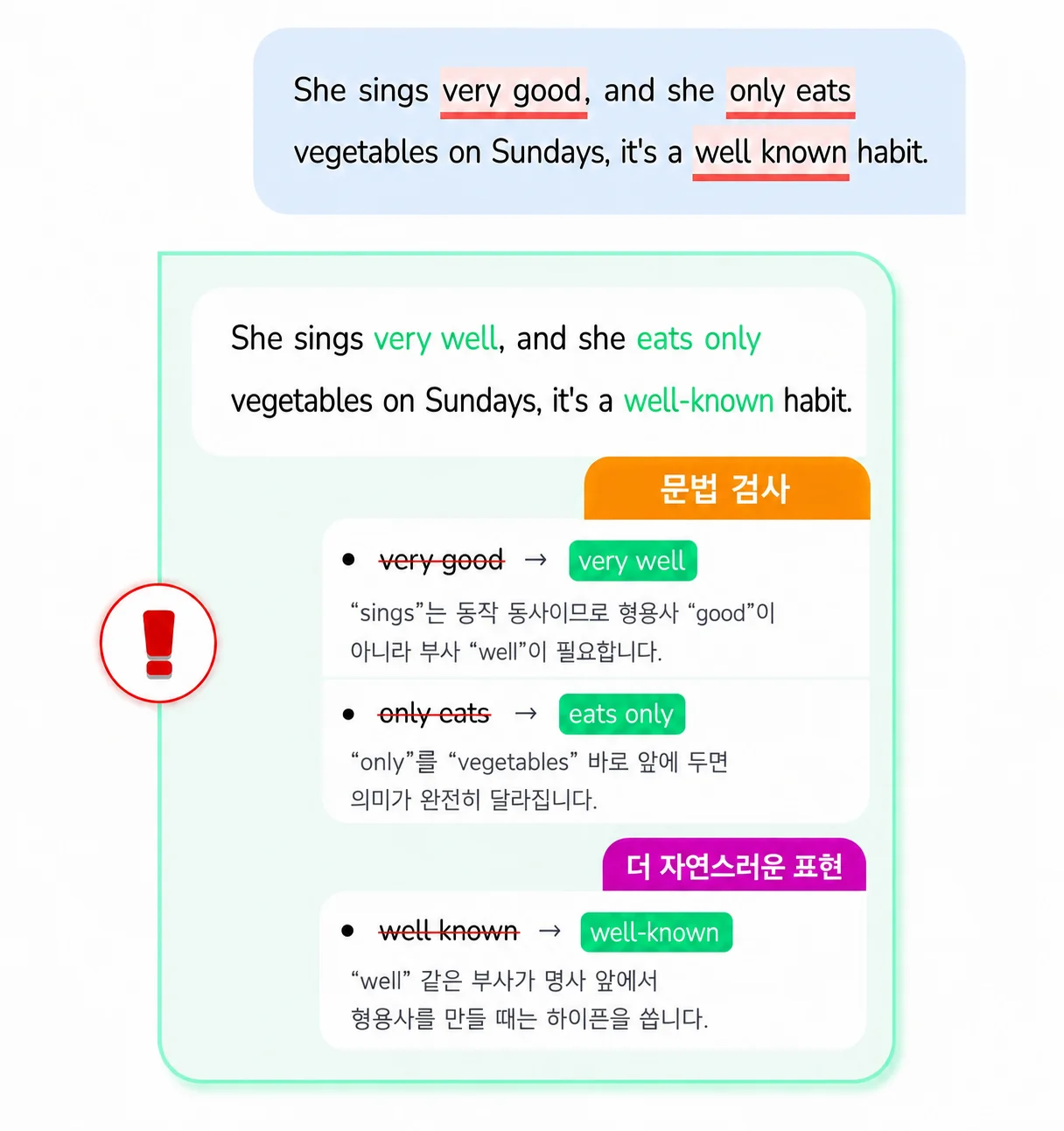
The "only" trap: only is one of the most frequently misplaced words in English, and moving it changes the meaning entirely.
- "Phillip only fed the cat." (all he did was feed it)
- "Phillip fed only the cat." (he fed the cat and nothing else)
A misplaced adverb can also create a squinting modifier, where it's unclear which word it's modifying: "Singing quickly improved his stammer" leaves it ambiguous whether quickly refers to singing or improved.
The Hyphen Rule for Adverbs Before Adjectives
Most -ly adverbs never take a hyphen when modifying an adjective, since there's no risk of confusion: "a happily married couple."
A small number of adverbs that look identical to adjectives, like well and fast, do take a hyphen before the adjective to prevent misreading:
- "A well-known author." (famous, not necessarily in good health)
- "A fast-growing company." (growing quickly)
How to Identify an Adverb?
If you're unsure whether a word is an adverb, check these signals:
- Does it answer how, when, where, why, or to what extent? These are the core adverb questions.
- Can you remove it without breaking the sentence? Most adverbs are optional extra detail, unlike verbs and nouns.
- Does it modify a verb, adjective, or another adverb rather than a noun? If it describes a noun instead, it's an adjective.
- Does it end in -ly? A strong hint, but not proof. Words like friendly and lovely end in -ly and are still adjectives.
Is ___ an Adverb? Quick Answers
Some of the most common words in English shift categories or carry a meaning that isn't obvious from their form.
| Word | Answer |
|---|---|
| fast | Can be either. "A fast car" (adjective) vs. "She runs fast" (adverb, flat form). |
| hardly | An adverb of degree meaning "barely," not "in a hard manner." "I hardly slept" means I slept very little. |
| there | An adverb of place ("I live there"), but functions as a dummy subject in "There is a problem," where it isn't modifying anything. |
| well | Usually an adverb of manner ("sings well"), but an adjective when it means "in good health" ("I am well"). |
| near | Can be an adverb ("come near"), a preposition ("near the station"), or an adjective ("the near future"). |
How Learna AI Teaches Adverbs?
Adverb placement is one of the few grammar rules that can completely flip a sentence's meaning without any word actually being wrong, which makes it especially hard to self-correct. Learna AI catches misplaced adverbs and adjective-adverb mix-ups as you speak, explaining why the position or form matters rather than just marking it wrong. Learners practicing with Learna report a 90% drop in misplaced-modifier mistakes, since hearing the corrected sentence in context builds the right instinct faster than memorizing a rule.
더 살펴보기
Learna의 학습 코스로 배운 문법을 직접 활용해 보세요:
자주 묻는 질문
부사란 무엇인가요?

부사는 동사, 형용사, 다른 부사 또는 문장 전체를 수식하는 말로, 어떻게, 언제, 어디서, 어느 정도로, 얼마나 자주에 대해 답해 줍니다.
부사에는 어떤 종류가 있나요?
대표적인 종류로는 방법, 시간, 빈도, 기간, 장소, 정도, 목적, 접속 부사가 있습니다.
부사와 형용사의 차이는 무엇인가요?
형용사는 명사와 대명사를 설명하고, 부사는 동사, 형용사, 다른 부사를 설명합니다. "a fast car"에서 fast는 형용사이고, "she runs fast"에서는 부사입니다.
모든 부사가 -ly로 끝나나요?
아닙니다. fast, well, always, never처럼 흔히 쓰이는 부사는 -ly로 끝나지 않고, friendly처럼 -ly로 끝나지만 형용사인 단어도 있습니다.
플랫 부사(flat adverb)란 무엇인가요?
플랫 부사는 -ly를 붙이지 않고 관련 형용사와 같은 형태를 유지하는 부사로, fast, hard, straight 등이 있습니다.
부사는 문장에서 어디에 놓아야 하나요?
수식하는 단어와 최대한 가까이 두어야 합니다. 특히 only의 위치를 잘못 두면 문장 전체의 의미가 달라질 수 있습니다.
접속 부사란 무엇인가요?
접속 부사는 두 개의 독립절이나 문장을 이어 주는 부사로, however, moreover, therefore 등이 있습니다.
부사의 비교급은 어떻게 만드나요?
대부분의 부사는 more를 붙여 비교급을 만들고(more quickly), 플랫 부사는 형용사처럼 -er를 씁니다(faster).
문장에서 부사를 어떻게 찾나요?
그 단어가 어떻게, 언제, 어디서, 왜, 어느 정도로에 답하는지, 그리고 명사가 아니라 동사, 형용사, 부사를 수식하는지 확인해 보세요.
왜 어떤 부사는 형용사 앞에서 하이픈이 필요한가요?
well이나 fast 같은 부사는 형용사와 형태가 똑같기 때문에, 하이픈을 쓰면(well-known) 두 개의 별도 형용사가 아니라 하나의 수식어로 함께 작동한다는 점이 분명해집니다.
제가 말하는 동안 Learna가 부사의 위치 오류도 바로잡아 주나요?
네. Learna는 "only"의 함정 같은 위치 문제를 잡아내고, 그 단어가 어디에 놓여야 하는지와 위치에 따라 의미가 어떻게 달라지는지 알려 줍니다.
부사를 남용하지 않고 더 자연스럽게 쓰는 데도 Learna가 도움이 되나요?
네. Learna는 문맥 속에서 부사 사용에 대한 피드백을 제공해 어색하거나 반복적인 표현을 피하도록 도와줍니다.