
Parts of Speech: Pronouns
A pronoun is a word that stands in for a noun so you don't have to repeat it. Words like he, she, it, they, and mine let you write and speak without sounding like a broken record. This guide covers the main types, the mistakes that trip up even confident speakers, and how to identify a pronoun on sight.
What Is a Pronoun?
A pronoun replaces a noun once your reader or listener already knows what you're referring to. Instead of repeating a name over and over, you swap it out:
The noun a pronoun replaces is called its antecedent. In the example above, Sarah is the antecedent of she. Most pronouns need a clear antecedent so the reader knows exactly who or what is being talked about; a handful, like I or you, don't need one because the context makes it obvious.
The Main Types of Pronouns
Pronouns come in several categories, and knowing which one you're using decides its form, its case, and where it can go in a sentence.
Replace specific people or things and change form based on whether they're doing the action or receiving it.
Object: me, you, him, her, it, us, them
Show ownership without needing a noun after them. They never take an apostrophe.
Point back to the subject when it acts on itself.
Connect a clause to the noun it describes.
Point to something specific, either nearby or farther away.
Refer to a person or thing without naming it specifically.
Used to ask questions.
Describe a mutual relationship between two or more people.
Commonly Confused Pronoun Pairs
These three pairs cause more genuine confusion than any other part of pronoun grammar, and each has a simple test behind it.
Who vs. Whom?
Use who when it's the subject of a verb, and whom when it's the object of a verb or preposition.
| Question | Test | Correct Form |
|---|---|---|
| ___ called you? | He called you. | Who called you? |
| To ___ did you send it? | You sent it to him. | To whom did you send it? |
Who's vs. Whose?
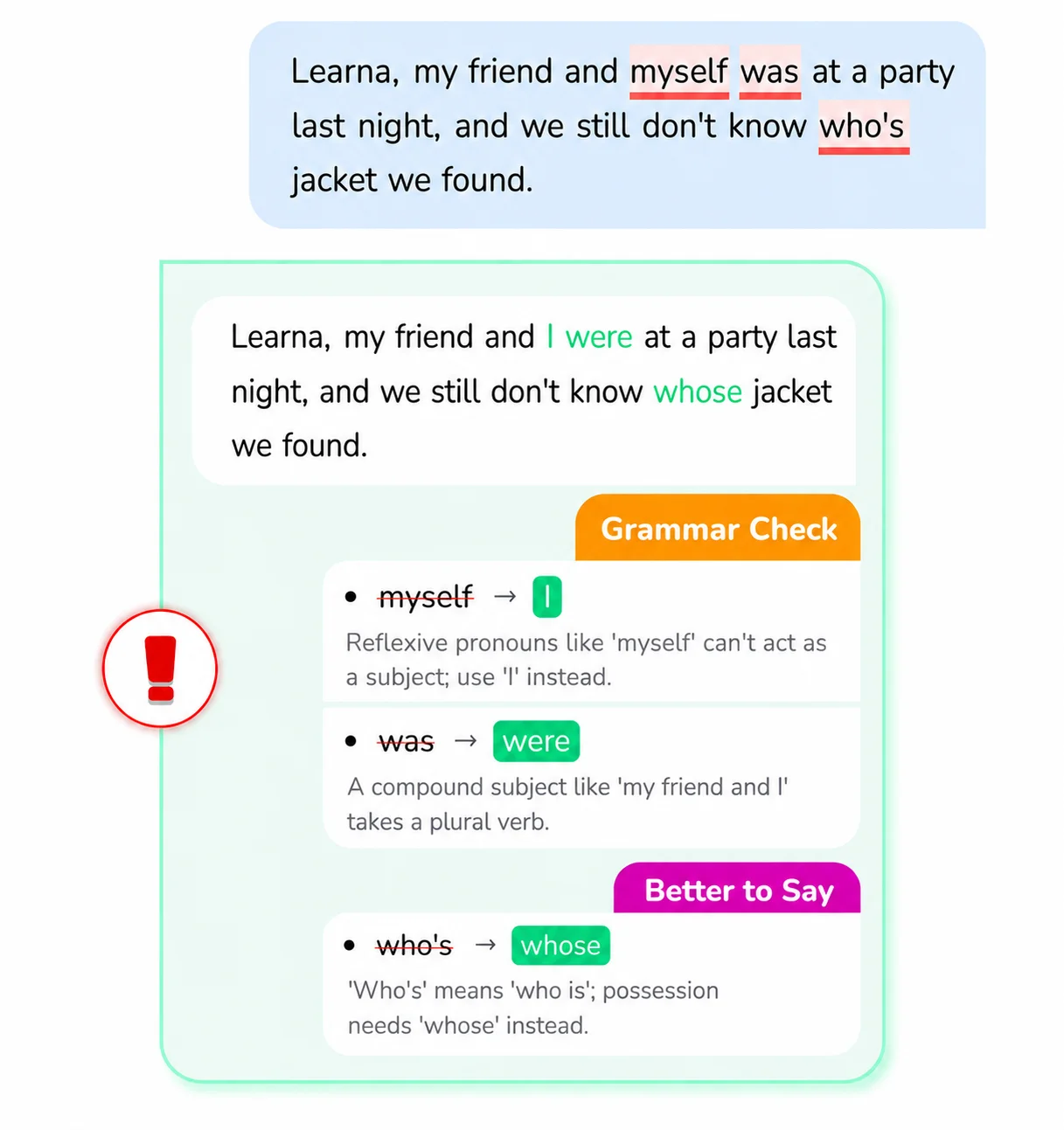
Who's is a contraction of "who is" or "who has". Whose shows possession.
- "Who's coming to the party?" (Who is coming)
- "Whose jacket is this?" (possession)
Your vs. You're?
Your shows possession. You're is a contraction of "you are".
- "Is this your book?" (possession)
- "You're going to love this." (you are)
Personal Pronoun Forms at a Glance
Personal pronouns change form depending on their role in the sentence.
| Subject | Object | Possessive Adjective | Possessive Pronoun | Reflexive |
|---|---|---|---|---|
| I | me | my | mine | myself |
| you | you | your | yours | yourself |
| he | him | his | his | himself |
| she | her | her | hers | herself |
| it | it | its | its | itself |
| we | us | our | ours | ourselves |
| they | them | their | theirs | themselves |
Pronouns in a Sentence: Agreement & Function
A pronoun has to agree with its antecedent in number (singular or plural) and, where relevant, gender.
- "Maria forgot her jacket." (singular, feminine)
- "The students finished their exam." (plural)
Pronouns can play the same sentence roles as nouns: subject ("They left early."), object ("I saw them."), or possessive ("That's theirs.").
Words like my, your, his, her, its, our, and their function as possessive adjectives when they sit directly before a noun ("my car"), rather than replacing one outright.
How to Identify a Pronoun?
If you're not sure whether a word is a pronoun, check for these signals:
- Does it stand in for a noun already mentioned? That's its antecedent.
- Can it act as a subject or object on its own? Pronouns don't usually need an article before them, unlike nouns.
- Does it change form based on case? I becomes me, he becomes him, and so on.
- Is it one of the closed set of pronoun words? Unlike nouns, English rarely invents new pronouns, so if it's not on a recognized list (personal, relative, demonstrative, etc.), it's probably something else.
Is ___ a Pronoun? Quick Answers
Some words genuinely function as more than one part of speech depending on the sentence.
| Word | Answer |
|---|---|
| that | Often a pronoun ("I like that"), but also a conjunction ("I know that you left") or a determiner ("that book"). |
| this | Usually a pronoun ("This is mine") or a determiner ("this book"), depending on whether a noun follows. |
| which | A relative or interrogative pronoun ("Which do you want?"), or a determiner when followed by a noun ("Which book?"). |
| it | Almost always a pronoun, standing in for a thing, an idea, or even the weather ("It's raining"). |
| whose | A possessive pronoun asking about ownership, distinct from who's, the contraction of "who is." |
How Learna AI Teaches Pronouns?
Pronoun rules look simple on paper, but agreement, case, and contractions like who's/whose are some of the most common mistakes learners make in live conversation. Learna AI catches these errors as you speak and explains the reasoning behind the correction, rather than just flagging the mistake. Learners practicing with Learna report an 89% drop in pronoun agreement errors after consistent practice, since hearing the correction in context makes the rule stick.
Explore More
Put your grammar knowledge into practice with Learna's learning paths:
Frequently Asked Questions
What is a pronoun?

A pronoun is a word that replaces a noun once the reader or listener already knows what's being referred to, such as he, she, it, or they.
What are the main types of pronouns?
The main types are personal, possessive, reflexive, relative, demonstrative, indefinite, interrogative, and reciprocal pronouns.
What is the difference between who and whom?
Who is used when it's the subject of a verb, and whom is used when it's the object of a verb or preposition. If you can replace it with "he," use who; if "him" fits, use whom.
What is the difference between who's and whose?
Who's is a contraction of "who is" or "who has." Whose shows possession. If "who is" fits the sentence, use who's.
What is an antecedent?
An antecedent is the noun, phrase, or clause that a pronoun replaces. It usually appears earlier in the sentence or paragraph.
Do possessive pronouns use an apostrophe?
No. Words like yours, his, hers, ours, and theirs never take an apostrophe.
What are reflexive pronouns used for?
Reflexive pronouns, like myself or themselves, show that the subject of a sentence is also the object, meaning the action reflects back on the doer.
How many types of pronouns are there?
Most grammars recognize 8 main types. Some sources list more by splitting subject and object pronouns into separate categories, or fewer by grouping similar types together.
Is "that" a pronoun?
It can be. "That" acts as a pronoun when it stands alone ("I like that"), but as a conjunction or determiner in other contexts
What is the difference between "your" and "you're"?
"Your" shows possession ("your book"). "You're" is a contraction of "you are" ("you're welcome"). They're not interchangeable despite sounding alike.
Does Learna correct pronoun mistakes like who/whom while I'm speaking?
Yes. Learna AI listens in real time and flags errors like mixing up who and whom, then explains which one fits and why.
Will Learna help me sound natural with pronouns, not just technically correct?
Yes. Beyond fixing errors, Learna models natural pronoun use in context, so your speech sounds like something a native speaker would actually say.