
Parts of Speech: Interjections
An interjection is a word or short phrase that expresses a sudden feeling, reaction, or command, like wow, ouch, or oops. Unlike every other part of speech, an interjection stands apart from the grammar of the sentence around it. This guide covers the different types, where they go in a sentence, and how to punctuate them correctly.
What Is a Verb?
A verb describes what the subject of a sentence is doing, experiencing, or being. It can show a physical action (run, eat, build), a mental action (think, believe, consider), or a state of being (be, seem, become).
Without a verb, a group of words is just a fragment, not a complete sentence. Even commands, which drop the subject, still need one: "Sit!" or "Listen!"
The Main Types of Verbs
Verbs fall into several overlapping categories. A single verb can belong to more than one type depending on how it's used.
Describe something physical or mental that happens directly in action.
Describe a state, feeling, or condition rather than an action. Generally not used in continuous tenses.
Work alongside a main verb to build complex tenses, moods, or form questions.
A specialized type of auxiliary verb expressing ability, possibility, permission, or obligation.
Connect the subject to a word that describes or renames it, rather than displaying an action.
Combine a verb with a preposition or adverb to create a brand-new meaning. Only the verb part is conjugated.
Transitive vs. Intransitive Verbs
This distinction decides whether a verb needs an object to complete its meaning, and it's one of the most common sources of confusion.
- Transitive verbs act on a direct object, the thing or person receiving the action ("She read the book"). Without an object, the sentence feels incomplete ("She read" raises the question, read what?).
- Intransitive verbs are complete without an object ("They laughed"). No object is needed, and adding one wouldn't make sense.
- Ditransitive verbs take both a direct and an indirect object ("She gave him the book"). Here, book is the direct object (what was given) and him is the indirect object (who received it).
- Ambitransitive verbs can work either way depending on the sentence: "I already ate" (intransitive) vs. "I already ate a sandwich" (transitive).
| Type | Needs an Object? | Example |
|---|---|---|
| Transitive | Yes, a direct object | She baked a cake. |
| Intransitive | No | The baby slept. |
| Ditransitive | Yes, direct and indirect | She baked him a cake. |
Regular vs. Irregular Verbs
Regular verbs form the simple past and past participle by adding -ed to the root: walk → walked. Irregular verbs don't follow this pattern, and their past forms have to be memorized individually.
| Base Form | Simple Past | Past Participle |
|---|---|---|
| be | was / were | been |
| go | went | gone |
| have | had | had |
| do | did | done |
| see | saw | seen |
| take | took | taken |
| make | made | made |
| get | got | gotten / got |
| know | knew | known |
| think | thought | thought |
| come | came | come |
| give | gave | given |
| find | found | found |
| write | wrote | written |
| speak | spoke | spoken |
Gerunds & Infinitives
Both gerunds and infinitives turn a verb into a noun, but they aren't always interchangeable. A gerund adds -ing to the verb ("Swimming is fun"). An infinitive adds to before the root form ("To swim is fun").
| Use | Form | Example |
|---|---|---|
| Object of a preposition | Gerund only | "I'm interested in learning." |
| After verbs like want, decide, hope | Infinitive only | "I want to leave." |
| After verbs like enjoy, avoid, finish | Gerund only | "I enjoy reading." |
| General or abstract statements | Infinitive | "To exercise is important." |
| Specific or completed actions | Gerund | "I liked exercising this morning." |
Verb Tenses: A Quick Map
English uses 12 main tenses, built from four structures (simple, continuous, perfect, perfect continuous) across three time periods (past, present, future).
| Period | Simple | Continuous | Perfect | Perfect Continuous |
|---|---|---|---|---|
| Present | I walk | I am walking | I have walked | I have been walking |
| Past | I walked | I was walking | I had walked | I had been walking |
| Future | I will walk | I will be walking | I will have walked | I will have been walking |
Each tense has its own rules for when to use it. For a full breakdown of every tense with detailed examples, visit our Verb Tenses guide.
Active vs. Passive Voice
In the active voice, the subject performs the action: "The chef cooked the meal." In the passive voice, the subject receives the action instead, formed with a conjugated form of be plus the past participle: "The meal was cooked by the chef."
Active voice is generally clearer and more direct, which is why most style guides recommend it for everyday writing. Passive voice is useful when the doer of the action is unknown or unimportant: "The window was broken."
Subject-Verb Agreement
A verb has to match its subject in number. Singular subjects take singular verbs; plural subjects take plural verbs.
- "The dog barks." (Singular)
- "The dogs bark." (Plural)
This gets trickier with collective nouns and compound subjects, where the correct verb form isn't always obvious at first glance.
How to Identify a Verb?
If you're unsure whether a word is a verb, try these two quick tests:
- Can you do it? Ask, "Can I ___?" Can I think, walk, exist? If yes, it's likely a verb.
- What is happening? In "Mark eats his dinner quickly," what's happening? Eating. That's the verb.
Is ___ a Verb? Quick Answers
Some of the most common words in English shift roles depending on the sentence.
| Word | Answer |
|---|---|
| to | Usually a preposition or the marker before an infinitive ("to run"), not a verb on its own. |
| being | Can be a verb form ("She is being kind") or a noun/gerund ("Being on time matters"). |
| have | A main verb showing possession ("I have a car") or an auxiliary verb building tense ("I have finished"). |
| well | Almost never a verb. Usually an adverb ("sings well") or adjective ("feeling well"). |
| like | Can be a verb ("I like coffee"), preposition ("like the wind"), or conjunction ("like I said"). |
How Learna AI Teaches Verbs?
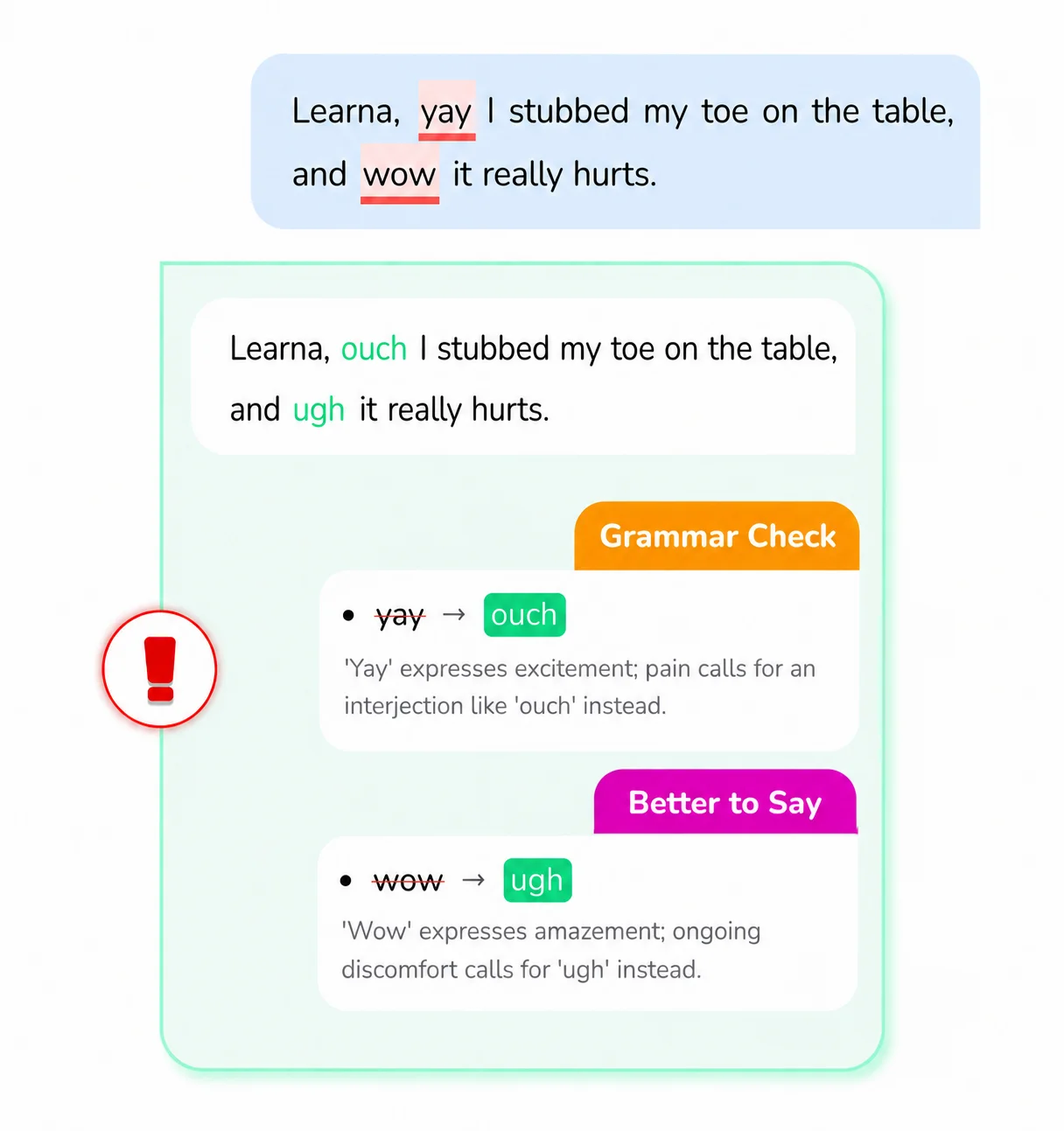
Conjugation rules are easy to memorize and hard to apply on the fly, especially with irregular verbs and tricky tenses like the present perfect. Learna AI listens as you speak, corrects verb form mistakes in real time, and explains why the correction fits, rather than just marking it wrong. Learners practicing with Learna report a 94% improvement in tense accuracy after regular conversation practice, since hearing the correct form in context builds the habit faster than memorizing a chart.
Explore More
Put your grammar knowledge into practice with Learna's learning paths:
Frequently Asked Questions
What is an interjection?

An interjection is a word or short phrase that expresses a sudden feeling, reaction, or command, and stands grammatically apart from the rest of the sentence.
What are examples of interjections?
Common examples include wow, ouch, oops, hey, hmm, and ugh.
What are the different types of interjections?
Interjections are grouped by origin (primary or secondary) and by function (volitive, emotive, cognitive, or greetings and partings). Different sources combine these differently, which is why the total count varies.
Is "hello" an interjection?
Yes, when it's used as a greeting. It functions as a noun in a sentence like "she gave a quick hello."
Do interjections need an exclamation mark?
Not always. Strong emotion typically uses an exclamation mark, but mild emotion can use a comma, and hesitation or confusion can use a period or question mark.
Are interjections appropriate in formal writing?
Generally no. Most style guides recommend avoiding interjections in formal or academic writing, since they can undercut a serious tone. A few mild ones, like indeed, are usually acceptable.
What is the difference between a primary and secondary interjection?
A primary interjection, like ugh or psst, has no other grammatical role. A secondary interjection is a word borrowed from another part of speech, like shoot or awesome.
Can you remove an interjection from a sentence?
Yes. Interjections are grammatically independent, so removing one doesn't affect the grammatical completeness of the sentence.
What is another word for interjection?
Interjections are sometimes called exclamations, though "exclamation" more specifically refers to the punctuation mark and sentence type associated with strong interjections.
How do you punctuate an interjection in the middle of a sentence?
Set it off with commas or parentheses, just like any other parenthetical element, so it reads as separate from the main clause.
Can Learna help me sound more natural with reactions and interjections?
Yes. Learna picks up on tone and suggests more natural interjections in context, so your reactions sound less textbook and more real.
Does Learna tell me when an interjection is too informal for the situation?
Yes. Learna gives feedback on tone, letting you know when a casual interjection fits and when a more formal phrasing works better.