
Simple Past: Regeln für regelmäßige und unregelmäßige Verben
Das Simple Past beschreibt eine Handlung, die in der Vergangenheit begonnen und abgeschlossen wurde. Es ist die Zeitform hinter fast jeder Geschichte, jedem Bericht und jedem Satz über ein abgeschlossenes Ereignis im Englischen – und wird oft einfach „Vergangenheitsform“ genannt, weil es die grundlegendste Form davon ist. Dieser Leitfaden behandelt die Bildung, die Rechtschreibregeln für regelmäßige Verben, die unregelmäßigen Formen, die man auswendig lernen muss, und die alltäglichen Zeitangaben, die dazugehören.
What Is the Past Simple Tense?
Past simple describes completed events, past habits, or facts that were true before now. Regular verbs add -ed; irregular verbs change form completely. It is one of four past tenses, alongside past continuous, past perfect, and past perfect continuous, and it is the simplest one to form.
The Past Tense Family at a Glance
Understanding how the past simple fits into the broader past tense family helps clarify when to use it alongside other past forms:
| Tense | Focus | Example |
|---|---|---|
| Past simple | Completed action | I played tennis yesterday. |
| Past continuous | Action in progress at a past moment | I was playing tennis at 5 PM. |
| Past perfect | Action before another past action | I had played tennis before it rained. |
| Past perfect continuous | Duration before another past action | I had been playing tennis for an hour when it rained. |
Regular vs. Irregular Past Forms
This is where most learners stumble. Regular verbs are predictable (walk → walked), but a large group of common verbs change unpredictably (go → went, have → had, see → saw). There is no shortcut here: irregular forms have to be learned verb by verb, which is why a dedicated irregular verbs list is worth keeping close by.
How to Form Sentences?
Forming past simple sentences involves straightforward structures, but remember that the verb returns to its base form in negatives and questions:
| Form | Rule | Example |
|---|---|---|
| Positive | past form of the verb (regular: base + -ed) | I played tennis yesterday. |
| Negative | didn't (did not) + base verb | I didn't play tennis. |
| Question | Did + subject + base verb? | Did you play tennis? |
Spelling Rules for Regular Verbs
When adding -ed to regular verbs, apply these standard spelling guidelines:
| Rule | Example |
|---|---|
| Add -ed to most verbs | play → played, watch → watched |
| Add -d if the verb already ends in e | live → lived, dance → danced |
| Double the final consonant after a short vowel | stop → stopped, plan → planned |
| Change y to i and add -ed after a consonant | study → studied, cry → cried |
When to Use the Past Simple?
The past simple tense serves several key functions when discussing past events:
Events that started and ended completely in the past.
Narrating a sequence of actions that happened one after another.
States or routines that were true in the past but are no longer active.
General facts or historical milestones anchored in the past.
Time-marked events: Always use past simple when an explicit past time is mentioned: "I graduated in 2015." / "We met two years ago."
Used To: Past Habits That Stopped
Used to describes a habit or state that was true in the past but is no longer true now. It works alongside past simple for past habits, but used to specifically emphasizes that the habit has stopped. The negative form is didn't use to (dropping the -d), and the question form is Did you use to...?
| Form | Structure | Example |
|---|---|---|
| Positive | used to + base verb | She used to walk to school. |
| Negative | didn't use to + base verb | She didn't use to like coffee. |
| Question | Did + subject + use to + base verb? | Did you use to play tennis? |
Common Time Expressions
Look for these typical time markers that signal the past simple tense:
| Expression | Example |
|---|---|
| yesterday | I called her yesterday. |
| last week / month / year | We traveled last summer. |
| ... ago | She left two hours ago. |
| in 2010 (a specific year) | He was born in 2010. |
| when I was young | We played outside when I was young. |
The 15 Most Common Irregular Verbs
Master these high-frequency irregular forms early to build confidence in conversation:
| Base | Past Simple |
|---|---|
| go | went |
| have | had |
| see | saw |
| make | made |
| get | got |
| take | took |
| know | knew |
| think | thought |
| come | came |
| give | gave |
| find | found |
| tell | told |
| become | became |
| say | said |
| leave | left |
See the full irregular verbs list for every base, past, and past participle form.
Common Mistakes
Avoid these frequent past simple errors in your writing and speaking:
| Incorrect | Correct |
|---|---|
| She goed to the market. | She went to the market. |
| Did you played tennis? | Did you play tennis? |
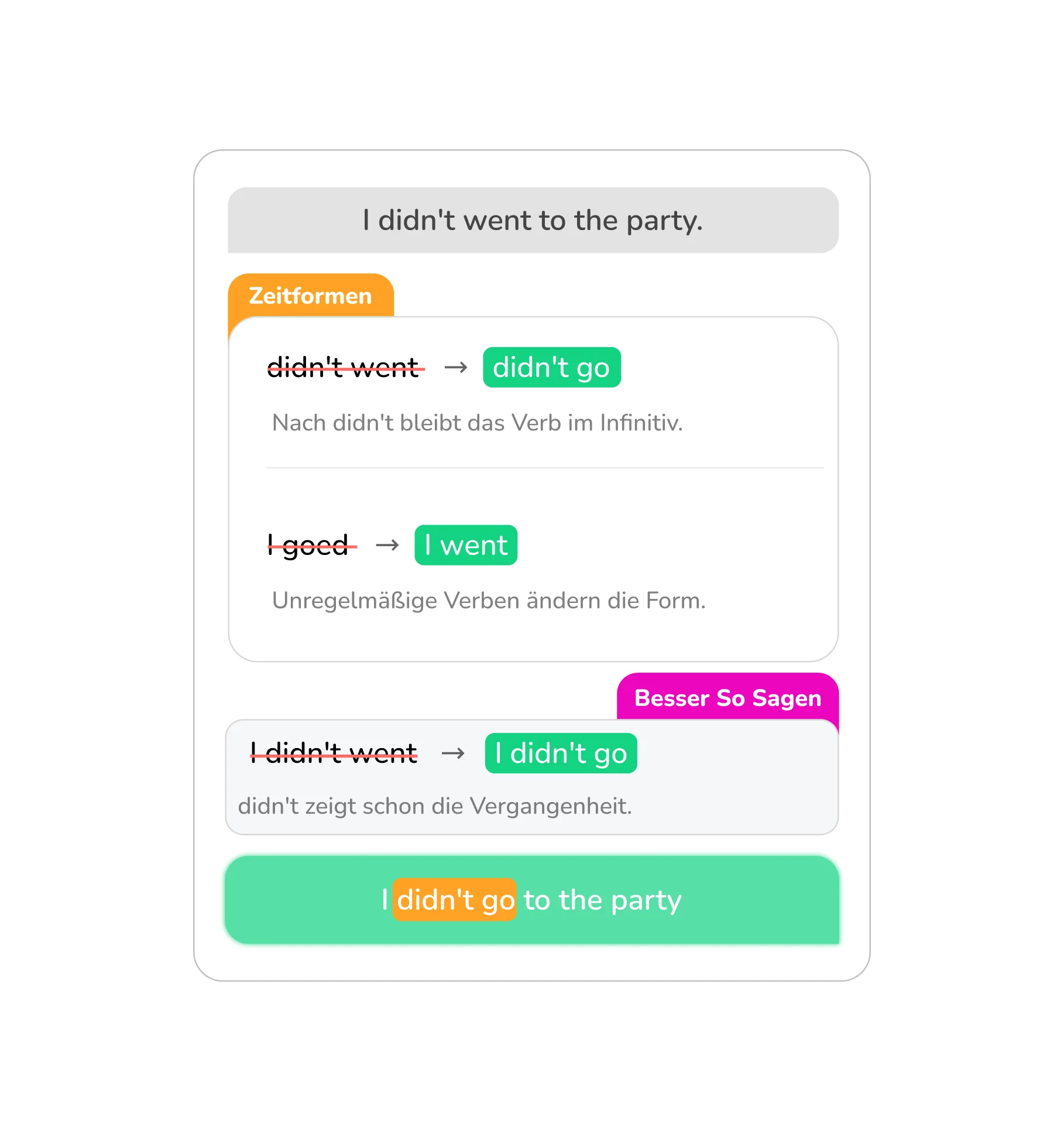
| I didn't went there. | I didn't go there. |
| I have visited Paris last year. | I visited Paris last year. |
| We was tired after the trip. | We were tired after the trip. |
| I use to live there. | I used to live there. |
| Did you used to play tennis? | Did you use to play tennis? |
How Learna AI Teaches the Past Simple?
Learna AI listens for irregular past forms in real conversation and corrects a slip like "goed" or "telled" on the spot, walking through the actual irregular form instead of just naming the mistake. It also catches the base-form reset after did or didn't, since keeping the past form there is one of the most common errors in spoken English, and it checks used to spelling in both positive and negative forms, flagging "use to" in positive sentences and "used to" after did. Learners telling stories in past simple with Learna report a 98% improvement in using the correct irregular form without hesitating mid-sentence.
Once regular and irregular forms feel steady, most learners move on to past continuous, which adds a sense of an action already in progress at a specific past moment.
Mehr entdecken
Bring dein Grammatikwissen mit den Lernpfaden von Learna in die Praxis:
Häufig gestellte Fragen
Was ist das Simple Past?

Es ist die Zeitform für Handlungen, die in der Vergangenheit begonnen und abgeschlossen wurden – gebildet mit -ed bei regelmäßigen Verben oder mit einer veränderten Form bei unregelmäßigen Verben.
Wie lautet die Formel für das Simple Past?
Bejahung: Vergangenheitsform des Verbs. Verneinung: didn't + Grundform. Frage: Did + Subjekt + Grundform?
Sind Simple Past und Past Tense dasselbe?
Ja, das Simple Past ist die grundlegendste Form der Vergangenheit und wird für einzelne, abgeschlossene Handlungen oder Ereignisse zu einem genannten oder implizierten Zeitpunkt verwendet.
Welche Regel gilt für regelmäßige Verben im Simple Past?
Hänge -ed an die Grundform an: aus walk wird walked, aus play wird played. Bei Verben auf e, y oder einem einzelnen Konsonanten gelten besondere Schreibregeln.
Wie funktionieren unregelmäßige Verben im Simple Past?
Sie folgen nicht der -ed-Regel und verändern ihre Form auf unvorhersehbare Weise, etwa go zu went oder eat zu ate. Jede Form muss einzeln gelernt werden.
Wie bildet man Fragen im Simple Past?
Verwende Did + Subjekt + Grundform: Did you play tennis? Das Hauptverb steht in der Frage nie in der Vergangenheitsform.
Welche vier Vergangenheitsformen gibt es?
Simple Past, Past Continuous, Past Perfect und Past Perfect Continuous. Das Simple Past ist die Grundlage und steht für abgeschlossene Handlungen und Ereignisse.
Welche Zeitangaben passen zum Simple Past?
Yesterday, last week, ___ ago, ein Jahr in der Vergangenheit wie 2010 und when I was young signalisieren typischerweise das Simple Past.
Kann das Simple Past frühere Gewohnheiten beschreiben?
Ja, genau wie used to: We lived in that house when I was a child funktioniert genauso wie We used to live there.
Was ist der Unterschied zwischen Simple Past und Past Perfect?
Das Simple Past nennt eine einzelne abgeschlossene Handlung; das Past Perfect zeigt, welche von zwei vergangenen Handlungen zuerst passiert ist.
Warum verwenden wir das Simple Past in Geschichten?
Es treibt die Ereignisse der Reihe nach voran – eine abgeschlossene Handlung nach der anderen. Genau deshalb stützen sich Erzählungen so stark darauf.
Gibt es einen anderen Namen für das Simple Past?
Ja, es wird meist einfach Past Tense bzw. Vergangenheitsform genannt, weil es die grundlegendste und am häufigsten genutzte Form ist, um über Vergangenes zu sprechen.
Wie hilft Learna AI bei unregelmäßigen Vergangenheitsformen?
Learna AI erkennt eine falsche unregelmäßige Form sofort beim Sprechen, liefert die richtige Form und wiederholt später ähnliche Übungen, damit sie langfristig sitzt.
Kann Learna mir helfen, Geschichten im Simple Past zu üben?
Ja. Learna AI kann dich dazu anregen, eine Abfolge vergangener Ereignisse zu erzählen, und korrigiert Fehler bei der Zeitform in Echtzeit, während die Geschichte entsteht.