
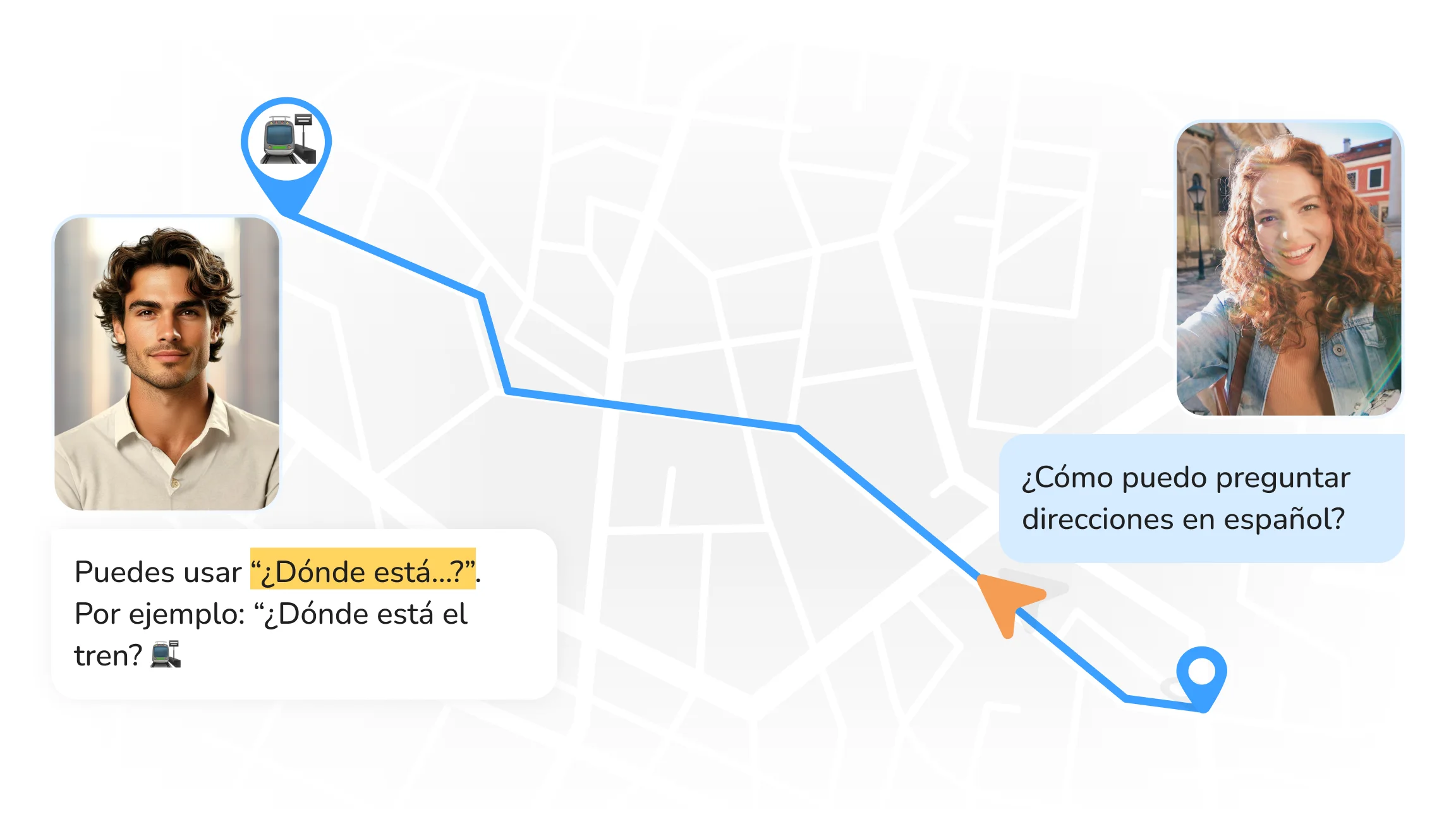
Polite Phrases to Start a Conversation in Spanish
Polite openers help get someone’s attention and show respect. Common greetings and brief attention phrases make the other person more willing to help. For beginners, combining a simple greeting with a help-seeking line works well in streets, stations, or shops. Examples below show how to say “excuse me,” “hello,” and “could you help me?” in useful, everyday ways.
- Hola. — Hello.
- Disculpe. — Excuse me (formal).
- Perdón. — Sorry / excuse me (less formal).
- ¿Me puede ayudar, por favor? — Could you help me, please?
- ¿Tiene un momento? — Do you have a moment?
- Buenos días / Buenas tardes. — Good morning / Good afternoon.
Using these phrases sets a polite tone before asking for specific directions.
Essential Spanish Questions to Ask for Directions
Core question patterns are short and easy to adapt. Focus on the main verb forms and place words. Common structures ask where something is, how to get there, and which transport to take. These patterns work for finding hotels, stations, attractions, or services.
Key question patterns:
- ¿Dónde está + place? — Where is + place?
- ¿Cómo llego a + place? / ¿Cómo se llega a + place? — How do I get to + place?
- ¿Está cerca? — Is it nearby?
- ¿Cuánto se tarda hasta + place? — How long does it take to + place?
- ¿En qué dirección está + place? — In which direction is + place?
- ¿Hay un autobús / tren / metro para + place? — Is there a bus/train/metro to + place?
These questions are useful in many travel situations and can be combined with polite openers for smoother interactions.
Examples You Can Use in Real Situations
Below are ready-to-use Spanish phrases for travel and short dialogues. Each example uses simple vocabulary and clear structure. The list includes basic and common Spanish phrases for travel to find hotels, stations, restaurants, and attractions.
- ¿Dónde está la estación de tren? — Where is the train station?
- ¿Cómo llego al hotel Plaza? — How do I get to Plaza Hotel?
- ¿Está lejos el museo? — Is the museum far?
- ¿Hay un metro cerca de aquí? — Is there a metro nearby?
- ¿A qué distancia está la oficina de turismo? — How far is the tourist office?
- ¿Puede indicarme el camino al aeropuerto? — Can you show me the way to the airport?
Role-play 1 — Finding a hotel:
A: Disculpe. ¿Me puede ayudar?
B: Claro. ¿Qué hotel busca?
A: El hotel Plaza, por favor.
B: Siga recto dos cuadras y gire a la izquierda. Está al lado del banco.
Role-play 2 — Asking for a station:
A: Buenos días. ¿Dónde está la estación de autobuses?
B: Cruce la plaza y tome la segunda calle a la derecha. La verás al final de la calle.
Role-play 3 — Tourist attraction:
A: Perdón, ¿cómo llego al museo de arte?
B: Tome el metro línea 2 hasta “Central” y camine cinco minutos.
Pronunciation tips:
- Stress the syllable in bold: es-TA-ción, hos-PEL (hotel often pronounced ho-TEL).
- Practice vowel sounds: a (ah), e (eh), i (ee), o (oh), u (oo).
- Speak slowly and listen for repeating words like derecha (right) and izquierda (left).
Practice suggestions:
- Repeat each phrase aloud five times before travel.
- Use short role-plays with a partner or language app daily.
- Record and compare pronunciation; focus on sounds like the rolled r and soft d.
Learna supports practice with scenario-based roleplays, instant pronunciation feedback, and listening exercises that match travel needs. These features help learners use basic Spanish phrases for travel in realistic contexts and build confidence before a trip.
Quick Reference Cards
- Common place words:
Calle (street), plaza (square), estación (station), aeropuerto (airport).
- Direction words:
Derecho / recto (straight), izquierda (left), derecha (right), al final (at the end).
- Transport words:
Autobús (bus), tren (train), metro (subway), taxi (taxi).
- Time/distance words:
Cerca (near), lejos (far), a cinco minutos (five minutes away), una parada (one stop).
How to Practice Step by Step
Step 1 — Learn basic phrases
Start with greetings, ¿Dónde está...? and ¿Cómo llego a...? Practice aloud for clarity.
Step 2 — Add place names
Combine phrases with hotels, stations, or attractions likely to be visited.
Step 3 — Role-play
Use short dialogues to practice asking, listening, and confirming directions.
Step 4 — Use Learna
Practice travel dialogues in Learna for personalised speaking feedback and progress tracking.
